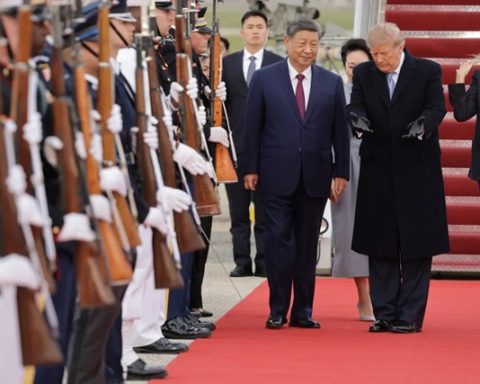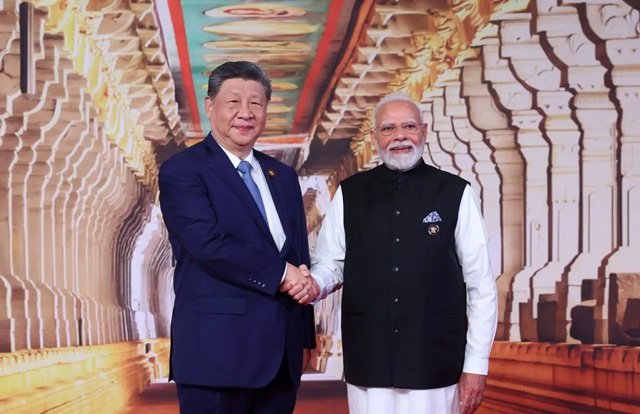
After the Trump-Xi spectacular three-day meeting, with some notable outcomes last week in Washington, the short 45-minute interaction between Modi and Xi on the sidelines of the BRICS summit this month produced little except ‘feel-good’. The US and China do not share borders but have matching tactical and strategic deterrence. India and China, in contrast, have been playing a charade over the normalisation of relations and an early harvest of a boundary settlement when the ground situation is just the opposite.
Following the Chinese ingress in Ladakh (2020), the failed Yangtse grab (2022) and the most recent Taksing encroachment in July 2026, denied by the Government, India is conspicuously missing the deterrent to PLA salami-slicing across the LAC. Delhi maintains a one-way internal dialogue on the Northern border, insisting that any public or parliamentary discussion will undermine soldiers’ morale and national security. Last month, Delhi celebrated its BRICS moment with an agreed joint statement and a brief bilateral between President Xi Jinping and Prime Minister Narendra Modi, which marked the unbridgeable gaps in bilateral relations while indulging in mutual self-delusion. Normalisation has largely been dictated by China due to altered Indo-US geopolitics.
For Delhi, it is imperative to hedge against a second active front as Beijing continues propping up Rawalpindi as its ‘secondary deterrent’ against Delhi. India has allowed dilution of its primary deterrent through the Agniveer scheme and shallow defence investment, justified by Modi’s rhetoric: “This is not an era of war” and “endless wars must end”. On September 20, days after the BRICS Xi-Modi bilateral, Islamabad initiated the Pakistan-China Boundary Commission, which institutionalises the 1963 Agreement through which Pakistan ceded 5,140 sq km of Shaqsgam territory to China, pending an overall agreement on the J&K dispute. The new agreement revives the disputed status of J&K. China has historically insisted that it has no border/LAC in Ladakh with India, while Delhi questions the legality of the China-Pakistan Economic Corridor and the Karakoram Highway through its claimed territory. According to both Pakistan and China, India’s internal political and cartographic alterations in August 2019 to the status of J&K have little impact on its international legal status.
The Modi-Xi jugalbandi, which began in 2014, resulted in joint statements only in 2014 and 2015; thereafter, there were separate read-outs until 2019 because most bilateral meetings were held on the sidelines of other multilateral events and not at bilateral summits. At the Astana meeting in 2017, the ‘strategic guidance’ mantra was coined: not to let differences become disputes, which was called the Astana Consensus. The last bilateral summit was held in Chennai in 2019, followed by the Ladakh encroachments and Galwan clashes, the most serious incident since Doklam (2017).
The October 2024 meeting of the leaders at Kazan produced ‘the disengagement breakthrough’, followed by the August 2025 meeting at Tianjin, at which separate read-outs focused on each other’s concerns and priorities: China wanting India to take a long strategic view, separating the border from the bilateral relationship, while a softened India emphasised that stability on the border would reflect the state of the bilateral relationship.
Strategic guidance by the leaders refers to a jugglery of vocabulary — “development partners, not rivals”; “benefit from each other’s strengths” and so on. The mistrust/distrust cannot be masked. The apparent progression in relations was reflected as follows: Kazan — stabilisation; Tianjin — normalisation; and Delhi — enhancement. While overall relations have been re-established to the pre-Galwan level, on the border only disengagement has taken place at friction points.
It is instructive to review what China attempted/achieved across Ladakh.
In April-May 2020, in response to India’s cartographic and political changes in J&K in August 2019, in the guise of mobilising PLA forces for an exercise, it built up forces at Demchok, Galwan, Hot Springs, Pangong Tso and Depsang, where, according to a Carnegie Endowment report, the PLA penetrated 1 to 10 km west of previous operational lines, creating a new operational reality for enhancing its bargaining position over the whole of Ladakh. In actual gains, it has blocked access at Depsang, its most strategic achievement; denied access to 26 of 65 patrolling points (Ladakh Police report, 2022); in other places, created buffer zones or no-patrol zones, established positions where it did not have any presence, curtailed civilian grazing rights and permitted selective coordinated patrolling.
Further, it demonstrated that the PLA can mobilise large forces, alter the military situation along the LAC and force India into prolonged military deployment. In short, it succeeded in changing the status quo and delivered a strategic warning to India about any future design over Aksai Chin.
India has described Chinese actions as “unilateral attempts to alter the status quo”. It lauds its own achievement in counter-mobilisation and forcing China into disengagement through its pre-emptive action on Kailash Heights, a bargaining chip that was frittered away.
About the Kailash offensive, we will not know other facts due to the banning of Army Chief Gen Naravane’s book. India traded away its biggest advantage on February 10, 2021, after holding Kailash Heights for five and a half months, for a half-cock disengagement process. Why the PLA did not occupy Kailash Heights along with other positions is another untold story. India failed to maximise its Kailash dividend to achieve, at the least, complete disengagement, preferably de-escalation and disengagement, and also to restore the status quo ante of 2020, which is now a pipe dream.
At another level, the Special Representative mechanism on the border question was resumed in December 2024, with the 25th round being held in Beijing in August 2026. The new normal for China is to continue its salami-slicing on the LAC while continuing negotiations ad infinitum. The most recent incident took place at Taksing in Subansiri district of Arunachal Pradesh in July 2026. Denial and obfuscation have become the Government’s standard response. Doing the rounds on social media, and released earlier this year, is the detailed account of Chinese ingress at places 60 km deep by Panka Baghe, with Koko from the area.
The British Independent newspaper confirmed the PLA intrusions in Taksing, including denial of access to civilians by the PLA to the Buddhist temple. While the PLA can reach the border within 24 hours, the Indian Army will take days due to the infrastructural gap. The Chinese grey-zone operation will continue along the LAC even as India restores full bilateral normalisation, hailing Mao’s dictum of winning without fighting.