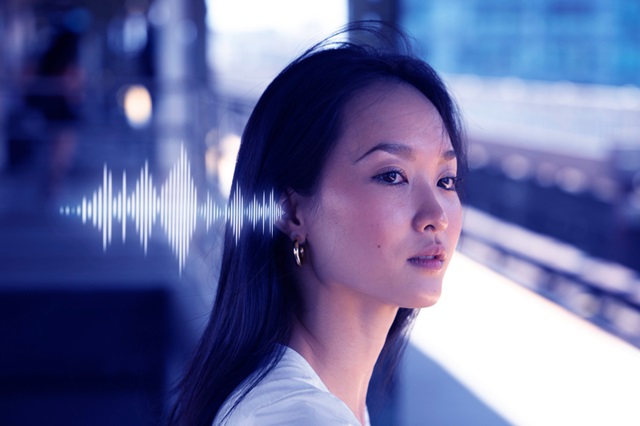
Artificial intelligence is revolutionizing the way people with motor neuron diseases (MND) communicate, offering a powerful solution to one of the most devastating aspects of these conditions—the loss of speech. As highlighted in a recent MIT Technology Review article, AI-generated voice clones are helping individuals regain their voices, restoring not only their ability to communicate but also their sense of identity and emotional connection with others.
A Life-Changing Innovation
For Jules Rodriguez, who lost his ability to speak after an ALS diagnosis, the idea of never hearing his own voice again was heartbreaking. However, thanks to AI-powered voice cloning technology from ElevenLabs, he was able to recreate his voice using past recordings, allowing him to speak again—this time through a device that tracks his eye movements. The impact was profound. “Hearing my voice again, after I hadn’t heard it for some time, lifted my spirits,” Rodriguez shared. His wife, Maria Fernandez, described the moment as both miraculous and bittersweet.
Unlike traditional voice banking, which required individuals to record thousands of sentences and often resulted in robotic-sounding speech, this new AI approach can generate a realistic voice clone from as little as one minute of recorded audio. The process is also significantly faster, taking about a week to complete. The result is a voice that sounds far more natural, incorporating breath pauses, stammers, and filler words like “um”—elements that make speech feel human.
Beyond Communication: Restoring Confidence and Connection
This breakthrough is more than just a technical achievement—it’s a deeply personal one. The ability to communicate in one’s own voice fosters stronger emotional connections and reduces the isolation that people with MND often experience. Speech and language therapist Richard Cave, who has worked with over 50 people using this technology, notes that many report feeling more included in conversations, with family and friends more willing to engage with them.
For some, like Rodriguez, voice cloning has even enabled them to return to personal passions. Once an aspiring comedian, Rodriguez has used his AI-generated voice to perform stand-up comedy on stage—a feat he never imagined possible after losing his natural speech.
Challenges and the Road Ahead
Despite its transformative potential, AI-generated speech still has limitations. Conversations remain slow due to the need for typing, and some users, like Joyce Esser, have found the technology impractical for real-time dialogue. The voices also lack emotional depth, sometimes sounding monotonous or fatigued during long passages.
To address this, researchers and companies are now exploring ways to enhance AI-generated speech with more expressive intonations and real-time emotional modulation. Additionally, hyperrealistic avatars—which replicate not just a person’s voice but also their facial expressions—are being developed to further bridge the gap between artificial and natural communication.
A New Era for AI in Assistive Technology
The potential of AI in assistive communication is vast. ElevenLabs has already provided free access to this technology for over a thousand individuals with speech impairments and aims to reach one million. The Scott-Morgan Foundation is also pioneering projects that integrate AI voices with digital avatars to create an even more immersive communication experience.
As AI continues to evolve, these innovations are set to reshape the future of assistive technology, offering individuals with MND and other speech-related conditions not just a way to speak—but a way to be heard, understood, and fully engaged in life once again.