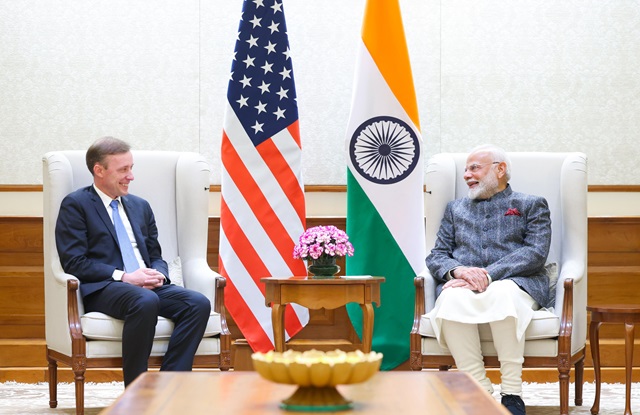
In an exclusive interview with Axios, Jake Sullivan, departing as White House national security adviser, issued a stark and urgent warning about the future of artificial intelligence (AI). With only days left in office, Sullivan laid out a vision for the next few years that could determine whether AI leads to a global catastrophe or if the U.S. successfully navigates the technology’s profound implications. He emphasized that AI’s development and its race with China are pivotal for America’s national security and global influence.
Sullivan pointed out that AI’s rapid progress is unlike any previous technological advancement. Unlike nuclear weapons or space exploration, AI is being driven by private companies, not government entities, giving these corporations the power of nation-states. This shift in control, Sullivan noted, brings a new challenge: the U.S. must ensure collaboration between the government and private companies to protect its early AI advantage and shape global AI regulations.
He warned that failing to manage AI’s development could have “dramatic” consequences, including the democratization of lethal weapons, massive job displacement, and an avalanche of misinformation. In his view, the stakes are as high as they get — potentially existential for every nation and company involved. The competition, Sullivan emphasized, isn’t just about creating smarter AI; it’s about ensuring the technology is used responsibly and doesn’t fall into the hands of malicious actors.
For the U.S. to remain ahead in the AI arms race, it must perfect technology capable of surpassing human intelligence without destabilizing the workforce or unleashing unforeseen dangers. Sullivan believes this can be achieved through unprecedented government-private sector cooperation and possibly even cooperation with China to establish global guidelines. He stressed the need for a new model of governance, given the extraordinary power in the hands of private tech giants.
Sullivan remains cautiously optimistic about AI’s potential but cautions that the risks must be handled with a clear-eyed approach. His remarks, while sobering, reflect a broader consensus among policymakers and experts who share concerns about China’s AI development and the ethical, economic, and security challenges ahead.
As he prepares to leave the White House, Sullivan is determined to continue addressing AI issues from the private sector, underscoring the urgency of the task. He believes the opportunities AI offers are vast but must be balanced with careful management of its risks.
The conversation around AI isn’t just academic; it’s shaping geopolitical strategies. The U.S. government has already taken steps to limit China’s access to crucial AI technologies, including export controls on semiconductors, a move that underscores the strategic importance of AI. However, Sullivan warns that this is a global challenge. Even if the U.S. gets it right, AI’s rapid advancement means other nations, particularly China, will quickly catch up — either through their own innovations or through espionage.
The transition of power from Biden to Trump may further accelerate this race. Trump’s approach, Sullivan suggests, may include deeper collaboration with tech CEOs, contrasting with Biden’s more cautious regulatory approach. AI’s role in the next administration’s agenda promises to reshape the political and business landscape for years to come, with industry giants like Elon Musk, Jeff Bezos, and Mark Zuckerberg already positioning themselves at the center of the discussion.
The challenge, Sullivan concludes, is not whether AI will continue to evolve — it’s whether the U.S. and the world can manage its risks and reap its benefits before it’s too late.