



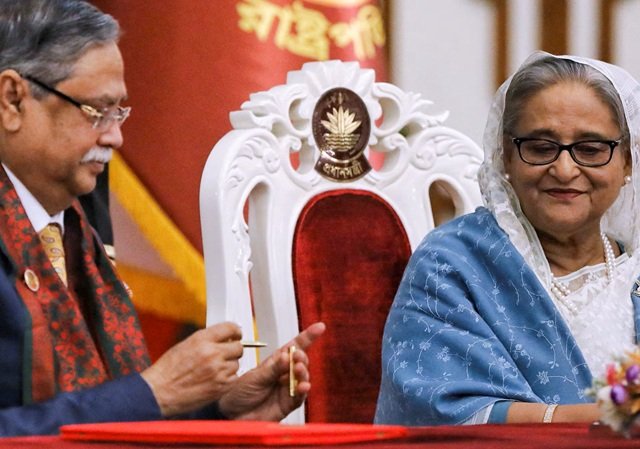
On July 24, 2026, Bangladesh President Mohammad Shahabuddin resigned from office after weeks of political uncertainty. Speaker Hafiz Uddin Ahmad Bir Bikram accepted the resignation at 5:01 pm, making it effective immediately under Article 50(3) of the Constitution. A day later, on July 25, 2026, the Cabinet Division immediately issued a gazette notification confirming the acceptance of Shahabuddin’s resignation letter, adding that Speaker Bir Bikram would discharge the responsibilities of President, as the new head of state, until a new President is elected, in accordance with Article 54 of the Constitution. The resignation of President Shahabuddin is a significant political development in Bangladesh’s post-July uprising transition, marking the end of his constitutional immunity and intensifying demands for accountability over the July-August 2024 violence.
Within days of Shahabuddin’s departure from office, on July 26, 2026, the Chief Prosecutor’s Office of the International Crimes Tribunal (ICT) filed a complaint against the outgoing President. Two organisations, the Bangladesh Azadi Party and Rashtra Sanglap Forum, filed two separate complaints. Rashtra Sanglap Forum Central Member Secretary Al Noor Mohammad Ayas named Shahabuddin a ‘close associate’ of former Prime Minister Sheikh Hasina in the complaint, and demanded an impartial investigation and trial for Shahabuddin’s role in ordering the shooting, inhuman torture, murder, and disappearance of students participating in the July mass uprising of 2024. Additionally, the Azadi Party also filed a complaint against former President Mohammad Abdul Hamid, along with Shahabuddin. After filing the complaint with the Chief Prosecutor’s Office, Azadi Party Convener Lieutenant Colonel (Retired) Mohammad Hasinur Rahman declared, “So many people have been killed and disappeared until August 5; these two former presidents never protested. They had tacit consent to these crimes.”
Shahabuddin assumed office as President of Bangladesh on April 24, 2023, for a five-year term under the Awami League government. During his 39-month tenure, he oversaw two national elections, administered the oath of office to three Prime Ministers, and witnessed the July-August 2024 mass uprising that led to the fall of the Awami League government and the departure of then-Prime Minister Sheikh Hasina from Bangladesh. His Presidency coincided with one of the most politically turbulent periods in Bangladesh’s recent history.
Regarding the President’s resignation, on July 24, 2026, Nahid Islam, Convener of the National Citizens Party (NCP), called for vigilance to prevent Shahabuddin from a safe exit or flight abroad. Islam said, “We are still saying that we must keep a vigilant eye so that this fascist-friendly president, Chuppu, cannot make any kind of safe exit or escape abroad under the pretext of physical illness or any other excuse, and the government must arrest this fascist president immediately.” Another party, the Bangladesh Khelafat Majlis, also stated that there was a question in the public mind, whether there was any political equation behind the President’s resignation. Other parties, including the Islami Andolan Bangladesh (IAB) and Jamaat-e-Islami (JeI), welcomed the President’s resignation. JeI Chief Shafiqur Rahman noted, “The President of Bangladesh has resigned from his post. Although late, a dark shadow of tyranny has been lifted from the nation’s neck”
Overall, the reactions by prominent political leaders to the resignation elicited mixed political opinions, ranging from calls for arrests to allegations of political manoeuvring behind the President’s departure.
Shahabuddin served as both the Head of State and Commander-in-Chief of the Armed Forces, and his departure removes the last prominent constitutional figure seen as aligned with Sheikh Hasina.
Significantly, on July 10, 2026, Sheikh Hasina declared that she would return to Bangladesh in December 2026, despite a political environment that has become increasingly unfavourable for the former Prime Minister. The Awami League remains a proscribed party, and many of its senior leaders and supporters have either been detained or are in hiding following the 2024 student-led uprising, Shahabuddin’s resignation further diminishes the party’s remaining institutional presence.




This analysis reads more like an incoherent harangue than a reasoned argument. Ms. Shivangi has not lived in Bangladesh and, therefore, lacks firsthand knowledge of the country’s plain and unvarnished realities.
Former President of Bangladesh Mr. Shahabuddin bowed to the diktat of the Washington administration on the very day of 5 August 2024. He wanted to resign from his position on the very day of 5 August 2024. But the morons Yunus, Tarique Zia and their accomplices used him designedly to serve their purposes, which HPM Sheikh Hasina knew very well.
Former President of Bangladesh, Mr. Shahabuddin expressed his intention to resign on 5 August 2024 although he acquiesced to the directives of the Washington administration on that very day. However, it is further contended that Professor Muhammad Yunus, Tarique Rahman, and their political associates deliberately retained him in office to advance their own strategic objectives—an eventuality that Prime Minister Sheikh Hasina had fully anticipated.
It is contended that Professor Muhammad Yunus, Tarique Rahman, and their political associates deliberately retained him in office to serve their own strategic objectives. Throughout his tenure, they kept him at arm’s length, affording him little meaningful influence while retaining him for symbolic legitimacy. He was repeatedly subjected to public disregard and institutional humiliation on numerous occasions.
He ceased to serve as a protective institutional safeguard for Prime Minister Sheikh Hasina on the very day of 5 August 2024. Had he resigned at that juncture, he might have been subjected to unjust repercussions. Nevertheless, he now appears to face a similar predicament. At neither that time nor the present did he possess the constitutional or political authority to protect Prime Minister Sheikh Hasina.
With India’s decisive military and diplomatic support, Bangladesh secured victory in the Liberation War of 1971 against Pakistan and its allies America and China, together with their direful local collaborators.
The forces that suffered defeat in 1971 never relinquished their sense of grievance and, over the ensuing decades, sought an opportunity to reverse that historic outcome.
They ultimately achieved this objective through a deep-seated camarilla orchestrated by the Washington administration for their geopolitical and economic interests of 5 August 2024 in dirty league with Pakistani ISI and their dreaded local confederates.
The United States has transformed Bangladesh—won through immense sacrifice and the bloodshed of the Liberation War of 1971—into a subordinate state, reducing it to the status of a dependent client and seeking to reshape it into a res publica in name alone, or a classic “banana republic,” akin to developments that they made Afghanistan, Iraq, and Libya and many more for their evil designs.
What the immediate future holds for us remains uncertain!!!
—- Anwar A. Khan, a direct witness of the brutal birth of Bangladesh from the direful Pakistani military regime from a very close proximity in 1971 and a frontline Freedom Fighter of the 1971 war field to establish Bangladesh (from Dhaka, Bangladesh).