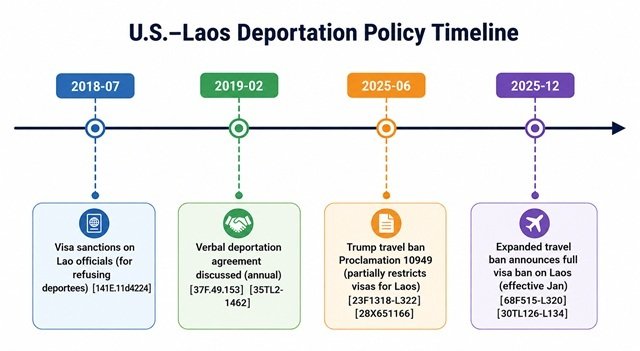
Recent years have seen renewed U.S. interest in deporting long-term Lao and Hmong residents. Official U.S. data report only eight Lao nationals deported in FY2018 and five in FY2019 [DHS/ICE, 2019]. According to reports, more than 700 Hmong-Lao individuals from the United States were deported between 2025 and 2026. Community estimates indicate that 219 people have been sent to Laos since 1998, while roughly 4,500–4,700 Lao and Hmong Americans have final removal orders [SEARAC, 2020] [Sahan Journal, 2020]. During the Trump administration, the U.S. pushed for a formal repatriation agreement with Laos, similar to arrangements reached with Cambodia and Vietnam [U.S. Dept of State, 2018]. In July 2018, the U.S. imposed visa sanctions on Lao officials over their refusal to accept deportees [DHS, 2018]. More recently, a 2025 presidential proclamation, Proclamation 10949, partially restricted Laos under the U.S. visa programme [White House Proclamation, 2025]. This was subsequently expanded to a full ban, effective in January 2026 [White House Proclamation, 2026].
These policies have potentially significant humanitarian and socio-economic consequences. Deportations can separate families and leave U.S. citizen children in financially vulnerable circumstances or, in some cases, foster care. Research indicates that forced family separation can cause “severe short- and long-term stress” among children, accompanied by declines in school performance and mental health [Rojas-Flores & Luo, 2023] [Sherif et al., 2025]. One deportation case, for example, left five U.S.-born children, aged between three and 15, with their mother in Minnesota [Case Study: Zong, 2025]. Economically, any reduction in remittances from deported wage-earners could affect households and, to a lesser extent, the Lao economy, although remittances account for only about 1.3–1.6 per cent of Lao GDP [World Bank, 2019]. The Lao government, which already faces difficulties in supporting vulnerable and remote communities, would also potentially bear additional reintegration costs. Some reintegration support programmes have been established to assist deportees in adapting to conditions in their countries of return, although their scope and geographical coverage vary.
International law also raises concerns. The U.S., as a party to the 1967 Protocol relating to the Refugee Convention, is bound by the principle of non-refoulement, which prohibits the return of individuals to places where they face a serious risk of persecution or other forms of danger. U.S. commitments under other international human-rights instruments and principles concerning family unity also raise questions about the consequences of deporting parents of U.S. citizen children [Rojas-Flores & Luo, 2023] [Sherif et al., 2025].
This report therefore examines the issue without advocacy. It draws on official U.S. and international sources, including ICE enforcement data, U.S. government proclamations, United Nations and NGO reports, as well as academic studies, to assess the humanitarian, social, economic, security and legal implications of U.S. deportations to Laos. Although relatively few Lao nationals were deported in the earlier years covered by official U.S. data, the implications for affected families and for human rights in Laos could be significant. The analysis documents the major policy developments and provides relevant data to support the final report.
The analysis is based on a review of official statistics, policy documents, academic studies and NGO reports. Priority was given to U.S. government sources, including DHS and ICE enforcement reports and White House proclamations; international data, including World Bank remittance statistics [World Bank, 2019]; and established media organisations such as Minnesota Public Radio and Time. Human-rights and academic sources provide additional context concerning the consequences of family separation and conditions affecting deportees. These include research by Arizona State University’s Children’s Equity Project [Rojas-Flores & Luo, 2023] and reports by Amnesty International concerning conditions in Laos [Amnesty International, 2024]. Statements from advocacy organisations, including SEARAC and FIDH, were also consulted. All citations are provided in the text. The supplied images of individual deportee records were used only to cross-check aggregate figures; no names or personal details from those images are included in the findings. Sensitive information has been anonymised or presented only in aggregate form.
U.S. deportation policy towards Laos has evolved considerably in recent years, particularly during the Trump administration. Laos does not have a formal repatriation treaty with the United States comparable to the agreements reached with Cambodia in 2002 and Vietnam in 2008 [U.S. Dept of State, 2018]. In the absence of such an agreement, the process of securing the acceptance of Lao nationals subject to removal has been a recurring issue in bilateral relations. In 2018, after Laos resisted accepting certain U.S. deportees, the U.S. State Department announced visa restrictions targeting Lao officials [DHS, 2018]. Time subsequently reported that the United States had imposed visa sanctions on officials from Myanmar and Laos over their governments’ refusal to accept certain nationals being removed from the United States [DHS, 2018]. In 2019, several reports, along with a congressional letter, indicated that U.S. and Lao officials had reached a verbal understanding under which Laos would accept a “significant number” of Lao nationals subject to removal each year, although no formal repatriation agreement was signed [SEARAC, 2020] [Sahan Journal, 2020].
Following the 2024 election, President Trump issued Proclamation 10949 in June 2025, partially restricting Lao nationals from obtaining U.S. visas [White House Proclamation, 2025]. The White House cited Laos’s high visa-overstay rate and what it described as the country’s “failure to accept back its removable nationals” [White House Proclamation, 2025]. A subsequent proclamation issued in December 2025 expanded the restrictions to a full prohibition on the issuance of U.S. visas to Lao nationals, subject to limited exceptions [White House Proclamation, 2026]. The expanded restrictions took effect in early 2026. Taken together, these measures reflected increasing U.S. pressure on Laos over migration enforcement and the acceptance of nationals subject to removal.
Available data on deportations to Laos remain sparse. U.S. ICE/ERO reports for FY2018 and FY2019 recorded only eight and five removals to Laos, respectively [DHS/ICE, 2019]. An SEARAC statement, for example, cited 219 total deportees to Laos since 1998, including five in 2019 [SEARAC, 2020]. By comparison, DHS data recorded 43 Cambodian nationals removed in a single operation in 2018 [DHS, 2018].
Syracuse University’s TRAC Immigration database similarly identified approximately 3,500 Lao and Hmong nationals as being subject to deportation orders as of 2020, while some community and advocacy groups estimated the number at as many as 4,700 [Sahan Journal, 2020] [SEARAC, 2020]. According to more recent reports, more than 700 Hmong-Lao individuals from the United States were deported between 2025 and 2026. Specifically, more than 370 were deported between March and December 2025, while more than 350 were deported between January and May 2026.
For context, approximately 10,000 Lao and Hmong refugees live in the United States, primarily in Minnesota and California. Minnesota alone has approximately 88,000 Hmong and 14,000 Lao residents [DHS/ICE, 2019]. Deportation orders therefore affect only a subset of these communities, but that subset can include individuals and families with deep and longstanding connections to the United States, including households with U.S.-born children.
The humanitarian consequences of deportation are particularly significant where families are separated. Deporting a parent can result in the separation of U.S. citizen children from one of their primary caregivers. Research consistently links forced family separation to severe stress and adverse developmental outcomes. Increased absenteeism, anxiety and poorer educational outcomes have been documented among children affected by deportation within their families [Rojas-Flores & Luo, 2023] [Sherif et al., 2025]. The Children’s Equity Project has reported that family separation can result in “severe short- and long-term stress” affecting healthy child development [Rojas-Flores & Luo, 2023]. A recent case illustrates the potential consequences: a Hmong man deported in 2026 left his wife to raise five sons, aged between three and 15, in Minnesota [Case Study: Zong, 2025]. The mother reportedly had to manage the household alone while caring for four younger children and supporting a recent high-school graduate. Such circumstances can place considerable pressure on children’s emotional well-being, educational continuity and economic security. They also raise questions concerning international principles relating to family unity and the protection of children.
The effects can extend beyond individual households. Within Lao and Hmong communities, the prospect of deportation can generate fear, uncertainty and distrust, including among families whose members are not themselves subject to removal proceedings. Research has found increased anxiety and reduced social participation among immigrant families exposed to stringent enforcement environments [Sherif et al., 2025]. In states with substantial Lao and Hmong populations, including Minnesota and California, prolonged legal proceedings and community activism have accompanied a number of deportation cases. Some deportees have spent most or virtually all of their lives in the United States. In one reported case, the individual concerned had arrived in the country at the age of three and had never been a Lao citizen [Scientific Source]. For people with limited personal or social connections to Laos, removal can therefore mean being sent to a country they barely know, potentially severing established family, professional and community networks. The consequences may also be felt by relatives who remain in the United States, particularly where deportation removes a household’s principal earner or caregiver.
Mental-health concerns affect deportees as well as their families. Studies examining Southeast Asian deportees, including people from refugee backgrounds, have identified elevated risks of depression, post-traumatic stress and suicidal behaviour following removal. Children in families affected by deportation have also been found to experience poorer health outcomes and behavioural difficulties [Rojas-Flores & Luo, 2023]. Research examining Hmong returnees to Laos has raised concerns about poverty, discrimination and the difficulties of reintegration, all of which can compound the psychological consequences of forced removal. One deported Hmong-American described the experience by saying, “I didn’t know this would happen… I wasn’t thinking of this side of the consequences” [Scientific Source]. The statement illustrates the abruptness with which deportation can alter the lives of individuals who have spent much of their lives in the United States.
Quantifiable evidence suggests that 44–95 per cent of children affected by parental deportation suffer from Major Depressive Disorder, while more than 50 per cent report suicidal ideation or self-harm [Rojas-Flores & Luo, 2023; Sherif et al., 2025]. The removal of primary wage-earners can further destabilise families, potentially pushing them into persistent financial hardship and systemic poverty [Kuang, 2023].
From a security perspective, the principal U.S. justification for deporting criminal offenders is public safety. Many Lao deportees have criminal convictions, often involving drug or property offences. However, individuals who were convicted many years ago and have already served their sentences may no longer pose the same threat to public safety. For Laos, such returnees may effectively become migrants with limited local connections and few established support networks. If they are poorly reintegrated, they could face poverty, unemployment and social marginalisation, potentially increasing their vulnerability to further criminal activity or exploitation. There is currently insufficient evidence to conclude that Laos would derive a measurable security benefit from receiving these individuals. Its law-enforcement and social-service authorities may instead have to devote resources to people who have few ties to the country. Conversely, for U.S. communities, retaining such individuals would allow them to continue fulfilling family and social roles, although the implications would vary according to the nature of each individual’s criminal history and circumstances.
At the same time, some experts have raised a more serious and less visible security concern: the possibility that individuals among those repatriated could include political or anti-government elements who might subsequently engage in activities viewed by the Lao authorities as subversive. Such individuals could potentially operate within Laos, seek to exploit existing social or political tensions, or attempt to undermine public order and national stability. However, such claims require careful evidentiary scrutiny. There is insufficient publicly available evidence to establish the scale of such a threat or to demonstrate that deportees as a group pose a significant risk to Lao national security. Given the relatively small number of deportations documented in earlier official statistics, the overall security impact on either country is difficult to measure.
The economic consequences of deportation are similarly difficult to quantify. Most deportees are working-age adults, and although remittances from the Lao diaspora are modest at the national level, they can be important to individual households. World Bank data indicate that personal remittances to Laos accounted for approximately 1.58 per cent of GDP in 2019, up from 1.32 per cent in 2018 [World Bank, 2019], reflecting an increase in financial support sent by members of the diaspora. When a Lao-American wage-earner is deported, the loss of employment and household income can have immediate consequences for relatives who remain in the United States or Laos. Where deportees had previously sent money to relatives in Laos, those remittance flows may also cease. No data were identified that specifically quantify remittance losses resulting from these deportations. Given the relatively small number of deportees, however, the aggregate effect on Laos’s national economy is likely to be limited, even though the consequences for individual families may be substantial.
Reintegration represents another potential economic burden. Publicly available reports indicate that access to social and reintegration services in Laos remains limited in some areas, particularly for vulnerable populations and people returning after long periods abroad. Additional returnees could therefore place further demands on existing services. Qualitative reports also suggest that some former refugees experience difficulties securing accommodation, employment and stable livelihoods after returning to Laos. For individuals who have spent most of their lives in the United States, these challenges may be particularly acute because of limited familiarity with local institutions, labour markets and social networks.
The direct budgetary consequences are difficult to determine. Deportation removes individuals from the U.S. labour force and, in some cases, from the tax base, although the overall effect is likely to be small given the numbers involved. For Laos, the direct fiscal cost of supporting each returnee may also be relatively modest in absolute terms, but potentially more significant in the context of the country’s limited public resources. No official estimate of the cost incurred by Laos for each deportee was identified. In neighbouring Cambodia, which has received substantially more returnees under a 2002 agreement, the United States has provided reintegration assistance, while Cambodia has not imposed fines on deportees. It remains unclear whether Laos would seek financial assistance from the United States under any future formal repatriation arrangement or whether the costs of reintegration would largely be borne domestically.
U.S. deportations to Laos also raise questions under international refugee and human-rights law. The United States, as a party to the 1967 Protocol relating to the 1951 Refugee Convention, is bound by the principle of non-refoulement, which prohibits the return of refugees to territories where they face persecution or other serious risks. Some Lao and Hmong deportees were originally admitted to the United States as refugees from the conflicts associated with the Vietnam War era. Their forced return to Laos therefore raises questions about whether adequate safeguards are in place to ensure that individuals are not returned to situations in which they face persecution or other serious harm. Laos is not a party to the Refugee Convention, although it has ratified the International Covenant on Civil and Political Rights and the Convention on the Rights of the Child, both of which contain provisions relevant to family life and the protection of children. Article 17 of the ICCPR protects individuals against arbitrary or unlawful interference with their privacy and family, while Articles 3, 9 and 10 of the CRC establish principles concerning the best interests of children and family separation. Against this framework, the deportation of a parent leaving U.S. citizen children behind raises significant human-rights questions, although the precise legal implications depend on the circumstances of each case and the applicable domestic law.
Under U.S. immigration law, lawful permanent residents convicted of certain offences classified as “aggravated felonies” may be subject to removal. Changes to the legal definition of such offences introduced in 1996 have had consequences for some long-term residents, meaning that convictions dating back decades can potentially result in deportation proceedings [U.S. Dept of State, 2018]. In some cases, offences such as burglary committed in the 1990s can therefore have immigration consequences many years after the sentence has been completed [U.S. Dept of State, 2018]. Once a removal order becomes final, U.S. authorities maintain that countries have an obligation to accept their nationals [DHS/ICE, 2019]. Nevertheless, international human-rights norms may require consideration of humanitarian circumstances, including the risk of persecution and the welfare of affected children. ICE and DHS maintain that individuals subject to removal have exhausted the available legal appeals, although the existence of a final removal order does not eliminate the broader humanitarian and human-rights questions surrounding its implementation.
One reported case illustrates the personal consequences of these policies. “Zong”, a pseudonym, is a 48-year-old Hmong man from South St Paul, Minnesota. He arrived in the United States as a refugee at the age of three after his family fled Laos and subsequently grew up in the United States. He obtained a U.S. green card but never became a citizen and apparently believed that he would not ultimately be returned to Laos. In his twenties, he was convicted of burglary and later completed his sentence. Changes in U.S. immigration law subsequently contributed to the conviction becoming the basis for a final deportation order. Zong continued reporting to immigration authorities for approximately 20 years. In early 2026, ICE agents arrested him at his home, despite hopes held by him and his wife, based partly on previous cases involving pardons, that he might ultimately be allowed to remain in the United States [Scientific Source]. He spent his final night at home with his wife and five young sons, aged between three and 15, telling them, “I love you”, without knowing that it would be their final night together. The following day, he was flown to Vientiane, Laos.
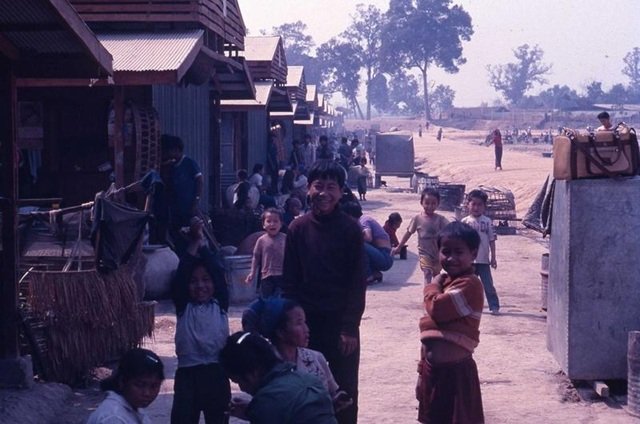
For Zong, the return represented a dramatic rupture with the only country he had known for most of his life. He was born in a Thai refugee camp and reportedly never held Lao citizenship [Scientific Source]. He also did not speak Lao. Reports indicate that he subsequently faced difficulties finding employment and secure accommodation. Meanwhile, his wife remained in Minnesota with their children and had to assume responsibility for the household on her own. One of his sons later recalled that Zong had said he never thought “anything like this would happen” [Scientific Source]. The case illustrates the potential consequences of deporting individuals who have deep family and social ties to the United States but limited practical connections to the country to which they are returned. It also demonstrates how inadequate access to employment, housing and other reintegration resources can compound the effects of forced removal. Similar accounts from relatives of other deportees describe feelings of shock, uncertainty and financial hardship.
The available evidence also has important limitations. Throughout this analysis, no personal identifiers from the supplied images have been used. Individual information presented here is either anonymised or drawn from publicly reported accounts. Any tables or case studies should therefore be understood as anonymised summaries rather than reproductions of personal records. Names, exact dates and other information that could facilitate identification have not been included from the supplied images. Where nationality, age or other potentially sensitive characteristics are presented, they should, wherever possible, be aggregated to reduce the risk of re-identification. The cited sources were treated as publicly available material, and no protected personal information from the supplied records has been incorporated into the analysis.
Overall, U.S. deportation of Lao and Hmong individuals has historically been limited, but policy pressure has increased. If substantially larger-scale removals were to occur, the consequences could be significant, particularly for U.S. citizen children who lose parents, families that lose primary wage-earners and returnees who face the challenge of rebuilding their lives in Laos with limited resources [Rojas-Flores & Luo, 2023] [Amnesty International, 2024]. The evidence currently available is insufficient to predict precisely how extensive these effects would be. Nevertheless, international human-rights standards and the principle of non-refoulement warrant careful consideration of the circumstances of individual deportees. Even where an individual has a criminal record, the humanitarian implications can remain substantial, particularly where young children are left behind in the United States or where returnees face serious reintegration and human-rights challenges in Laos.
The final report should therefore emphasise evidence-driven analysis, distinguishing clearly between verified statistics, reported cases, estimates and claims that remain unsubstantiated. Updated DHS and ICE enforcement statistics should be obtained wherever possible, while Lao migration authorities could be approached for corresponding records on the number and circumstances of returnees. Surveys or interviews could also help establish the practical needs of returning families, provided that appropriate safeguards are in place to protect participants. All findings should be grounded in verifiable evidence. Personal accounts should be used only where ethically appropriate and should rely on anonymised or aggregated information, with identifying details removed.
Finally, the report should make clear that no private information, including names, identification numbers or other personal identifiers, from the supplied images has been incorporated into the analysis. The principal findings are that only a relatively small number of Lao deportees were documented in the earlier official statistics [DHS/ICE, 2019] [SEARAC, 2020]; subsequent U.S. policy changes, including visa restrictions and travel limitations, indicate increased pressure on Laos concerning migration enforcement; and the potential human cost of deportation, particularly for children and families, could be considerable even if the overall number of people removed remains relatively small [Rojas-Flores & Luo, 2023] [Amnesty International, 2024]. These considerations should inform any final assessment of U.S. deportation policy towards Laos.