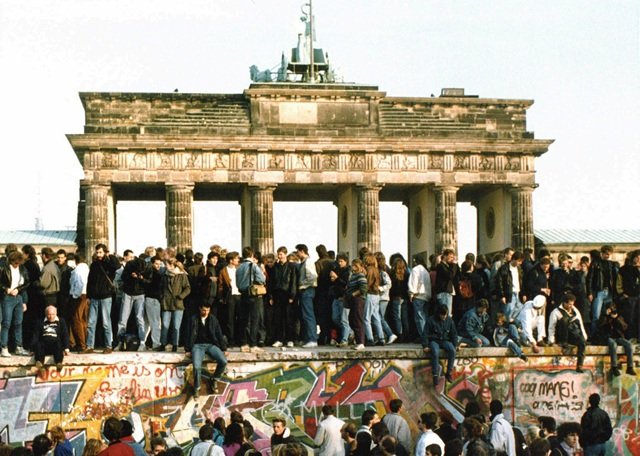
On New Year’s Eve 1989, as the Berlin Wall had fallen and reunification was becoming imaginable, photographer Maurice Weiß of the Ostkreuz agency captured a moment of extraordinary optimism at the Brandenburg Gate. Amid a vast crowd celebrating the end of division, one reveller leapt into the air, arms spread and legs tucked beneath him, while others prepared to catch him.
For Anne Hähnig, the photograph has become a way of imagining what those people might have thought if they could see Germany in 2026. Would they consider the German reunification a success?
The question is more complicated than the jubilant scene suggests. The economic gap between eastern and western Germany has narrowed substantially since 1990, but it has not disappeared. In 1991, eastern wages stood at roughly half the western level. By 1996, they had reached 74 per cent. Since then, progress has been considerably slower. Eastern companies remain much smaller than their western counterparts, one reason they pay lower salaries.
In 2025, the median gross annual income in eastern Germany is expected to stand at €46,013, compared with €55,435 in the west. Unemployment is also higher, at 7.8 per cent compared with 5.9 per cent.
The differences extend beyond wages. Household wealth remains substantially lower in the east. In 2025, average household assets are expected to amount to €150,900 in eastern Germany, compared with €359,800 in the west.
Demographic change has added another layer. Life expectancy in the east has moved towards western levels, while measured life satisfaction has also gradually converged. But after 1990, birth rates in eastern Germany fell sharply, while large numbers of people — particularly younger residents — left their home regions. The result is an eastern population that has become significantly older.
Political and professional representation tells another part of the story. Eastern Germans account for 19 per cent of the population but have remained underrepresented in senior positions. The disparity is particularly pronounced in the military, where eastern Germans account for 0.0 per cent of leadership positions, followed by the economy at 4.0 per cent, the judiciary at 2.7 per cent and culture at 6.8 per cent.
There have nevertheless been conspicuous exceptions. Germany has produced a federal chancellor from eastern Germany as well as a federal president. Yet the broader imbalance in positions of influence has persisted.
These figures could easily be read as evidence that reunification remains unfinished. Political leaders such as Reiner Haseloff have even predicted that differences between east and west could continue for another 100 years.
But that, according to Hähnig’s argument in Die Zeit, is not necessarily the right measure of German unity.
The crucial distinction is between unity and uniformity. Germany was reunified; it was not required to become identical from east to west. The existence of regional differences does not by itself demonstrate that the political project of reunification failed. A more revealing question is how citizens respond when those differences produce political or economic problems.
Do they seek solutions within the shared constitutional framework of the Federal Republic, or do they seek separation?
The record of the past 36 years provides a striking answer. Eastern Germans did not withdraw from the political system after the upheavals that followed reunification. Instead, they changed it.
The industrial collapse after 1990 brought mass unemployment and, for many, social isolation. Yet political dissatisfaction did not produce a sustained movement for eastern Germany to become an autonomous region again. Instead, voters turned to elections and political parties — sometimes dramatically reshaping the country’s political system in the process.
Two parties that first became particularly successful in eastern Germany are now represented in the Bundestag: Die Linke and the AfD. Their presence demonstrates the depth of political dissatisfaction in parts of the east, but it also illustrates continued participation in the parliamentary system.
The AfD presents an obvious complication. Its commitment to constitutional principles has repeatedly been questioned, and its political trajectory cannot simply be presented as evidence of democratic stability. Yet the broader point remains: eastern Germans have overwhelmingly pursued political change through parties, elections and the institutions of the Federal Republic rather than through demands for territorial separation.
There has been no significant political force during the 36 years of unity demanding that eastern Germany re-emerge as an autonomous state or region.
That absence becomes particularly striking in an era of renewed nationalism, when demands for stronger nation states have become prominent in many countries. In Germany, however, the political conflicts of reunification have not produced a serious separatist movement.
The relationship has instead involved compromises on both sides. Eastern Germans accepted a political system in which western Germany’s institutions and practices were frequently treated as the standard after 1989. Western Germany, meanwhile, absorbed large numbers of eastern migrants and spent enormous sums supporting the eastern states.
The economic transfer has not transformed the east into a group of wealthy donor states. It remains highly unlikely that eastern states will become net contributors to the federal financial equalisation system in the foreseeable future.
Yet an intriguing political change has emerged. Eastern state premiers, once reluctant even to discuss eastern Germany as a distinct political category, increasingly invoke regional differences when defending their interests in Berlin.
The issue of pensions provides a recent example. When the federal government proposes abolishing the pension arrangement for people with 45 years of contributions, resistance has been led particularly strongly by eastern state premiers, who have pointed to the specific circumstances of their regions.
That renewed emphasis on eastern interests might appear to demonstrate that reunification remains incomplete. But Hähnig reaches the opposite conclusion.
Eastern state governments are small and their economies relatively weak. Acting individually, their influence at federal level is limited. Their political interests therefore encourage them to cooperate with regions facing similar demographic, economic and social conditions.
The persistence of an eastern German identity in politics, in this reading, is not necessarily evidence of failed integration. It can instead be evidence that eastern German politicians understand how power operates within a united federal state.
Germany does not need its eastern and western regions to become indistinguishable for reunification to have succeeded. The more significant fact is that, despite decades of unequal wealth, different economic structures, demographic disparities and political tensions, the fundamental framework of a single Germany has endured.
The people celebrating at the Brandenburg Gate in 1989 could hardly have known what the following 36 years would bring. They could not have predicted the wage gap, demographic decline, political realignment or continuing arguments over eastern Germany’s place in the country.
But they might have recognised something more basic. There is one country, one government, a common external border, freedom to travel, freedom of expression and freedom to vote. The differences remain. The separation does not. That, Hähnig argues in Die Zeit, is why German unity has succeeded.