Migrant smuggling to Europe remains a lucrative illicit industry even as overall irregular migration has declined, exposing a persistent security challenge for European governments and a humanitarian danger for those attempting to reach the continent. The issue has become increasingly complex because the networks facilitating these journeys are decentralised, adaptable and capable of moving their operations when authorities disrupt established routes.
This analysis, based on material from the Soufan Center, highlights how the changing nature of migrant smuggling is creating a contest between increasingly sophisticated criminal networks and European authorities seeking to control irregular entry. In the European Union, smugglers were estimated to have been responsible for more than 90 percent of irregular migrant entries around 2016. The resulting tensions bring sovereignty, security and humanitarian concerns into direct conflict: frontline European states face difficulties identifying who enters their territory, while criminal organisations profit from the vulnerability of migrants seeking to reach Europe.
The scale of the challenge has changed, but it has not disappeared. Across all routes, Frontex recorded roughly 49,000 detections of irregular crossings in the first half of 2026. At the same time, deaths on the Central Mediterranean route have risen sharply even as arrivals have declined. The Western Mediterranean route, meanwhile, moved in the opposite direction. According to International Organization for Migration figures for January to April, arrivals on the route grew 66 percent in 2026, driven mainly by sea departures from Algeria. Algerians accounted for 42 percent of arrivals on the route, while Moroccans accounted for 22 percent.
The networks behind these movements do not necessarily resemble conventional hierarchical criminal organisations. They operate through decentralised structures involving recruiters, drivers, safe houses, small boat crews, document forgers, financial handlers and ‘sales’ people. According to Europol, leadership and key operatives are often based outside the European Union, allowing them to maintain control and command remotely. Arresting operatives inside Europe can therefore have limited impact, while lower-level participants can be readily replaced.
Different networks have dominated different routes into Europe, while rivalry between groups continues as they compete for migrants to transport. That competition can also become violent, reinforcing the connection between migrant smuggling and wider criminal activity.
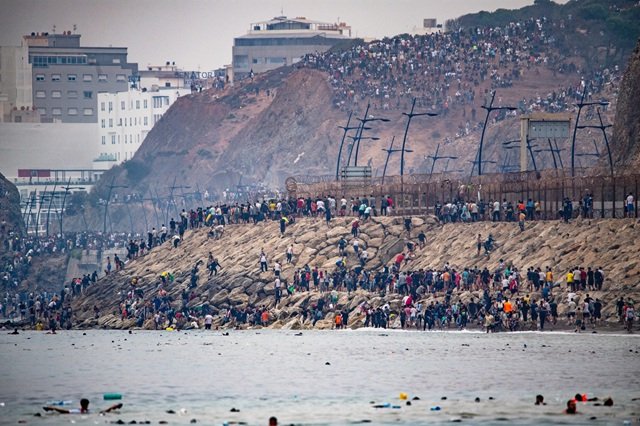
The Western Mediterranean route illustrates how quickly such networks can exploit changing circumstances. A separate mass land crossing at Ceuta in July, involving primarily Moroccan nationals, drew tens of thousands of people and killed at least 67, many of whom drowned during the crossing. The crisis was driven by the online reframing of a Spanish Supreme Court ruling as a certainty that Spain would grant legal status.
European and Spanish authorities linked the deceptive framing to human smuggler networks online. The episode demonstrated the growing importance of the information environment surrounding irregular migration. In response, the European Commission has compelled social media platforms to strengthen fact-checking and wants to “set up a mechanism helping the platforms to better cooperate with local fact-checkers.”
Digital technology has become an increasingly important component of the smuggling business itself. Social media platforms and messaging applications are used to recruit personnel, including drivers, and to advertise journeys to migrants seeking to cross into Europe. Law enforcement interdictions increasingly identify social media, messaging applications and cryptocurrency payments as elements of migrant journeys facilitated by smugglers.
Technology, however, has not eliminated the physical brutality associated with the trade. Violence remains part of the operating methods of these networks. Migrants and their families in transit countries are frequently subjected to kidnapping and torture for extortion, while some migrants are forced to work to repay debts owed to smugglers. Rival networks have also engaged in significant violence, with their activities often intertwined with wider gang affiliations.
For some criminal organisations, migrant smuggling has become only one component of a broader business model. Networks increasingly seek to maximise revenue by combining migrant, drug and weapons smuggling. Their connections to larger criminal organisations across Europe demonstrate how the boundaries between different forms of illicit trade can become increasingly blurred.
A major operation led by Spanish authorities and supported by Europol illustrates that convergence. The operation, which took place on June 16 and was made public on August 7, dismantled one of the largest criminal networks involved in smuggling migrants, weapons, cannabis, synthetic drugs and fugitives. Police made 78 arrests, 77 in Spain and one in Algeria, including three high-value targets. They also seized 18 boats, including so-called “ghost speedboats” used to evade detection.
According to authorities, the group had moved more than 2,000 people and earned over €24 million in profits. Those arrested had ties to criminal groups across Europe and to larger organisations such as the “Mocro Mafia,” a loose criminal network known to dominate the European cocaine trade.
Europe’s response has consequently expanded across policing, intelligence, border surveillance and legal measures. The European Commission has proposed replacing a 2002 package of rules criminalising assistance with illegal entry into the European Union with legislation that would also criminalise “public instigation”. That proposal has stalled, however, and Parliament has yet to adopt a position.
Police-led cooperation has remained more active. Europol’s European Centre Against Migrant Smuggling, established in March 2026 as the successor to the 2016 European Migrant Smuggling Centre, has significant financial and human resources and has become a hub for coordinating smuggling data across the continent. The Eurojust-hosted JITs Network Secretariat supports joint investigation teams, allowing authorities to pursue transnational networks through joint prosecutions.
Last month, the Commission and the High Representative proposed an EU-wide sanctions regime targeting migrant smuggling. The proposed measures would allow asset freezes and travel bans and could extend the reach of European authorities towards network leaders operating beyond EU jurisdiction, addressing the command-and-control problem that arrests within the Union alone have struggled to resolve.
Frontex has also collected intelligence on smuggling routes, conducted surveillance and shared data with Europol. Yet the European Court of Auditors assessed its effectiveness in 2021 as insufficient despite a rapid increase in its budget. Financial and operational arrangements with transit countries, including Türkiye, Libya, Tunisia, Egypt, Mauritania and Morocco, have likewise produced varying results.
The experience of the Atlantic route demonstrates the problem. After Mauritania intensified interceptions in 2024, alongside increased Moroccan patrols, arrivals towards Spain’s Canary Islands plummeted. Yet Frontex has indicated that tighter controls may displace rather than eliminate smuggling, with departures shifting towards Algerian shores.
The same pattern is visible farther afield. Smuggling networks have demonstrated an ability to respond rapidly to countermeasures and detection risks, including through routes originating far beyond Europe’s immediate neighbourhood. One case involved migrants from Vietnam entering the Schengen area on short-term visas through Hungary before travelling to France and then towards the United Kingdom, generating millions for the networks involved. In South Asia, Pakistani interventions against Europe-bound flows have reduced irregular Pakistani migration while contributing to the emergence of routes through Azerbaijan, Malaysia and Egypt.
The continuing evolution of these networks leaves European authorities confronting an illicit enterprise that has proved remarkably adaptable. Irregular migration and human smuggling have significantly decreased year-over-year, but the business remains lucrative and dangerous, exploiting migrants’ desperation while maintaining connections to established criminal organisations.
The Ceuta crisis has added another dimension by demonstrating how rapidly information circulating online can influence irregular migration. For Europe, the challenge is therefore not confined to patrol boats, border controls or arrests. Disrupting the networks requires attention to their finances, leadership, communications, criminal partnerships and ability to redirect movement when pressure is applied.
As the Soufan Center’s analysis makes clear, the persistence of migrant smuggling is rooted in its capacity to adapt. Routes can shift, personnel can be replaced, digital platforms can be exploited and criminal services can be combined. Europe’s response is evolving in parallel, but the continuing movement of people and criminal activity across borders means that disrupting the networks remains both a security and humanitarian imperative.