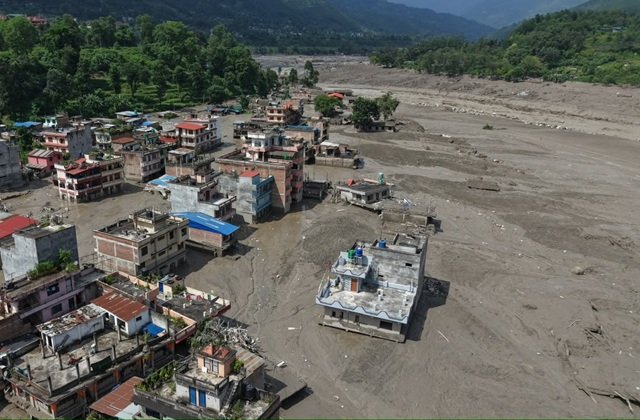
The death toll rose to at least 163, according to Nepal Police in a statement on X, while more than 800 people are missing in Nepal alone. Combined with those missing in China, the number exceeds 1,300. Nepal’s disaster management authorities have also reported that at least 579 domestic and international tourists are among the missing, highlighting the scale of the disaster in an area frequented by trekkers.
Nepal’s tourism authorities had on Wednesday reported 403 missing tourists, including 142 Indians, as well as travellers from the United States, Malaysia, Britain, Australia, the Netherlands, Portugal, South Korea, South Africa and Italy. Nepali travellers were also among those reported missing. The scale of the disruption has made it difficult for governments to establish the whereabouts and safety of their nationals. Australian Prime Minister Anthony Albanese described the prospects for obtaining information on Thursday as “difficult”, while Germany’s Foreign Ministry had previously expressed similar concerns.
The flash floods caused widespread destruction across the mountainous border region. According to authorities, entire villages were swept away, while roads and bridges were damaged or destroyed. Several major highways were blocked, further complicating rescue and relief operations. Water and solar power facilities were also damaged, adding to the disruption caused by the disaster.
Nepal has deployed army helicopters and rescue teams to the affected area as efforts continue to reach people who may still be stranded. China has also sent rescue personnel to the Gyirong border crossing, which was inundated by the flood. Access to the disaster zone remains severely constrained by huge quantities of mud and debris left in the wake of the flood.
The cause of the disaster has also been revised following further analysis by the US Geological Survey. The USGS initially suspected that an earthquake had triggered the event after recording seismic activity near the Nepal-China border. On Wednesday morning, it had reported a magnitude 4.4 earthquake near the border.
By Thursday, however, the USGS said its analysis showed that the seismic activity was not caused by an earthquake. Instead, a magnitude 5.2 “seismic event” recorded at 8.37 a.m. local time on Wednesday was attributed to a glacier collapse followed by an ice and debris avalanche. The USGS said the event had “catastrophic consequences”.
The International Centre for Integrated Mountain Development (Icimod) in Kathmandu reached a similar conclusion. Icimod expert Saswata Sanyal said an avalanche of ice and debris from a glacier first blocked the Lhende River before releasing the enormous flood wave. The findings point to the glacier collapse and subsequent movement of ice and debris as the trigger for the devastating flash flood.
With hundreds of people still unaccounted for and access to parts of the affected region severely restricted, rescue teams face difficult conditions as authorities continue efforts to determine the full human and material toll of the disaster.