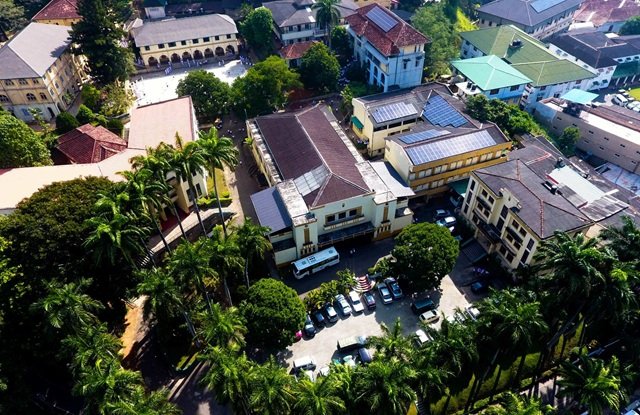
Trinity College, Kandy, symbolizes the distinctive educational environment Sri Lanka experienced under British rule, as the institution embodied Victorian values and closely followed the English public school model. Established by Rev. Richard Collins in 1872, Trinity achieved prominence during the tenure of its renowned principal, Rev. Frazer. During this period, the college attracted students from diverse national backgrounds, including the children of Indian Nawabs and Maha Rajas. The experiences of these Trinitians fostered a cosmopolitan camaraderie within the college, which influenced their varied life trajectories. Regardless of their subsequent professions, all alumni maintained a strong allegiance to Trinity while fulfilling their professional responsibilities.
This is true of Atma Jayaram, a celebrated Spy master, defence adviser, and gentleman par excellence. In the annals of history on intelligence services, Atma Jayaram’s name stands among the other stalwarts like the famous R.N. Kao, who worked closely with the former. Despite his revered memories in the Indian and foreign defence circles, a few Indians today are aware of his Sri Lankan connection, particularly to his formative education at Trinity College, Kandy. In fact, Atma was born in Sri Lanka during British rule to an affluent Tamil family and Atma’s father, a South Indian doctor who worked in the hill country plantations in Sri Lanka, decided to send Atma to Trinity College, Kandy, which undoubtedly held the helm in the island’s education.
Post-colonial theorists often contend that one’s cultural upbringing becomes an indelible force, profoundly shaping the course of adult life and influencing one’s perspective on the world. In this light, Trinity College in Kandy played a formative role in shaping Jayaram’s destiny to an extraordinary degree. This influence manifested in his enduring affection for Sri Lanka, which persisted even as he ascended to the highest ranks of the Indian defence establishment.
Atma Jayaram’s early years at Trinity College, Kandy, were marked by an understated quietude; he neither played Rugby nor participated in Cricket, the two pursuits that captivated most young men of the Empire. Instead, Jayaram’s time at Trinity was devoted to academics, with a particular passion for physics—a rare inclination at a school where students typically gravitated toward the liberal arts, such as classics or English literature, in preparation for careers in law. Hillary Abeyarathne’s commissioned history of Trinity, published in 1972 to commemorate its centenary, makes brief mention of Jayaram for his contributions to the college magazine in the late 1920s.
Following his academic brilliance at Trinity, Atma proceeded to study physics at the newly established University College in Colombo. He subsequently pursued postgraduate studies at Cambridge.
Cambridge in the 1930s, during the turbulent interwar years, was a haven for radical intellectuals and anti-colonial activists, where anti-colonial slogans were chanted and Das Kapital was revered. Deeply affected by the grim realities of the Great Depression and its subsequent contribution to the rise of totalitarianism in Europe, many Cambridge students increasingly embraced socialism as a panacea for the prevailing social and political turmoil.
It was against this backdrop that Soviet intelligence began monitoring promising British students, some of whom were subsequently recruited as Soviet agents within the British establishment. This ultimately gave rise to the infamous Cambridge Spy Ring, which included future double agents such as Kim Philby and Guy Burgess. Although it would be speculative to suggest that Atma was acquainted with members of the Cambridge Spy Ring, he did associate with Kim Philby, one of its most prominent figures.
Ironically, both Philby and Atma went on to become intelligence officers. While Philby, driven by ideological convictions, betrayed his country of birth in favour of the Soviet Union, Atma went on to serve his adopted country, India. Nevertheless, their respective public-school backgrounds at Westminster and Trinity may have provided common ground for the enduring friendship they maintained throughout their intelligence careers.
Jayaram’s association with Sri Lanka came to an end when his Indian origin prevented him from sitting the prestigious Ceylon Civil Service examination, compelling him to seek his fortune in India. The young Jayaram subsequently joined the Imperial Indian Police and was later recruited into the Intelligence Bureau under the supervision of Sir N. B. Smith, a formidable British police officer who played a pivotal role in restructuring the British administration during its declining years in India.
It goes without saying that Smith’s selection of Jayaram may have been influenced by their shared Anglophone outlook, which complemented Jayaram’s distinguished academic credentials from Trinity and Cambridge.
The British themselves were increasingly aware that their days were numbered as the Empire approached its swan song. Following India’s independence, Atma Jayaram continued his service in the Intelligence Bureau (IB), which remained India’s principal intelligence agency, responsible for gathering both internal and external intelligence until the establishment of the Research and Analysis Wing (R&AW).
Jayaram’s Sri Lankan connections and distinguished academic credentials from Cambridge enhanced his standing within the IB, paving the way for numerous overseas assignments. For instance, when the IB established its first station in Colombo, R. N. Kao was reportedly among those who consulted Jayaram.
Recently declassified documents from the National Archives in Colombo have shed light on Atma Jayaram’s involvement in assisting Sri Lanka during the leftist guerrilla insurrection that engulfed the island nation. By the time Sri Lanka was confronted with this unexpected insurgency, Jayaram had reached the pinnacle of his career as head of the IB and maintained close relations with Indian Prime Minister Indira Gandhi. Acting on Jayaram’s advice, 150 Indian Gurkha soldiers were reportedly deployed to protect Colombo International Airport.
It would be difficult to establish a direct connection between his interest in Sri Lankan affairs and any personal nostalgia for his birthplace, particularly Trinity College, Kandy. Nevertheless, it is not difficult to imagine that childhood memories remained with him throughout his life. For his part, the enduring bond between Jayaram and Trinity never seems to have faded.
Trinity honoured its distinguished alumnus when Jayaram became Chief of the Intelligence Bureau by publishing a special note on his achievement in the annual College magazine. Jayaram, in turn, frequently hosted his former art teacher at Trinity, Mr David Painter, whenever Painter visited New Delhi. On one such occasion, Jayaram introduced Painter to Indira Gandhi, who subsequently persuaded her father, India’s then Prime Minister Jawaharlal Nehru, to commission a portrait of himself. While working on the portrait, Painter stayed with Atma and Sushila, and the three developed a lifelong friendship.
Atma Jayaram’s story is a quintessential example of how colonial culture and its associated values were perpetuated through British educational institutions. The values inculcated by institutions such as Trinity College in Kandy and The Doon School in Dehradun shaped the outlook of the privileged local elites who studied there, instilling in them a sense of duty as the paramount calling in life. Undoubtedly, Atma Jayaram devoted his professional life to serving India’s interests; nevertheless, he continued to cherish his boyhood memories of Sri Lanka, particularly his enduring affection for Trinity.