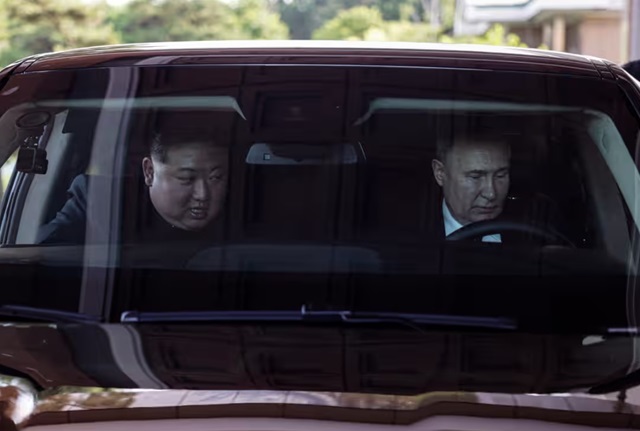
North Korea has temporarily suspended military support for Russia, including deliveries of ballistic missiles and artillery ammunition, following a disagreement over Moscow’s diplomatic approach towards South Korea, according to Ukraine’s military intelligence agency. The reported interruption raises questions about the stability of a military partnership that has supplied Vladimir Putin’s war effort with weapons, ammunition and thousands of North Korean troops.
The dispute centres on comments by Andrey Rudenko, Russia’s deputy foreign minister, who indicated that Moscow would seek to de-escalate tensions between Seoul and Pyongyang. North Korea’s Foreign Minister, Choe Son-hui, reportedly objected to the remarks, arguing that they were inconsistent with the alliance between the two countries. According to Ukraine’s Main Directorate of Intelligence (GUR), she demanded that the Kremlin clarify its position towards South Korea before military co-operation could proceed.
The suspension was reportedly requested personally by North Korean leader Kim Jong-un. Its scope extends beyond weapons shipments to include Russian military flights over North Korean territory. Deliveries of artillery shells and KN-23 short-range ballistic missiles have also been affected, according to the Ukrainian intelligence assessment. Pyongyang is additionally holding back on a Russian request to expand its military contribution, which would increase the North Korean presence in Russia from approximately 8,500 personnel to 50,000.
If sustained, the interruption would affect a military relationship that has developed considerably since Russia launched its full-scale invasion of Ukraine. North Korea began supplying Moscow with weapons in 2023 and subsequently committed troops to the conflict from 2024. Its contribution has included ballistic missiles and substantial quantities of artillery ammunition, providing Russia with an additional source of military supplies as the war has continued.
Pyongyang has also deployed an estimated 14,000 troops to fight alongside Russian forces in Kursk Oblast. Ukrainian, Western and North Korean officials have put the number of North Korean personnel killed at no fewer than 6,000. The scale of these casualties illustrates the human cost of Pyongyang’s military involvement and the extent to which its alliance with Moscow has moved beyond diplomatic declarations into direct participation in an overseas war.
North Korean forces nevertheless remain deployed in Russia, according to the GUR assessment. Units belonging to the North Korean army’s 11th Corps continue to operate in the Kursk region, while a combined North Korean missile unit has reportedly been stationed in Voronezh Oblast since midsummer as part of Russia’s 112th Missile Brigade. The reported suspension of further co-operation therefore does not mean that existing military deployments have been withdrawn.
The weapons relationship has been particularly significant for Moscow. Since 2024, Russia has launched several dozen North Korean ballistic missiles against Ukrainian territory. As recently as 7 November, Ukrainian President Volodymyr Zelensky claimed that Russian forces had used KN-23 missiles to strike a Ukrainian energy facility. The continued presence of North Korean missile units inside Russia, alongside the reported interruption of new supplies, suggests that the two countries’ military relationship remains operationally substantial despite the diplomatic disagreement.
For Pyongyang, the relationship also carries an economic dimension. Experts cited in the source material describe military assistance to Russia as a rare source of hard currency for a country heavily affected by international sanctions. Weapons exports and the deployment of military personnel have consequently become important components of North Korea’s expanding relationship with Moscow. A prolonged suspension could therefore have implications not only for Russian military planning but also for Pyongyang’s own economic and strategic calculations.
The disagreement over South Korea is particularly significant because it exposes a potential tension within the partnership. Moscow has sought to strengthen its relationship with Pyongyang while apparently keeping open the possibility of improving relations with Seoul. In October, Rudenko said Russia had received indications from South Korea that it wanted to normalise bilateral relations after the war in Ukraine. He also said discussions had taken place about resuming direct flights between the two countries.
For North Korea, however, Moscow’s willingness to explore such an arrangement appears to have raised concerns about the political commitments underpinning their alliance. The reported objection by Choe suggests that Pyongyang expects Russian policy towards South Korea to remain consistent with the strategic relationship established between the two governments. The episode illustrates the potential difficulty of maintaining an alliance when the partners’ wider diplomatic interests do not necessarily coincide.
Yet the reported military suspension has not halted high-level political engagement. Last week, Putin received Jo Yong-won, one of Kim’s closest aides, at the Kremlin. Both sides reportedly praised bilateral co-operation, indicating that diplomatic channels remain active despite the disagreement. The meeting also suggests that neither government has publicly abandoned the broader relationship.
The partnership has received further political endorsement from China. In September, Chinese President Xi Jinping and Putin reaffirmed their countries’ close ties with North Korea in messages marking the 78th anniversary of the country’s founding. Putin also pledged continued co-operation under the comprehensive strategic partnership signed with Pyongyang in 2024, an agreement that includes a mutual defence provision.
The Russian president has presented deeper relations with North Korea as a contribution to regional security and the development of a multipolar international order. The reported suspension, however, raises a more immediate question: how durable is that partnership when the diplomatic priorities of its principal participants begin to diverge?
For now, North Korean troops remain deployed in Russia, missile units continue to operate alongside Russian forces, and political contacts between the two governments are continuing. But the reported halt to weapons deliveries and the rejection of a proposed troop expansion indicate that Pyongyang is prepared to use its military contribution as leverage in a dispute over Russian foreign policy. For Moscow, whose war effort has drawn heavily on North Korean military assistance, the episode exposes the risks of relying on an ally whose support is tied to political expectations extending well beyond the battlefield.