Editorial
Ratko Mladić is dead at 84, having spent the final years of his life behind the walls of a United Nations detention facility in The Hague. His death closes the biological chapter of one of the darkest military careers in postwar Europe, but it does not close the argument over what he represented. Mladić was not merely a Serbian general who became involved in a brutal civil war. He became the military instrument of a political project that sought to redraw Bosnia and Herzegovina through terror, expulsion and mass murder. In 2017, the International Criminal Tribunal for the former Yugoslavia convicted him of genocide, crimes against humanity and war crimes and sentenced him to life imprisonment. The tribunal established that he participated in campaigns intended to permanently remove Bosnian Muslims and Croats from territory claimed by Bosnian Serbs, the terror campaign against Sarajevo, the Srebrenica genocide and the taking of United Nations personnel hostage.
His greatest historical crime was not simply that he commanded troops who killed civilians. It was that he helped turn the deliberate destruction of civilian life into a military strategy. Sarajevo became a laboratory for this method. For almost four years, the city was subjected to artillery bombardment and sniper fire, with civilians treated as targets rather than collateral victims. The purpose was to spread terror among the population. Markets, streets, homes and ordinary life became vulnerable to military fire from the surrounding hills. More than 10,000 people were killed during the siege, including children. Mladić’s forces did not merely fight an opposing army. They attempted to make life inside Sarajevo unbearable.
Then came Srebrenica. In July 1995, the supposedly protected United Nations enclave fell to Mladić’s forces. What followed was one of the most carefully organised mass killings in Europe since the Second World War. Thousands of Bosniak men and boys were separated from women and children, detained, transported to execution sites and murdered. The tribunal found that Mladić participated in a campaign designed to destroy the Bosnian Muslim population of Srebrenica by killing its men and boys while forcibly removing women, children and some elderly men. Around 25,000 people were expelled from their homes. The scale was not an accidental consequence of battlefield chaos. It required detention sites, transport, personnel, execution locations and the systematic concealment of bodies. That machinery of death is precisely why Srebrenica became legally recognised as genocide.
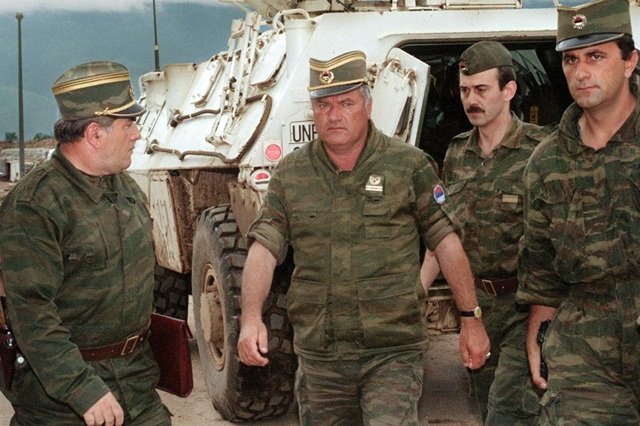
One of the most revealing episodes in Mladić’s career was also one of the most politically consequential. In 1995, his forces seized United Nations peacekeepers and military observers as hostages. The purpose was coercive. The UN personnel were used to deter NATO from carrying out further air strikes against Bosnian Serb positions. A commander who presented himself as a defender of Serbs was therefore willing to place international peacekeepers in chains when it served his military objectives. It exposed the weakness of international intervention at the time and demonstrated how far the Bosnian Serb leadership was prepared to go when it believed the international community would hesitate.
Yet perhaps the most important fact about Mladić is what happened after the guns fell silent. He disappeared. He remained a fugitive for almost sixteen years after being indicted in 1995, eventually arrested in Serbia in May 2011. That period matters because it demolishes the comforting idea that international justice automatically follows mass atrocity. It did not. A man responsible for some of Europe’s worst crimes since 1945 lived outside the reach of the tribunal for years while political networks and sympathisers helped sustain the possibility of his escape from justice. His eventual arrest was important, but it came long after the victims had buried their dead.
Mladić also leaves behind something more dangerous than his crimes. He leaves a divided memory. To many victims, he is inseparable from genocide, ethnic cleansing and the destruction of families. To sections of Serbian society, however, he remained a military hero or symbol of resistance, despite the judicial record against him. That contradiction is not a footnote to his story. It is one of the reasons the Bosnian war remains politically alive decades later. A convicted war criminal can die in prison, but the political mythology surrounding him can survive outside it.
His death therefore may not be dressed up as tragedy. Death is the natural ending of a human life. Justice is something else. Mladić was not executed, nor should his death be mistaken for punishment. He died after receiving a life sentence that recognised the extraordinary gravity of what he had done. His victims did not receive life sentences. They received graves. Their children received photographs of fathers who never came home. Their communities received empty houses and memorial stones. Mladić received decades in which the world argued over his guilt while survivors carried the evidence in their bodies and memories.
Europe has buried dictators, generals and ideologues before. The lesson of Mladić is that the machinery of civilisation can collapse remarkably quickly when nationalism, fear and political ambition are given military power. His uniform did not make him a monster. His choices did. His legacy is not military brilliance, Serbian nationalism or battlefield mythology. It is a record written in artillery craters, mass graves and the names of the dead at Srebrenica. He wanted territory. He helped destroy a society to obtain it. He died in captivity. Bosnia is still living with the consequences.