A growing series of attacks on oil tankers and commercial vessels in the Black Sea is worsening an environmental crisis already aggravated by Russia’s war against Ukraine, with oil pollution reaching coastal beaches, harming birds and threatening marine ecosystems.
Ukraine has targeted Russia’s oil industry, a major source of revenue for the Kremlin, while Russian forces have attacked ships carrying grain and other Ukrainian exports. The latest escalation has added to pollution from previous maritime accidents, including the sinking of two ageing Russian tankers in December 2024 whose fuel oil continues to wash ashore.
One of the largest vessels struck in the latest wave of Ukrainian attacks, the Aframax Rio, was reportedly carrying up to 100,000 tonnes of oil. Precise estimates of the quantity spilled into the sea remain unavailable.
Ukraine sank a Russian tanker on 6 October without causing casualties, while Russian attacks this month have targeted commercial vessels in waters near Bulgaria and Romania, both members of the North Atlantic Treaty Organisation. At least seven ships that had departed from Ukraine have suffered explosions, and 23 sailors, many of them Turkish, have died or disappeared this month, according to the source report. More than 50 sailors have died or disappeared in such incidents since the war began.
The consequences of the latest attacks are already being felt along Russia’s Black Sea coastline. On 13 October, Krasnodar regional governor Veniamin Kondratyev declared a regional emergency threat around the resort town of Gelendzhik and the port city of Novorossiysk, citing a possible oil spill linked to drone attacks on ships on 6 October.
Sochi, one of Russia’s principal tourist destinations, closed its beaches for two days until 8 October. Russia’s consumer protection agency, Rospotrebnadzor, subsequently said tests showed pollution levels had returned to normal.
Satellite images taken on 10 October and published by environmental monitoring project Prozrachni Mir, or Transparent World, showed a substantial slick off the coast near Novorossiysk, a major export hub for Russian and Kazakh oil destined for the Black Sea and the Mediterranean.
The environmental group said the spill was probably connected to the Aframax Rio, a Liberian-flagged tanker reportedly operating as part of Russia’s so-called shadow fleet, which Moscow uses to circumvent international sanctions.
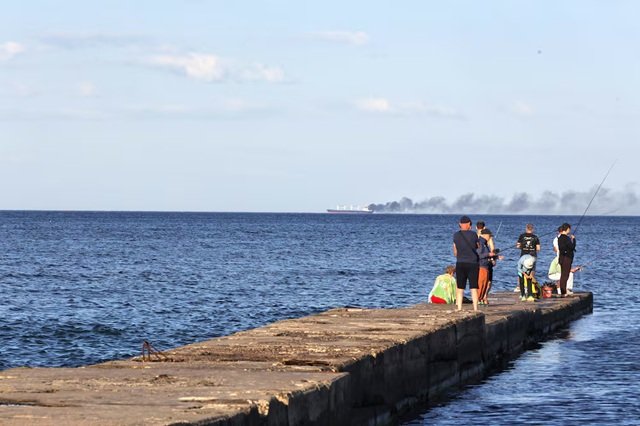
The vessel was struck by Ukrainian naval drones on 6 October and caught fire, producing a large column of black smoke visible from nearby coastal communities. Its 23 Indian crew members were evacuated unharmed. The damaged tanker remains tilted inside containment barriers at the port of Novorossiysk.
Residents have shared images of birds covered in oil and suffering apparent chemical burns, while local officials have acknowledged that contamination has reached beaches. Olga Kotliar, head of the Abrau-Dyurso district near Novorossiysk, said small fragments of pollution had reached the shore, staining footwear and swimmers’ feet with oily black residue. She described the sight of birds covered in diesel fuel as particularly distressing.
Alexei Oderov, head of Novorossiysk’s emergency services, told the local newspaper Górod that pollution had reached a point about 500 metres from the coast. He said the substance appeared to be fuel oil rather than crude oil, although the exact source remained disputed.
The latest incident follows earlier pollution affecting Russia’s Black Sea resorts. Ukrainian strikes on the Tuapse oil terminal caused a major spill this spring. In December 2024, two Russian tankers, the Volgoneft 212 and Volgoneft 239, broke apart during a storm. Both were more than 50 years old and had been lengthened through modifications to their hulls.
Cleanup operations have not been completed. Fuel oil deposited on the seabed can soften as seawater warms during summer, allowing it to rise and reach the coastline again.
Meanwhile, Russian attacks have increasingly affected waters within the territorial boundaries of European Union countries. On Thursday, two tankers, the Comoros-flagged Yara J and the San Marino-flagged Wine Trader, caught fire near the Danube delta at Sulina, inside Romanian territorial waters. Seven of the 12 people aboard the Wine Trader were reported missing. Romanian authorities had not established the causes of the incidents, although sources told Euronews that the vessel may have been struck by two drones.
European officials have condemned the attacks. European Commission President Ursula von der Leyen said the Black Sea had become another front in Russia’s escalation of the war, calling the situation unacceptable.
Bulgaria has begun testing seawater around the tourist regions of Varna and Burgas following earlier attacks near its coast. Authorities have not detected any unusual spills from the latest incidents.
However, Greenpeace has warned of the wider scale of pollution in European waters. The environmental organisation identified 226 oil slicks in Romanian waters between April 2022 and September 2025, covering a combined area five times the size of Bucharest. In Bulgarian waters, it detected 170 spills in 2025 alone, with a combined area twice the size of Sofia.
The latest attacks have added to the cumulative environmental damage, while continuing pollution from older wrecks illustrates how the consequences of maritime incidents can persist long after the fighting moves elsewhere.