Reverend Sam may be a man of God, but he did not get ahead in Sierra Leone’s diamond business through divine intervention. Eight years after he began digging for gems in Kono, eastern Sierra Leone, the rewards have been substantial. “I’ve built three houses,” he says. “You should see my cars. I’ve put my children through university thanks to diamonds.”
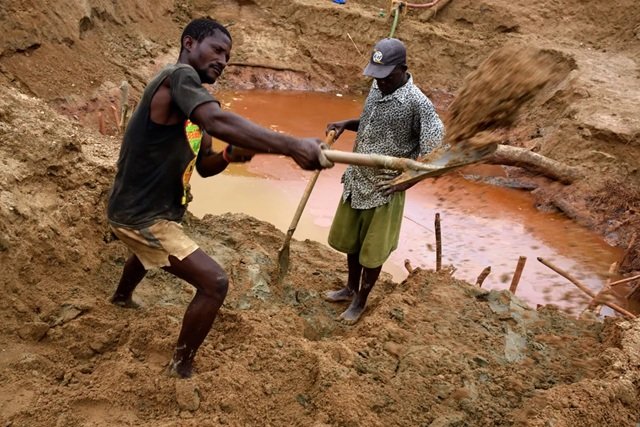
Yet the reality beneath that prosperity is considerably harder. It is not yet midday in Kono, but the heat is already punishing. Sam stands beside a pit at least 30ft deep, its bottom filled with muddy water. Men stripped to the waist hack at the earth with shovels and pickaxes, while women carry buckets of dirt on their heads to a wooden trough, where the material is washed before the stones are fed into a vibrating jigger to separate them by size and weight.
Sam does not own the land. He finances the excavation and brings his own crew of “boys”. Anything recovered is divided between him and the landowner, with Sam receiving 70% of the profits and the owner 30%. The workers receive 60 leones, about $2.50, for an eight-hour shift with a half-hour lunch break.
“There’s no contract, no insurance, no healthcare – except, you want to be human, so I try to look after [them],” Sam says. “But if they find anything, it belongs to me.”
Workers accused of stealing or lying about finding a stone are dismissed immediately. Sometimes Sam calls the police, although he generally prefers to settle disputes quietly. In an industry where a single stone can transform fortunes, trust is essential. “Trust is everything in the diamond business,” he says.
The tension between the extraordinary wealth diamonds can generate and the conditions in which they are extracted has long defined Sierra Leone’s relationship with the precious stone. The country’s diamonds became internationally notorious during its civil war, fought between 1991 and 2002, in which as many as 70,000 people were killed and more than 2.5 million displaced – more than half the country’s population at that time.
The association between diamonds and conflict was cemented internationally by Blood Diamond, the 2006 thriller set largely in Kono and starring Leonardo DiCaprio as a South African diamond smuggler. Its political message was unmistakable: the glamour of a diamond ring could conceal violence and human suffering.
So powerful was the film’s influence that, two decades later, the industry still regards its legacy as an obstacle. Phil Brilus, diamond polishing and manufacturing manager for De Beers, argues that public perceptions have not caught up with changes in the trade. The claim on social media that all natural diamonds are blood diamonds is, he says, “nonsense”, while the industry needs to start telling “the good news about natural diamonds”.
As reported by The Observer, the industry has attempted to build mechanisms that make the provenance of diamonds more transparent. In 2018 De Beers launched GemFair, a partnership scheme with local Sierra Leonean mines. Participating mining firms must guarantee minimum working standards, while De Beers pays the international market price for stones and gives each one a unique digital identity recorded on a blockchain. In theory, customers can trace a gem back to the individual miner who extracted it.
But GemFair remains a tiny part of the wider industry, accounting for less than a percentage point of De Beers’s annual production according to the company’s own estimates. The question, therefore, is whether the diamond trade has genuinely escaped the conditions that gave rise to the blood-diamond label.
The challenge is compounded by the changing economics of natural diamonds. The global market is in decline, with the price of natural diamonds falling to its lowest level on record in April. Industry analysis suggests global production peaked in 2005. Only 30 significant natural diamond mines are currently in production worldwide, while finding viable new deposits has become increasingly difficult. Major mines have closed in recent years, including De Beers’s flagship Venetia mine in South Africa.
For artisanal miners, the transformation is particularly visible. Natural diamonds extracted through small-scale operations account for only 10-15% of global trade, but they remain deeply embedded in the economies and cultures of poorer countries including Angola, the Democratic Republic of Congo and Sierra Leone.
In Kono, diamonds have undeniably changed lives. Sebru Joe, an artisanal miner turned community organiser, says his family depended on gold and diamond mining and that diamonds enabled him to attend university. As a young man, he once found a substantial stone while panning in his father’s stream. He hid it inside a hole cut into his sandal and travelled almost 2,000km across three borders to Ghana, where he sold it and paid his university fees.
But he doubts that such a journey remains possible today. “In my grandfather’s time, you could say: ‘Put the rice on for lunch, I’m going to find a diamond’ and you could come back half an hour later with a gem. Today, it is much more difficult – you need to dig deep, you need earth-movers, heavy equipment. Artisanal mining hasn’t completely gone, but it’s very reduced.”
The industry has also changed through regulation. Before 2003, the international diamond trade was largely unregulated. The Kimberley Process subsequently brought more than 86 countries, representing almost all global production, into an international certification scheme intended to exclude conflict diamonds from legitimate trade.
The system requires rough diamonds to be exported in tamper-proof clear plastic bags accompanied by certificates identifying their country of origin. Yet it has limitations. Its definition of a “conflict diamond” is narrow, meaning Russian diamonds, for example, which have been sanctioned since the full-scale invasion of Ukraine in 2022, are not classified as such.
Andrew Grant, an associate professor in the department of political studies at Queen’s University in Ontario, Canada, argues that despite its limitations, the Kimberley Process has changed the trade significantly. “Before the KP, anything went,” he says. “Now it’s almost impossible for a consumer in the west, who is buying from a legitimate dealer, to end up with a blood diamond.”
In Kono, however, the old risks have not disappeared entirely. Accounts of illegal routes through Liberia and warnings about the dangers of moving large stones remain. Yet the majority of diamonds leaving Sierra Leone appear to do so legally. Under the country’s 2023 update of its Mines and Minerals Act, 70% of the value of an exported stone is promised to its owner. For Sam, that provides a strong incentive to remain within the legal system rather than risk smuggling a valuable stone through Guinea.
The industry now faces another threat that cannot be addressed simply through certification: synthetic diamonds. Once primarily used for industrial purposes, laboratory-grown stones have become increasingly viable for jewellery as manufacturing costs have fallen. They are sold as ethical and environmentally responsible alternatives to natural diamonds and at a fraction of the cost.
The consequences are being felt at both ends of the industry. In Koidu, Sierra Leone’s largest diamond-producing mine, Koidu Ltd closed last March, leaving more than 1,000 workers without jobs. Disputes over working conditions, pollution and payment agreements continue. The company attributed the closure to a deadlock over a rights abuse lawsuit, while suspicions in Kono persisted that the diamonds had simply been exhausted. Koidu Ltd was approached for comment but did not respond.
Meanwhile, London’s diamond traders are confronting the synthetic challenge directly. Wulf Rabstein, treasurer of the London Diamond Bourse, says the threat posed by synthetics and fakes is “massive”. The industry, he says, has had to become increasingly “academic and scientific”, scrutinising every stone that passes through its hands.
The debate over the future of natural diamonds ultimately returns to their most powerful selling point: their rarity and origin. On the diamond floor at De Beers’s London headquarters, a shipment of rough Sierra Leone diamonds sits alongside its Kimberley Process certificate. Charlotte Rose, president of the London Diamond Bourse, describes the stones as “miraculous”, products of thousands of years of heat and pressure deep within the earth.
“There are no good or bad diamonds,” she says. “Only good or bad people.”
Back in Kono, the workers continue to dig. No diamond has yet been found. Exhausted miners shelter from the heat as children carry water in jerrycans. Reverend Sam calls over his foreman, Francis, who once discovered a 38-carat diamond worth as much as $7.5m (£5.5m) in today’s prices.
Francis received no share of that extraordinary value beyond his day’s wages.
Mining, he says, “is hard work, but it’s a job, by the grace of God”.
Then, seemingly uncomfortable in the presence of his employer, he slips away.