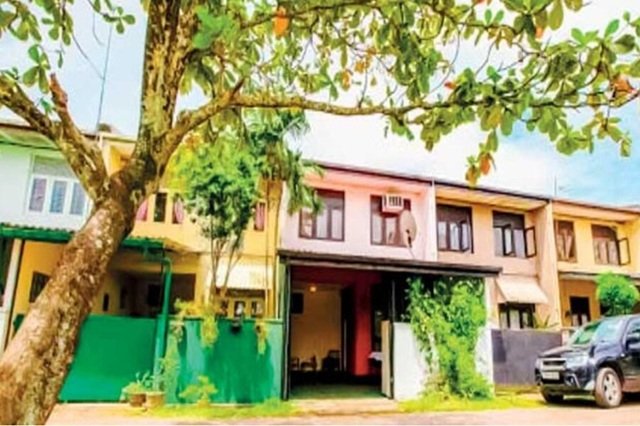
Sri Lanka’s Parliament is providing official residential units in the Madiwela parliamentary housing complex to 111 serving lawmakers at a monthly rent of just Rs.2,000 per unit, according to information released under the Right to Information Act.
The accommodation is being provided to four cabinet ministers, nine deputy ministers and 98 other MPs from the 10th Parliament. The Parliamentary Secretary-General’s Office confirmed that all lawmakers occupying the units are charged the same monthly rent and that there are currently no outstanding rental payments.
The figures have emerged at a politically sensitive time, when the government is asking the public to bear the burden of economic adjustment, taxation and higher living costs. Against that backdrop, a monthly parliamentary housing charge equivalent to only around US$6–7 raises questions about the scale of subsidised benefits available to elected representatives.
The parliamentary response also confirms that MPs occupying Madiwela residences do not receive a separate rental allowance. The accommodation therefore represents a direct residential benefit rather than an additional cash housing payment.
Among the cabinet ministers occupying units are Minister of Fisheries, Aquatic and Ocean Resources Ramalingam Chandrasekar, Minister of Women and Child Affairs Saroja Savithri Paulraj, Minister of Plantation and Community Infrastructure K. V. Samantha Vidyaratne, and Minister of Housing, Construction and Water Supply Dr Susil Ranasinghe.
The list also includes Deputy Ministers Vasantha Piyathissa, Nalin Hewage, Gamagegedara Dissanayake, Dr Namal Sudarshana, R. M. Jayawardena, Rathna Gamage, Arun Hemachandra, T. B. Sarath and Namal Karunaratne, among others.
The beneficiaries are predominantly government MPs, but the housing scheme also extends across the political divide. Opposition lawmakers listed as occupants include H. M. Dharmasena, Chamara Sampath Dasanayake, J. D. Aluthwala, Kader Masthan, S. S. Sridharan, Rohana Bandara, Dilip Vedaarachchi, M. L. A. M. Hizbullah, Nalin Bandara, Ramanathan Archuna, Kins Nelson, Dayasiri Jayasekara, Chanaka Medagoda, Rishad Bathiudeen, Kavinda Jayawardena, Hector Appuhamy, Selvam Adaikkalanathan, Shanakiyan Rasamanickam, Chathura Galappaththi, Rohini Kumari Wijerathne, Chithral Fernando, Palani Digambaran, Chaminda Wijesiri, D. S. Radhakrishnan, Imran Maharoof and Varun Liyanage.
The disclosure is therefore not simply a question of which party occupies which house. It highlights a wider issue concerning the privileges attached to political office and whether those benefits remain appropriate when ordinary citizens are being asked to shoulder the costs of economic recovery.
At Rs.2,000 a month, the parliamentary residences are being offered at a rate that would be difficult to replicate in the ordinary housing market. Yet the Parliamentary Secretary-General’s Office has confirmed that no rental arrears are currently owed by the occupants.
The disclosure also illustrates the gap that can emerge between the financial realities faced by citizens and the institutional benefits enjoyed by those elected to represent them. While the parliamentary accommodation may be justified as an administrative facility for lawmakers, its exceptionally low rental charge inevitably invites scrutiny over whether public benefits provided to politicians should be reviewed alongside the wider economic sacrifices expected from the population.
For a country undergoing difficult economic adjustments, the question is not merely whether MPs are entitled to official accommodation. It is whether the public should continue to subsidise that accommodation at a rate of Rs.2,000 a month when the broader cost of living has made housing and everyday expenses a growing concern for ordinary households.