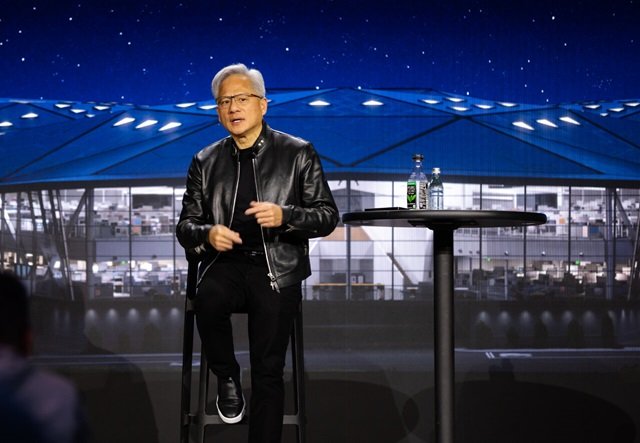
Nvidia CEO Jensen Huang made headlines at the All-In conference in Los Angeles on Monday after President Donald Trump called him live on stage, turning an already closely watched discussion about artificial intelligence into an unusually public display of alignment between two of the technology sector’s most influential figures.
Huang, dressed in his now-signature alligator leather jacket, was handed a foldable phone to answer the call. Rather than taking Trump’s call privately, he placed the president on speaker for the conference audience. “I’m onstage with the besties,” Huang told Trump, referring to the venture capitalists who host the All-In podcast, including Chamath Palihapitiya, Jason Calacanis, David Friedberg and David Sacks.
Trump responded with a joke about Huang’s difficulty putting him on speaker. “The great thing about life is Jensen can develop the most complex computer chip in the world … but he can’t figure out how to put you on speaker,” Trump said. Huang was, however, asking stagehands for an additional microphone so the conversation could be heard by the audience.
The exchange quickly moved to one of the most consequential debates surrounding artificial intelligence: whether the rapid development of increasingly capable AI systems should be slowed. The discussion came as the All-In hosts and Huang considered Anthropic CEO Dario Amodei’s call to “slow the pace” at which AI capabilities are improved. SpaceX CEO Elon Musk and OpenAI CEO Sam Altman have publicly said they agree with Amodei, while Huang’s position has diverged.
Trump rejected the argument that growing concerns about AI should lead to a slowdown. He said those calling for restraint were “playing right in the hands” of people who did not want the technology to advance, naming political interests and China. “And we’re not going to let that happen. It’s a hoax,” Trump said.
Huang responded: “You’re right. We’re not going to let that happen, sir,” prompting applause from the audience. Huang then told Trump, “Did you hear that? Thousands of people are clapping.”
The exchange highlighted the close relationship between the rapid expansion of AI and the commercial interests surrounding it. Nvidia’s business model depends largely on AI laboratories purchasing its chips, while the company’s shares remain up 33% over the past year despite falling a few percentage points on the day. Whether Huang genuinely shares Trump’s assessment of AI risks or was reluctant to contradict the president publicly remains unclear.
The disagreement also extends beyond AI safety to the growing controversy over data-centre construction. Trump and allies including Y Combinator CEO Garry Tan have described opposition to new data centres as part of an international “psyop” designed to restrain American economic growth. Yet recent Gallup polling cited in the discussion found that seven in 10 Americans oppose data centres being built in their area. More than 50% cited effects on environmental resources, while about 20% expressed concerns about rising costs of living and impacts on quality of life.
Trump acknowledged the need for caution, telling Huang that “We have to be a little bit careful … We have to do things and we have to do them prudently, but that doesn’t mean we’re going to stop an industry.” He concluded: “So I’m with you all the way. I didn’t even know how you felt about it. I just hoped you felt the same way as me. We’re going to lead.”