The BRICS grouping was created as an alternative to a global order dominated by a handful of powerful Western nations led by the United States. Its members now account for a combined 40 per cent of the world’s economic output, compared with 29 per cent for the G7, while its leaders have pledged to transform what Indian Prime Minister Narendra Modi called the old “pyramid of privilege” into “a platform of partnership”.
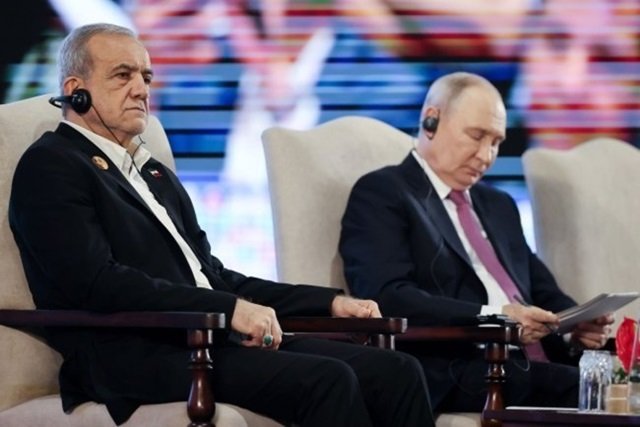
The presence of Russian President Vladimir Putin and Iranian President Masoud Pezeshkian at the New Delhi summit illustrated the grouping’s importance to countries facing Western sanctions and diplomatic isolation. Few other major international forums offer both leaders comparable access to a broad group of non-Western powers. Yet the summit also exposed the limits of BRICS as a vehicle for delivering concrete strategic gains to Moscow and Tehran.
Both governments sought to portray their participation as evidence that they could overcome the economic sanctions and diplomatic isolation imposed by Western countries. But Putin and Pezeshkian left the summit with limited tangible results, despite the importance of BRICS to both countries.
Putin arrived with two principal objectives: advancing an alternative currency payment system to one dominated by the US dollar and expanding Russia’s economic partnerships. The 45-page New Delhi Declaration did acknowledge the importance of alternative payment systems that are “fast, low cost, more accessible, efficient, transparent and safe”. But it also stressed that there was “no one-size-fits-all approach” and that national priorities had to be respected.
The qualification reflected divisions within BRICS over how practical and reliable an alternative financial structure would be. For some members, replacing a system centred on the US dollar with one in which China would inevitably play a dominant role would not necessarily represent a more attractive alternative. The declaration therefore stopped short of becoming the de-dollarisation manifesto Moscow had hoped for, while allowing members whose exports to the United States remain important to avoid a direct challenge to the existing financial order.
The outcome was particularly significant for Russia, which has been heavily affected by the West’s ability to restrict access to international financial networks. US President Donald Trump’s threat to impose a 100 per cent trade tariff on imports from BRICS countries seeking to challenge the dollar was not the only obstacle. Differences among BRICS members themselves proved equally important.
Putin also sought to deepen Russia’s economic relationship with India. Russia and India pledged to reach US$100 billion in bilateral trade by the end of the decade. But Modi noted that US$60 billion of current trade consists of Russian oil deliveries, while India “is not yet a major exporter to Russia”. Increasing trade would therefore require Russia to purchase substantially more Indian goods.
That ambition faces serious constraints. Russia increasingly lacks convertible currencies with which to import manufactured products, while its energy revenues have weakened. As Putin arrived in New Delhi, Russia’s finance ministry reported that oil and gas revenues for the first eight months of 2026 had fallen to US$59.1 billion, 17 per cent below the same period in 2025 and a third below the figure for 2024. The summit offered Moscow diplomatic visibility but no immediate escape from those economic pressures.
Pezeshkian faced similarly limited gains. At the 2025 BRICS summit in Rio de Janeiro, the organisation issued a “strong condemnation” of US strikes on Iran. In New Delhi, seven months into the current Gulf war, BRICS leaders limited themselves to expressing “deep concern over the continued escalation of tensions in the Middle East”, without assigning blame.
Iran’s position within the expanded grouping also made a stronger collective response difficult. The New Delhi summit brought together 11 states, three of which Iran had attacked with missiles or drones in 2026. Pezeshkian’s most significant diplomatic engagement came outside the main proceedings, when he met Sheikh Khaled bin Mohamed bin Zayed Al Nahyan, the Crown Prince of Abu Dhabi, marking the highest-level Iranian-Emirati contact since the war began on Feb 28.
The summit nevertheless delivered an important political benefit to Modi. He managed to accommodate competing interests while preventing BRICS from becoming an overtly anti-US gathering. Images of Modi holding the hands of Chinese President Xi Jinping and Putin reinforced India’s international profile and its aspirations to act as a mediator and stabilising power.
Modi concluded that “The power of Brics lies in our diversity and cooperation.” Yet the summit also demonstrated the difficulty of converting that diversity into decisive collective action. For Russia and Iran, the event offered diplomatic recognition and an opportunity to challenge perceptions of isolation, but little in the way of concrete economic or strategic relief.
For the two leaders who arguably needed the summit most, the New Delhi gathering ultimately delivered diplomatic embraces and general goodwill rather than the breakthroughs they sought.