by Our Correspondent in Colombo
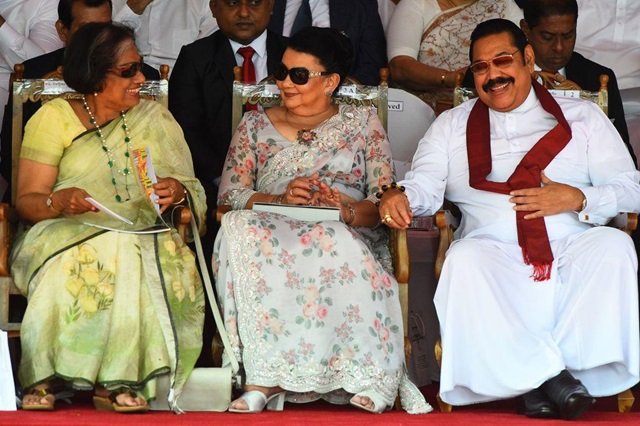
Shiranthi Rajapaksa’s return to Sri Lanka brings renewed attention not only to the financial investigation surrounding the Siriliya Saviya Foundation, but also to the long political and family history surrounding one of the country’s most prominent former first ladies. Born Shiranthi Wickramasinghe in Badulla, she was the only daughter of Navy Commodore E. P. Wickramasinghe and Violet Wickramasinghe and spent much of her formative years in the hill country. In a 2006 interview, she recalled growing up in what she described as a close family environment, surrounded by her parents and two brothers. She attended Holy Family Convent, Bambalapitiya, where she was active in netball, hockey and tennis before pursuing studies in child psychology and pre-school education.
Her first national prominence, however, came not through politics but through the beauty pageant world. Shiranthi was crowned Miss Sri Lanka in 1973 and represented the country at both the Miss Universe and Miss World competitions that year. Contemporary accounts describe her as having attracted attention from the film industry after the pageant, although her father reportedly discouraged her from entering the cinema. The dates of the pageant record are occasionally misstated in online accounts, with some later profiles giving conflicting years; contemporary and biographical sources, however, consistently identify 1973 as the year in which she represented Sri Lanka internationally.
Her subsequent life took her into education and early-childhood development rather than entertainment. She became professionally associated with child psychology and pre-school education and later established Carlton pre-schools in several parts of the country. By the time Mahinda Rajapaksa became president in 2005, she had become a highly visible public figure in her own right, although her public identity was increasingly inseparable from that of her husband.
Shiranthi married Mahinda Rajapaksa in 1983, when he was already an established politician and lawyer. Rajapaksa had entered Parliament in 1970 at the age of 24 and had subsequently served in opposition and government, eventually becoming Prime Minister in 2004 and president in 2005. The marriage brought Shiranthi into one of Sri Lanka’s most consequential political families. The couple have three sons, Namal, Yoshitha and Rohitha.
Her wider family connections also became politically significant. Her mother, Daisy Forrest Wickramasinghe, later became the subject of a money-laundering investigation involving a joint account with Yoshitha Rajapaksa. In February 2025, the Kaduwela Magistrate’s Court imposed an overseas travel ban on Daisy after police said she had been named a suspect following investigations into the source of funds amounting to about Rs.59 million. The case remains a matter of investigation and allegations; the existence of the case does not by itself establish criminal liability.
Another important connection emerged around the family of Shirani Bandaranayake, who would become one of the most controversial judicial figures of the Rajapaksa era. Bandaranayake’s husband, Pradeep Kariyawasam, was appointed chairman of the Sri Lanka Insurance Corporation in 2009 and later chairman of the National Savings Bank during Mahinda Rajapaksa’s presidency. Kariyawasam subsequently faced bribery proceedings over the NSB’s controversial purchase of shares in The Finance Company. In 2018, the Colombo Magistrate’s Court convicted him and imposed a five-year suspended prison sentence and a fine of Rs.300,000.
Shirani Bandaranayake herself had a complicated relationship with the Rajapaksa establishment. Mahinda Rajapaksa appointed her to the Supreme Court in 1996? No: she was appointed to the Supreme Court by President Chandrika Bandaranaike Kumaratunga in 1996 and became the country’s first woman Supreme Court judge. Rajapaksa later appointed her Chief Justice in 2011. During her tenure, however, relations between the judiciary and the executive deteriorated sharply. Her impeachment and removal in January 2013 followed a process that was challenged in the courts and widely criticised by lawyers, civil-society groups and international observers. Her removal became one of the defining controversies over judicial independence during the Rajapaksa presidency.
The episode also created a striking political reversal. Bandaranayake had been appointed Chief Justice by Mahinda Rajapaksa and her husband had held senior positions in state institutions under his government. Yet, after her removal, she became associated with the struggle over judicial independence and opposition to what critics described as executive interference in the judiciary. She was briefly reinstated as Chief Justice in January 2015 after the change of government and retired the following day. Her husband’s later conviction over the NSB transaction added another dimension to the controversy surrounding the family’s relationship with the Rajapaksa administration.
The significance of these connections is not that they establish wrongdoing by Shiranthi Rajapaksa. They instead illustrate the dense network of political, judicial, financial and family relationships that surrounded the Rajapaksa presidency. Shiranthi herself was not a politician, but as First Lady from 2005 to 2015 she occupied an unusually prominent position within that network. Her Siriliya Saviya Foundation became associated with charitable and social programmes, while later investigations raised questions about its finances, vehicles, bank accounts and fundraising activities.
The present investigation therefore reaches back into the final decade of Mahinda Rajapaksa’s presidency. The Siriliya Saviya inquiry originated in 2015 and has periodically resurfaced, with investigators examining several transactions and assets connected to the foundation. Among the matters under scrutiny is a bank account opened in the foundation’s name and the use of the National Identity Card number “222222222V” in the account documentation. Investigators also questioned the handling of funds raised for medical equipment and other charitable purposes. These allegations remain matters for investigation and judicial determination, not established findings of guilt.
One of the most closely examined transactions involves money raised for medical equipment for the Lady Ridgeway Hospital for Children. Investigators have been examining the movement of funds connected to the foundation and have sought statements from individuals associated with the transactions. The investigation has consequently moved beyond questions about the foundation’s public activities to the more specific issue of how money entering its accounts was recorded, transferred and spent.
That history explains why Shiranthi Rajapaksa’s return in October 2026 has attracted renewed attention. After travelling to Singapore for further medical treatment in September, she returned to Sri Lanka on 5 October and sought anticipatory bail in connection with the FCID investigation. Her lawyers argued that she faced a possibility of arrest. The application itself does not constitute a finding that she committed an offence. It is a legal attempt to obtain protection against arrest while the investigation proceeds.
The immediate dispute is now procedural: the authorities want Shiranthi Rajapaksa to provide a statement to investigators, while she has sought judicial protection in anticipation of possible arrest. But the larger story reaches far beyond a single bank account. It touches the political history of the Rajapaksa presidency, the rise and fall of its political power, the controversial removal of a Chief Justice once appointed by Mahinda Rajapaksa, the financial investigations involving members of the extended family, and the unresolved questions surrounding institutions and networks that operated during the decade in which Mahinda Rajapaksa dominated Sri Lankan politics.
The latest chapter unfolded last night, when Shiranthi Rajapaksa, wife of former President Mahinda Rajapaksa, returned to Sri Lanka from Kuala Lumpur on a Malaysia Airlines flight after travelling abroad for medical treatment. She entered the country through the airport’s Gold Route and subsequently went to the Police Financial Crimes Investigation Division in connection with the ongoing investigation. Police have now instructed her to appear before the FCID again on October 13 to provide a statement. Meanwhile, she has sought anticipatory bail from the Maligakanda Magistrate’s Court, asking for an order preventing her arrest. Her return, followed almost immediately by her appearance before the financial crimes investigators, adds another chapter to the continuing legal and political scrutiny surrounding the Rajapaksa family—suggesting that, whatever its political fortunes, the past has not finished asking its questions.