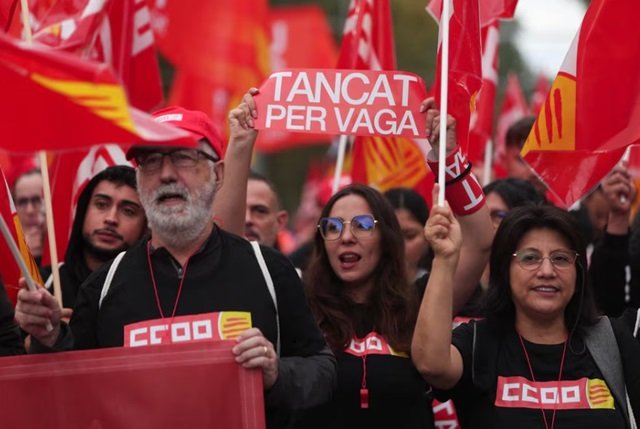
Trade unions and social organisations staged coordinated demonstrations across seven European countries on Friday, 20 November, demanding affordable housing, rent controls and government action to address the rising cost of living, in a mobilisation reflecting mounting economic insecurity across the continent.
Protests took place in Spain, France, Italy, the United Kingdom, Portugal, Greece and Belgium, bringing together movements that have gained momentum in recent weeks but have yet to secure what organisers consider satisfactory responses from national governments. The demonstrations focused primarily on housing affordability but also highlighted wider concerns over employment security, rising energy costs and the decline of major industrial sectors.
The initiative was launched in Paris just over two weeks earlier by Spain’s Confederation of Tenants’ Unions, with the stated ambition of mobilising millions of people through Sunday. Organisers are seeking to turn separate national campaigns into a coordinated European movement around housing rights and economic protection.
The protests come amid a sustained increase in housing costs. Rental prices across Europe have risen by nearly 30 per cent since 2010, while energy costs have surged this year amid the war in Iran. The combination has intensified concerns about the affordability of essential services and the financial pressures facing households.
The mobilisation has also expanded beyond housing. Organisers and participating groups have drawn attention to employment insecurity associated with the rapid integration of artificial intelligence, alongside the weakening of traditional industrial sectors, particularly steel, chemicals and automotive manufacturing.
Ludovic Voet, confederal secretary of the European Trade Union Confederation (ETUC), which brings together 92 organisations representing nearly 45 million workers, said the demonstrations reflected a widespread feeling of abandonment despite historically high levels of wealth creation.
“European institutions and member states currently talk about nothing but competitiveness, simplification and deregulation, and that means very little to people. We do not see ourselves as budget lines,” Voet said.
In France, the campaign has acquired a cultural dimension, with students and workers expected to stage another demonstration on Saturday. Following an appeal on social media, professional and amateur musicians joined protesters at Place de la République in Paris, organising open-air concerts in support of the movement’s demands.
In Italy, demonstrations organised by the CGIL trade union are expected to attract substantial participation from Rome’s peripheral neighbourhoods, which are home to more than 1.5 million people. The Donne De Borgata (Women of the Suburbs) collective, established in the Primavalle neighbourhood in 2022, is among the participating groups. Its members spent the weekend camping outside the Colosseum to draw attention to the economic and social insecurity experienced by women in the city’s outlying communities.
The European mobilisation is also coinciding with an international youth strike against fossil fuels organised by a Portuguese student association, connecting demands for housing and economic security with wider concerns about energy and environmental policy.
The coordinated demonstrations illustrate how housing affordability has become part of a broader debate over living standards, employment and economic priorities across Europe, bringing together trade unions, community organisations, students and social movements.