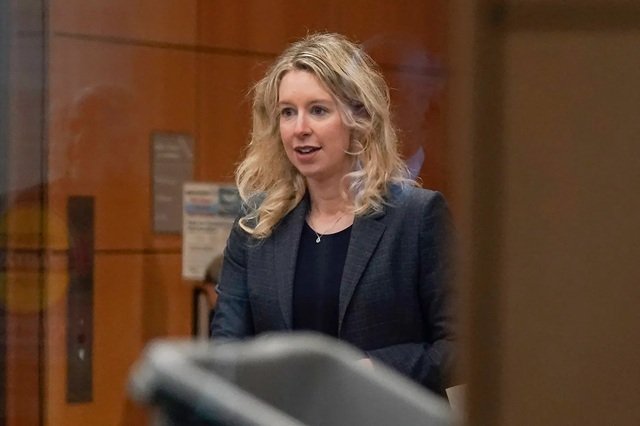
A single sentence in Nathan Fielder’s documentary about Elizabeth Holmes threatens to alter the way audiences understand one of the most notorious corporate fraud cases in modern American history. Asked when he believed his daughter’s life had changed, Holmes’s father offers an unexpected answer: when she was 19, she was raped.
The revelation comes more than an hour into You Can See Everything, directed by Fielder and Lance Oppenheim. Yet the subject is never seriously revisited. Instead, the nearly three-hour film follows Holmes through the period before she entered prison in May 2023, examining her relationships, her insistence on innocence and the unsettling question of whether the person on screen is revealing herself or performing another carefully controlled version of her identity.
Holmes became internationally notorious through Theranos, the blood-testing company she founded in 2003 after leaving Stanford University. Its central promise was revolutionary: a small amount of blood obtained through a finger prick could be used to test for more than 240 medical conditions. The proposition attracted powerful commercial partners and extraordinary investment. Walgreens announced a partnership in 2013, and by 2015 Theranos was valued at $9 billion. Forbes named Holmes the world’s youngest and wealthiest self-made female billionaire.
The company’s claims subsequently unravelled after a whistleblower raised concerns about the reliability of its proprietary testing technology, prompting an investigation by the Wall Street Journal. Holmes and former chief operating officer Ramesh “Sunny” Balwani were charged with fraud and conspiracy. In January 2022, Holmes was convicted on one count of conspiracy to commit fraud and three counts of fraud. She was sentenced to 11 years and three months in federal prison.
The criminal case is not in dispute. What remains more complicated is the attempt to understand the person behind the deception, and whether the violence she says she experienced as a teenager is relevant to that understanding.
The documentary offers no definitive answer. Holmes appears wide-eyed and persistently convinced of her innocence, but the film leaves viewers uncertain about the extent to which her behaviour is genuine, calculated or shaped by circumstances she may herself struggle to comprehend. Her relationships with men become particularly important to this ambiguity.
Holmes was 18 when she met Balwani, then 37, in 2002. They began a romantic relationship two years later. Holmes later alleged that he had promised to protect her after the rape and that their relationship became abusive and coercive. Balwani denied those allegations. The documentary also raises questions about her relationship with her current partner, Billy Evans. In one revealing instance, Evans acknowledges that he posts messages from Holmes’s X account while she is in prison without consulting her.
Small interactions acquire a more troubling significance as the film progresses. In one scene, Evans impatiently takes a bowl of eggs from Holmes while she is preparing breakfast, apparently dissatisfied with the way she is whisking them. Such moments do not establish a pattern of abuse, but they contribute to the film’s broader uncertainty about autonomy, influence and the power exercised by those closest to her.
The documentary’s central omission, however, is the rape itself. The film records the father’s statement but does not pursue it. The question is whether this was a deliberate editorial decision, Holmes’s preference or simply a subject the directors did not know how to approach.
The issue has also received limited attention in John Carreyrou’s Bad Blood, the 2018 book that exposed the Theranos scandal. In an afterword concerning Holmes’s trial, the New York Times reporter wrote that she had considered telling her lawyers about the sexual assault as part of her defence, but was advised against doing so because it might be interpreted as an attempt to generate sympathy.
Holmes did testify about the rape during her 2021 trial. She said she had been assaulted at a Stanford fraternity house when she was 19, shortly before leaving university and establishing Theranos. She described deciding to build a company as a way of constructing a new life after the experience. Carreyrou, in his account of her testimony, questioned the presentation of this revelation, describing it as part of what he called her “Svengali defence”.
That interpretation was complicated by an investigation by National Public Radio a year after the trial. It found that a person named Elizabeth Holmes had reported a rape to the Santa Clara County Sheriff’s Office at 10pm on 5 October 2003. The report recorded an alleged assault at a Stanford fraternity house earlier that morning. Deputies responded and documented the complaint, although the record did not identify an alleged perpetrator, provide further details or lead to criminal charges.
The existence of the report does not establish every aspect of Holmes’s account. But it makes it difficult to dismiss the allegation simply as a courtroom strategy. Its significance is precisely what neither Carreyrou’s revised account nor Fielder’s documentary fully examines.
In a personal essay published by Observer UK, the writer argues that this omission matters because sexual violence can have consequences that extend far beyond the immediate assault. Drawing on her own experience of rape and subsequent recovery, she questions whether Holmes’s apparent childlikeness, emotional presentation and dependence on men might be understood, at least partly, through the possibility of unresolved trauma. These are interpretations, not clinical findings, and the documentary does not establish that Holmes has experienced the psychological effects described.
The wider statistics nevertheless point to a serious issue. A 2017 Prison Reform Trust report found that more than half of women imprisoned in England had survived domestic abuse. A report published last year by Advocates for the Human Rights cited research indicating that at least one study found 99 per cent of women in US prisons and 84 per cent of girls in juvenile detention centres had experienced gender-based violence before entering custody.
None of this diminishes the seriousness of Holmes’s fraud or the responsibility attached to it. Nor does a history of sexual violence explain away the deliberate deception that destroyed public trust in Theranos. But criminal accountability and an examination of personal trauma are not mutually exclusive.
When Evans describes Holmes as “really weird” and “just not normal”, the documentary leaves viewers with a question it never resolves. Perhaps the more important question is whether the violence she experienced at 19, and the relationships that followed, form part of an explanation that the public has been too willing to overlook.
Holmes’s conviction explains why she went to prison. It does not, by itself, explain the person whose life preceded it.