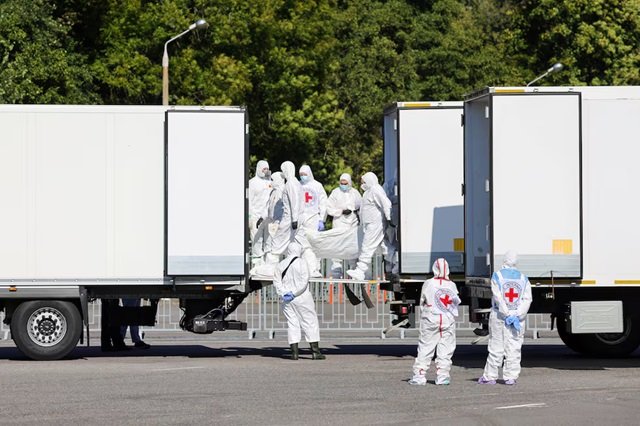
At least 280,000 people are missing in the war between Russia and Ukraine, according to the list maintained by the International Committee of the Red Cross (ICRC). The figure includes both Ukrainians and Russians, without distinction between nationality, and is likely to be higher because it represents only cases reported to the organisation. Most of the missing are believed to be soldiers. Many may have died, but their families still live without confirmation, leaving parents and wives caught in a prolonged state of uncertainty that psychologists describe as “ambiguous loss”.
In some homes, that uncertainty has become part of everyday life. Families continue to preserve bedrooms exactly as they were, while some parents still place food at an empty chair or imagine that a missing son might suddenly return. The absence cannot be treated as death because there is no definitive confirmation, yet the person is no longer present. “They have to live with the silence, without any element of reality to hold on to in order to accept or not accept their death,” Wilhelm Odde, the ICRC’s representative responsible for Protection and Restoring Family Links in Russia, told El País. “They harbour the hope that he is alive, but at the same time they see that he is not, because he is not here. Being alive also means being present, a voice, but they have to live with the silence.”
The Ukrainian Commissioner for Missing Persons in Special Circumstances estimated in spring that 90,000 Ukrainian citizens, including soldiers and civilians, were missing. The Russian government does not provide figures for its missing nationals. Families from both sides regularly approach the ICRC office in Moscow seeking information about relatives whose fate remains unknown. Odde said the number of missing people was increasing month by month and that, for families, “the only thing left is the absence of their loved one”.
The ICRC’s work is complicated by the nature of the conflict. Its offices in Russia and Ukraine collect requests from families and compare them with available information from both sides. “As this is an international armed conflict, it goes without saying that communication between the two sides is not easy,” Odde said. “This is where the role of the ICRC as a neutral intermediary is crucial.” The organisation does not itself inform families that someone has died; that responsibility belongs to the authorities.
The emotional consequences can persist for years. One ICRC worker described parents who had travelled from a distant region of Russia to search for a son who disappeared in 2023. His death has never been confirmed, and they continue to believe that if they have not received his body, he may still be alive and hiding somewhere. After years of uncertainty, the worker said, they no longer cry but simply listen and nod with a sad expression.
Another worker recalled an elderly grandfather, around 90, who had been searching for his grandson for two years. He lived alone and had left the young man’s possessions untouched. “His clothes, his perfume, everything is intact,” the worker said. The grandfather later discovered poems written by his grandson, something the family had not known about. He read them with the ICRC worker and described looking through the window at people returning from work and imagining that his grandson might also be among them.
Some families continue to reject evidence even when forensic procedures have taken place. One woman who visited the ICRC had received official information about her son’s death and had even buried the remains, but remained convinced that the body was not his. “I don’t perceive that he has died; I feel that he is alive,” is a phrase repeatedly heard by workers dealing with families of the missing. Some cling to dreams or claims of telepathic experiences, which can also expose vulnerable relatives to fraudsters.
The organisation deliberately avoids creating false hope. Lucile Marbeau, communications officer at the International Red Cross delegation in Moscow, said calls from families were constant. “Our work is guided by the premise of not creating false hopes for families. We never promise to find the person. That makes our work more difficult, but the guiding principle is always the families, not causing them more pain than they already suffer.” Yet even the smallest piece of information can revive expectations. According to another ICRC worker, hope can prove stronger than any protocol designed to manage it.
The uncertainty can also divide families. Workers encounter cases in which older mothers refuse to accept that a son has died while his wife does accept the death. The disagreement can lead to bitter disputes, with mothers accusing daughters-in-law of betrayal or of being motivated by money. In reality, workers say, the wife may simply have accepted the loss and tried to continue with her life, while the mother remains unable to do so.
Since Russia’s full-scale invasion of Ukraine in 2022, the ICRC has been able to inform 18,400 families that their relatives, both civilians and military personnel, are alive. Messages exchanged with prisoners of war provide a crucial “proof of life”, while the organisation has facilitated about 38,400 personal messages. The Russian Red Cross, which is completely independent of the ICRC, provides psychological assistance to families through a major support centre.
For families, confirmation remains essential not only emotionally but legally and financially. “Is he alive or dead? This is what the ICRC calls the right to know,” Odde said. “This right to know the whereabouts of a missing family member is enshrined in international humanitarian law.” Russia and Ukraine are both parties to the Geneva Conventions and are obliged to provide information about missing people to their families. Confirmation of death can also allow relatives to begin mourning and, in some cases, obtain financial compensation. Russian families may receive up to 14 million roubles, more than €140,000, through federal payments, regional bonuses, military insurance and other social assistance.
Even after four years, however, some families still have no answer. “There are relatives who have been searching for their loved ones without receiving a response for four years,” Odde said. “They never give up; I don’t know of any family that has completely given up.” For those families, the consequences can extend far beyond the immediate generation. “It is something that accompanies the family, something that lasts from generation to generation, remembering that the grandfather left one day. And that leaves a mark,” Odde said.