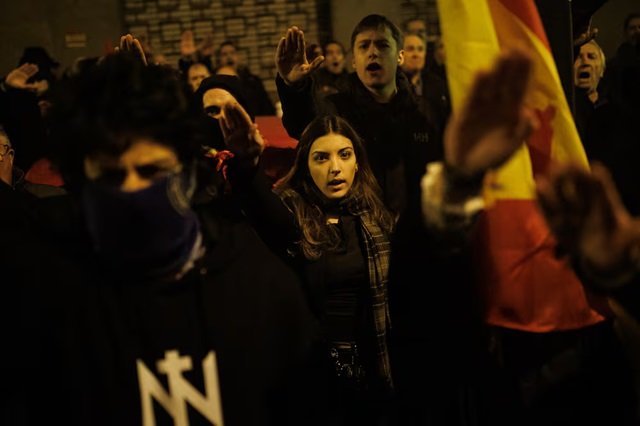
Private telephone conversations intercepted by Spain’s National Police have exposed the violent rhetoric, racial hatred and fascination with Nazi ideology within Núcleo Nacional, a neo-Nazi organisation whose leadership was dismantled in a series of arrests earlier this month. Among the most disturbing revelations are statements attributed to Isabel Peralta, one of the group’s leading figures, who told a friend that she wanted a son whom she could teach to use firearms and who would assault Black people. The recordings, obtained and reported by the Spanish newspaper El País, offer an account of the organisation’s internal discussions, personal rivalries, weapons culture and ambitions at a time when investigators were building a case against its members.
In a telephone conversation on 17 September, Peralta reportedly discussed her desire to become a mother, telling a friend that she wanted a boy so that she could teach him to handle firearms, including a German Mauser rifle. She subsequently explained that she preferred a male child because she wanted him to attack people and beat Black people. The conversation forms part of a collection of intercepted communications involving members of Núcleo Nacional that police obtained during their investigation. The recordings provide evidence of the language used by the group’s leadership in private, beyond its public activities and political messaging.
The conversations also reveal that Peralta had previously operated a security and property-eviction company, which she said she was forced to close after receiving a one-year prison sentence for hate-related offences. The conviction followed her participation in a 2021 demonstration outside the Moroccan Embassy in Madrid, when she was associated with the far-right organisation Bastión Frontal. She was convicted of hate crimes and incitement to discrimination. In a conversation with an acquaintance in August, she complained that she could no longer register business interests in her own name because doing so might expose her to further imprisonment.
Weapons appear repeatedly in the intercepted discussions. On 4 October, Peralta asked another member how much ammunition he had fired at a shooting range. He replied that they had used all the cartridges, prompting her surprise because there had reportedly been more than 200. According to the investigation by Gijón’s Court of Instruction No 1, Peralta kept 13 long firearms at her home in Pinto, near Madrid, together with dozens of ammunition boxes. The weapons reportedly included 10 rifles and three pistols. Investigators also found a declaration of allegiance to Adolf Hitler at the property.
One conversation on 30 September revealed the practical problems created by the firearms stored inside her home. Peralta complained to her partner that her dog mistook rifles placed on the floor for absorbent mats and urinated and defecated on the material. The exchange offered an unusually mundane glimpse into the domestic environment in which the weapons were kept. Her earlier public statements had already attracted controversy. In 2021, during a commemoration of the Blue Division, the Spanish volunteers who fought alongside Nazi Germany against Soviet forces during the Second World War, she declared that Jews were the enemy.
The recordings also document antisemitic hostility among other members of the organisation. In one conversation, Peralta’s boyfriend rejected the idea of holding an event at a particular venue because its owner was Jewish, using an antisemitic slur to describe him. After ending the conversation, he reportedly said he was going to an arms shop to collect a shotgun. Another exchange concerned a member whose psychological state appeared to worry Peralta. She told her partner that the individual seemed deeply troubled and had been staring at a swastika in his home with visible revulsion. Her boyfriend responded by suggesting that the member should be kidnapped and interrogated.
The group’s hostility was not confined to racial and religious minorities. Its conversations also reveal tensions involving former members, accusations of misconduct and fears of public exposure. Approximately a week before one of the recorded exchanges, senior figures reportedly discussed the possibility that a female member might file a sexual harassment complaint after being insulted and expelled from the organisation. One participant dismissed her potential allegations as retaliation for her removal. The recordings further indicate that members concealed their ideological affiliations when seeking to rent venues for events. Peralta’s partner admitted that they had presented themselves to one property owner as ordinary troublemakers rather than Nazis to avoid being rejected.
Violence against political opponents was another recurring subject. On 26 September, Peralta’s boyfriend told her that a man who owed him €30 had threatened him with a pointed object. Rather than expressing concern, she reportedly questioned why he had not struck the man in the head. In another conversation the following day, her partner described an encounter with a group of approximately 20 to 30 anti-fascists, saying that they had been followed and forced to run away. Peralta herself had complained about being pursued by members of rival groups.
The intercepted communications also reveal uncertainty about Núcleo Nacional’s future. Following a poorly attended event in Seville, Peralta speculated about the possible dissolution of the organisation and expressed frustration that other far-right groups might occupy its political space. She criticised Save Europa, another far-right organisation, for what she considered its excessively pro-Jewish position. Her partner rejected the prospect of dissolution and argued that the organisation needed better internal structures. He also suggested that a period of declining public support could be used to organise smaller, more private activities and demonstrations of strength.
Peralta’s dissatisfaction extended to the organisation’s internal leadership. In a conversation with a family member about a month before the arrests, she described a demonstration as a failure and criticised her own speech. She complained that members did not listen to her despite her confidence in her intelligence and analytical abilities. The relative advised her to record her speeches and publish them online to avoid criticism and internal jealousy.
The investigation culminated in the arrest of 14 members across Madrid, Asturias, Guadalajara, Pontevedra, Burgos and Alicante. Gijón’s Court of Instruction No 1 authorised the arrests as part of an investigation into alleged incitement to hatred, unlawful association and illegal possession of firearms. Those detained included Peralta, Enrique Lemus, whose death was subsequently announced by Núcleo Nacional on social media, and Iván R. Diez. The detainees were later released under precautionary measures, including the withdrawal of their passports and a prohibition on leaving Spain. Spain’s Juvenile Prosecutor’s Office had also begun investigating the organisation earlier this year.
The recordings published by El País provide a detailed account of the language and relationships within the group, while the judicial investigation will determine the legal responsibility of those involved. They also reveal how weapons possession, admiration for the Third Reich, antisemitism and threats of physical violence featured in conversations among its members. The distinction between the statements captured in the recordings, the allegations under investigation and any eventual judicial findings remains essential as the case proceeds.