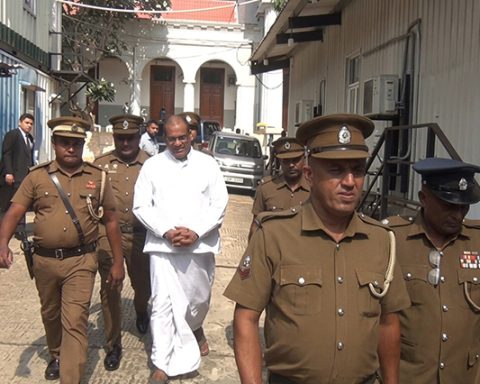
by Satchi Sithanandan
There is something almost theatrical about a man in a saffron robe standing up in a courtroom and telling a judge what the law ought to be. Courts are built precisely to prevent such theatre. Their authority depends on an arrangement that is both ancient and strangely fragile: one person speaks, another listens, lawyers argue, evidence is examined, and eventually a judge says what the law requires. The ritual works because everyone in the room accepts, at least provisionally, that the judge has the last word.
On 25 January 2016, at the Homagama Magistrate’s Court, Galagoda Aththe Gnanasara Thera broke that ritual. The case before the court concerned the disappearance of journalist Prageeth Eknaligoda. After the magistrate ordered that suspects in the case be further remanded, Gnanasara Thera, who was not a party to the proceedings, stood up and addressed the court. According to the evidence recorded by the Court of Appeal, he said that “war heroes” were being imprisoned while the Tigers were being released and demanded bail for the “war heroes”. He also said: “This is the English man’s law. We don’t accept it.” The magistrate warned him that he was obstructing the proceedings. The warning did not end the episode. He continued. When Senior State Counsel Dileepa Peiris intervened, Gnanasara called him an “impotent state officer”—“napunsaka rajya niladhariya”—and left the courtroom muttering about the Attorney General’s “impotent officer”.
Those words matter. But the words alone do not explain the sentence.
That distinction has been blurred repeatedly in public discussion of the case. It is tempting to reduce the entire affair to the proposition that a Buddhist monk insulted a judge and was given six years in prison. That is not what the Court of Appeal found. Nor is it accurate to say that he was sentenced to nineteen years in the ordinary sense. The court imposed four sentences—four years, four years, six years and five years of rigorous imprisonment—but ordered them to run concurrently. The effective sentence was six years. The four counts concerned, respectively, his unauthorised intervention and conduct prejudicial to the authority of the court; his statement that he would not accept the court’s orders and that the law should not be followed; his direction that the court grant bail to suspects; and his insult to Senior State Counsel Peiris.
The Court of Appeal’s reasoning was consequently broader than the language of abuse. It found that his conduct was deliberate and that he intended to intimidate the magistrate into making an order he wanted. The court described its duty in uncompromising terms: courts must be free from “all forms of intimidation and undue influence” so that they can administer justice. It also noted that Gnanasara had not apologised and had instead maintained that his conduct was lawful.
This is where the story becomes much larger than one Sri Lankan monk.
For contempt of court is not a peculiarly Sri Lankan invention, nor is the spectacle of a furious litigant or lawyer attacking the authority of a judge. The common-law world has been arguing about this problem for centuries. The extraordinary thing is not that courts punish contempt. They do. The extraordinary question is how far they should go, and who should decide when the line has been crossed.
One of the most revealing cases in the history of American law began with a courtroom that had almost lost its character as a courtroom.
In Mayberry v. Pennsylvania in 1971, Richard Mayberry represented himself during a 21-day criminal trial. He repeatedly insulted the judge. The Supreme Court’s record describes a man who accused the court of “railroading” him and who repeatedly vilified the judge during the proceedings. The trial judge eventually found contempt on eleven of the twenty-one trial days and imposed one to two years for each contempt—a staggering total of eleven to twenty-two years.
The sentence is important because it destroys a convenient myth. Six-year contempt sentences are not something that no court has ever contemplated. American judicial history contains an even more spectacular example.
But Mayberry is remembered not because eleven to twenty-two years became the accepted punishment for insulting judges. It is remembered for the opposite reason.
The United States Supreme Court vacated the judgment.
The problem was not that Mayberry’s behaviour was admirable. It was plainly not. The problem was that the judge who had endured the insults had also become the judge who punished them. The Supreme Court held that where the judge and defendant have become locked in a “running, bitter controversy”, due process may require another judge to hear the contempt case.
That principle contains a warning that reaches far beyond America. A judge possesses enormous power, and contempt gives the judiciary an especially sharp instrument: the power to punish behaviour directed against the very institution exercising the punishment. The danger is obvious. The court must defend itself without becoming the complainant, prosecutor, victim and sentencer all at once.
The American Supreme Court had made that point even earlier in Cooke v. United States, in 1925. There, a lawyer was punished for conduct connected with an attempt to challenge a judge’s authority. The Supreme Court did not abolish contempt. Instead, it insisted upon procedural safeguards. The contempt power, it said in substance, could be exercised swiftly when necessary, but that extraordinary power did not remove the need for fairness. The case became part of a line of authority insisting that contempt is a judicial power to protect the administration of justice, not a personal weapon.
That distinction became even sharper in Offutt v. United States.
The facts are almost painfully familiar. During a fourteen-day criminal trial, defence counsel and the judge became locked in an increasingly personal confrontation. The judge repeatedly warned the lawyer about his conduct. At the end of the trial, the lawyer was convicted of twelve instances of contempt and sentenced to ten days. The Court of Appeals reduced the sentence to forty-eight hours. The United States Supreme Court went further and ordered that the contempt charges be retried before a different judge.
The Supreme Court’s language is worth remembering. The contempt power, it said, was “wholly unrelated to his personal sensibilities”. The danger was that a judge might confuse an offence to himself with an obstruction of the law.
That is one of the great sentences in the history of contempt jurisprudence.
A courtroom is not supposed to protect the judge’s ego.
It is supposed to protect the process.
The distinction sounds philosophical until someone is actually standing in front of the bench shouting.
Then it becomes everything.
Consider In re Little, decided by the United States Supreme Court in 1972. Larry Little represented himself after the trial judge refused a request for a continuance. During his closing argument he accused the court of bias, said the judge had prejudged the case and described himself as a political prisoner. The judge held him in contempt and sentenced him to thirty days. As Little was being removed from the courtroom, he also called the judge an obscene name. The Supreme Court expressly described that language as “reprehensible”. Yet it reversed the contempt conviction because the statements in the circumstances had not actually disrupted the proceedings.
The Court then produced a sentence that should be printed above every judge’s bench:
“The vehemence of the language used is not alone the measure of the power to punish for contempt.”
And then came the sharper warning: the fires kindled by the language must constitute an “imminent” threat to the administration of justice. Judges, the Court said, are supposed to have “fortitude”.
This is not judicial softness. It is judicial self-discipline.
The court is powerful enough to survive an insult.
What it may not be powerful enough to survive is the normalisation of a courtroom in which nobody obeys the judge.
That was the problem in Sacher v. United States, another American case, and here the balance moved in the opposite direction. The trial lasted nine turbulent months. Eleven Communist Party leaders were prosecuted under the Smith Act. Their lawyers repeatedly obstructed the proceedings through what the record described as “persistent obstructive colloquies, objections, arguments” and numerous accusations against the court. There were forty contempt specifications. Sentences reached six months.
The Supreme Court upheld the contempt convictions at issue, but its language again carried a warning. It said that “Summary punishment always, and rightly, is regarded with disfavor”. The lawyers could not treat every adverse ruling as an invitation to insult or obstruct the judge, but neither was contempt supposed to become an instrument of judicial impatience.
That is the recurring paradox.
A court must sometimes be severe precisely because it must remain restrained.
If a judge never punishes deliberate obstruction, the authority of the court becomes ornamental. If a judge punishes every insult as though it were an attack upon the state itself, the courtroom becomes something else: a place where the judge’s personal authority is indistinguishable from the law.
British courts have wrestled with the same boundary.
In Re Duggan in 2022, David Duggan repeatedly interrupted a Family Court hearing and became abusive towards the judge. His language was spectacularly crude. He told the judge, “Get fucked”, and later said, “I’m not bothered what you say.” The High Court found his behaviour contemptuous because it was not simply rude: it involved repeated interruption, abuse and a refusal to respect the court’s authority. Yet the sentence was fourteen days, suspended for twelve months.
The contrast with the six-year Sri Lankan sentence is striking, although the cases are not factually identical.
In another recent English case, Re Hesketh, the behaviour was more frightening. Daniel Hesketh threatened the judge with physical violence, saying: “I swear to God now if I see you outside this courtroom, Judge, I am gonna punch the fucking lights right out of ya.” He also made threats involving the judge’s family. The court treated the threats as serious interference with the administration of justice and imposed four months’ imprisonment.
Again, the lesson is not that Britain is lenient and Sri Lanka is harsh. Legal systems have different statutes, constitutional arrangements and sentencing powers. The lesson is narrower and more useful: even conduct substantially more menacing than an insult can result in a sentence measured in months rather than years.
Australia offers another version of the same story.
In proceedings involving Stephen Maunsell in the Australian Capital Territory, he told magistrates, “You’re a bunch of corrupt c***s.” He was warned about his language. He continued to challenge the authority of the court and called another magistrate a “raving feminist”. The proceedings treated the conduct as contempt. But once again, this did not automatically translate into a multi-year prison sentence. The court considered the behaviour, the warnings, the subsequent apology and the question of whether the contempt could be purged.
There is something almost mundane about these cases when viewed together. Judges everywhere encounter angry people. Some shout. Some swear. Some accuse judges of corruption. Some refuse to sit down. Some threaten them. Some behave as though the courtroom were a television studio and the judge merely another participant in an argument.
The law does not respond to all of them in the same way.
That is because contempt is not an offence against manners.
It is an offence against the functioning of justice.
The old English case of R v. Gray, decided in 1900, illustrates the older version of the doctrine. Howard Gray published a vicious personal attack on Justice Darling after a criminal trial. Lord Russell described it as “personal scurrilous abuse of the judge as a judge”. Gray admitted that his language had been “intemperate, improper, ungentlemanly” and apologised. The case helped establish that public attacks on judges could, in the right circumstances, become contempt. But the long history that followed has steadily forced courts to confront a difficult question: when does criticism of a judge become an attack on justice itself?
Sri Lanka has its own uncomfortable history here.
In 2003, Anthony Michael Fernando was sentenced by the Supreme Court to one year’s rigorous imprisonment after a contempt episode in which, according to the subsequent United Nations record, he had repeatedly filed applications and, after being warned, “raised his voice and insisted on his right to pursue the application”. The Supreme Court order said he had persisted in disturbing proceedings and sentenced him to one year’s rigorous imprisonment.
The United Nations Human Rights Committee later examined Fernando’s complaint. It recorded his contention that the punishment was grossly disproportionate and raised serious concerns about the fairness of the contempt proceedings.
The Fernando episode is particularly relevant because it demonstrates that Sri Lanka itself has wrestled with the danger of disproportionate contempt punishment long before Gnanasara.
It also shows why a historical account cannot be written as a morality play in which one side always represents the dignity of the law and the other side always represents its enemies.
Courts can be defied.
Courts can also overreact.
Both propositions can be true at once.
And then comes Gnanasara.
The monk’s own words deserve to remain in the record, stripped of both hagiography and hatred. He did not quietly criticise the magistrate from outside the courthouse. He stood up after the remand order and declared that “war heroes” were being imprisoned while Tigers were being released. He demanded bail. He described the law as the “English man’s law”. And, according to the Court of Appeal’s findings, he continued after being warned that he was obstructing the proceedings. When State Counsel intervened, the language became personal: “impotent state officer”.
The Court of Appeal therefore had a stronger case than a court faced merely with an angry opinion.
The monk was attempting to intervene in a case in which he had no legal standing. The court found that he was seeking to influence the magistrate’s decision and that his conduct was intended to intimidate the magistrate into granting an order he wanted. The court also relied on the evidence of the magistrate, State Counsel and another lawyer, finding that their accounts corroborated each other.
That is why the sentence cannot honestly be described as punishment for a single sentence such as “This is English man’s law.”
But neither should the other extreme be adopted: that once a court labels conduct “contempt”, the severity of the punishment becomes self-justifying.
The sentence deserves its own question.
Why four years for the first count?
Why four for the second?
Why six for the third?
Why five for the fourth?
Why should four portions of one courtroom episode become four separate punishable contempts?
Gnanasara’s lawyers raised precisely such objections when they went to the Supreme Court. They argued that the four charges arose from a single incident, that the evidence did not establish some of the counts beyond reasonable doubt, and that the sentences were excessive compared with earlier contempt cases. The Supreme Court rejected the appeal by a majority in October 2018.
That appellate history matters because the six-year sentence was not simply the spontaneous anger of one magistrate. The Court of Appeal imposed it. The Supreme Court later declined the challenge. The case therefore belongs to Sri Lanka’s judicial history, not merely its political folklore.
But international history makes another point unavoidable.
In Mayberry, eleven to twenty-two years were imposed and then vacated.
In Little, an obscene insult did not survive Supreme Court scrutiny.
In Offutt, ten days became forty-eight hours before the Supreme Court ordered a retrial before another judge.
In Sacher, months of prolonged obstruction produced sentences of up to six months.
In England, repeated abuse in Duggan produced a suspended fourteen-day sentence, while explicit threats against a judge in Hesketh produced four months.
In Australia, courtroom abuse and allegations of corruption were treated as contempt without automatically generating years of imprisonment.
And in Sri Lanka, Fernando received one year for a much narrower episode that later came before the United Nations Human Rights Committee.
The numbers do not prove that Gnanasara’s six-year sentence was unlawful. They do something more modest and more valuable: they show that the sentence belongs at the severe end of the comparative history of contempt punishment.
That is a fact worth stating without apology.
There is another fact worth stating with equal bluntness.
The monk was not punished because he had an unpopular political opinion. Courts cannot properly become prisons for political speech merely because the speech offends a judge. Nor was he punished simply because he criticised the law as foreign. People are allowed to despise laws, campaign to change them and call them colonial relics.
What made the Homagama episode different, according to the Court of Appeal, was the setting and the purpose. He entered a live judicial proceeding in which he had no legal role, confronted the magistrate after an order had been made, demanded a particular judicial outcome, continued after warnings, and insulted State Counsel. The court found this to be deliberate intimidation and interference with judicial authority.
That is the record.
But the other half of the record is that contempt law has always frightened judges themselves.
The American Supreme Court’s warning in Offutt remains almost painfully relevant: the power is “wholly unrelated to his personal sensibilities”. Little says that the “vehemence of the language” is not enough. Mayberry says that a judge embroiled in a personal conflict may have to step aside. Sacher warns that summary punishment is properly viewed with disfavor. These are not anti-court principles. They are the judiciary’s own methods of protecting itself from becoming arbitrary.
The deepest history of contempt, therefore, is not really the history of people insulting judges.
It is the history of judges trying to answer a much harder question:
How much power should a court use to defend the power of courts?
Use too little, and the courtroom becomes a shouting match.
Use too much, and the courtroom becomes a place where authority is protected by fear.
Between those two failures lies the difficult discipline of judicial restraint.
That is why the Gnanasara case deserves neither hagiography nor caricature. The monk’s conduct, as found by the Court of Appeal, went well beyond an unfortunate sentence uttered in frustration. His recorded words were part of an intervention that the court found deliberate, coercive and disruptive. The conviction was upheld on appeal. The effective sentence was six years. Those are the facts.
But another fact belongs beside them.
A six-year rigorous-imprisonment sentence for contempt is not an ordinary international response to angry words. The world’s most influential common-law courts have repeatedly insisted that contempt punishment must remain tied to the actual obstruction of justice, that judges must guard against personal retaliation, and that imprisonment should not become a reflexive answer to wounded judicial dignity.
The monk therefore presents the judiciary with a paradox of its own.
He was punished because, according to the court, he attempted to make his authority count inside a room where only judicial authority could decide the matter.
But the court’s own authority is tested by what it does next.
A court does not prove that it is powerful merely by sending someone to prison.
It proves its power by demonstrating that the punishment belongs to the law, not to the temperament of the person wearing the robe.
That is the historical lesson running from Gray to Mayberry, from Little to Sacher, from Offutt to Duggan, and from Fernando to Gnanasara.
The question is not whether courts should punish contempt.
They must.
The harder question is whether, when they do, they can make the punishment itself look like justice.
And that is a question no judge, monk, lawyer, politician or citizen gets to escape.
***
P.S. — Where the Monk Stands Now: As this essay goes to publication, Ven. Galagoda Aththe Gnanasara Thera is once again in prison. On 5 October 2026, the Court of Appeal ordered the enforcement of the remaining period of the six-year rigorous-imprisonment sentence imposed on him in 2018 for contempt of court, following the Supreme Court’s 10 September ruling that the presidential pardon granted to him by former President Maithripala Sirisena in 2019 was legally invalid; Gnanasara Thera had been arrested after an open warrant was issued when he failed to appear in proceedings concerning enforcement of the sentence and was subsequently taken to Welikada Prison. On 6 October, prison officials produced him before the Colombo High Court in a separate case arising from statements he allegedly made about Islam on 12 April 2014, in which the Attorney General has charged him with offences concerning insulting religious beliefs and interference with religious harmony; the prosecution says it expects to call three witnesses and produce 13 items of evidence, and Colombo High Court Judge Buddhitha Sri Ragala ordered that Gnanasara Thera be produced again when the case is taken up on 23 October. He appeared in court in prison-issued clothing, amid a separate dispute over whether an ordained monk should be required to wear prison attire. The distinction is important: his present imprisonment is the enforcement of the old 2018 contempt sentence after the invalidation of the 2019 pardon, while the Islam-related case remains a separate, unresolved proceeding.