China is accelerating the development of ultra-deep oil and gas reserves as it seeks to expand domestic energy supplies amid global uncertainty, with advances in exploration and extraction technology enabling access to increasingly difficult resources.
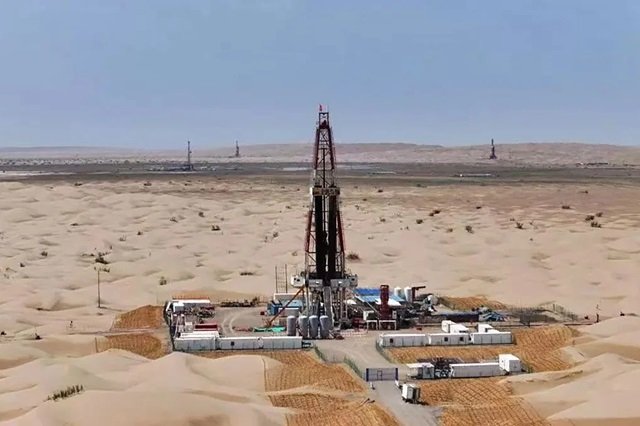
A major focus is the Hade-Fuman oilfield in the resource-rich western region of Xinjiang, where PetroChina has produced more than 26 million tonnes of oil equivalent from reservoirs located more than 6,000 metres underground, state broadcaster CCTV reported on Monday. Wells extending beyond 6,000 metres are generally classified as ultra-deep, where extreme underground pressure and temperatures make extraction particularly difficult.
Located in the Taklamakan Desert, the Hade-Fuman oilfield consists of the Hade and Fuman fields. PetroChina said Fuman, which contains more than one billion tonnes of oil and gas resources, was China’s largest ultra-deep oilfield. The reserves were discovered in 2021 after advances in geological understanding and exploration technology enabled the company to identify and access complex reservoirs at great depth.
PetroChina said it had developed specialised drilling equipment and technologies to exploit the Fuman field, allowing it to drill wells with an average depth of more than 8,300 metres. That distance is almost equivalent to the height of Mount Everest, the world’s highest peak.
The development forms part of a wider effort by China’s major oil companies to increase domestic oil and gas exploration as Beijing seeks to strengthen energy security. The importance of those efforts has increased amid global energy turbulence this year, with disruptions around the Strait of Hormuz, a major route for Gulf oil and gas exports, highlighting vulnerabilities in international energy supply chains.
Under a five-year plan for the oil and gas sector, China is targeting domestic production of 440 million tonnes of oil equivalent by 2030. The plan also calls for 20,000 kilometres of new long-distance oil and natural gas pipelines, taking the country’s total network to 220,000 kilometres. According to the source, that would be enough to circle the Earth more than five times.
China’s domestic production reached a record 420 million tonnes of oil equivalent last year, while crude oil output reached 216 million tonnes. The figures provide the basis for further efforts to increase production as the country develops resources that were previously considered more difficult to recover.
The push is also extending offshore. The Liuhua oilfield, off the coast of Zhuhai in Guangdong province, is among the latest projects to undergo development. Discovered in the late 20th century, the field has been redeveloped since late 2024, with advances in China’s deepwater technology helping improve extraction efficiency under challenging offshore conditions.
CCTV reported that cumulative crude oil production from Liuhua had exceeded two million tonnes as of Saturday, adding another source to China’s expanding effort to increase domestic oil and gas output.