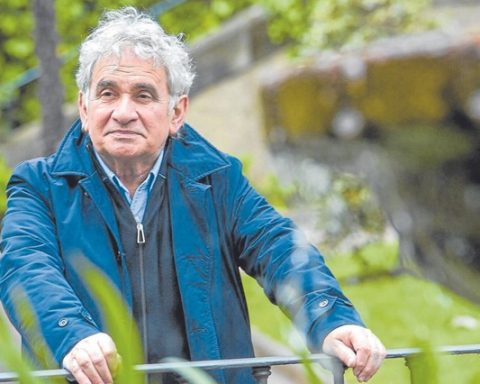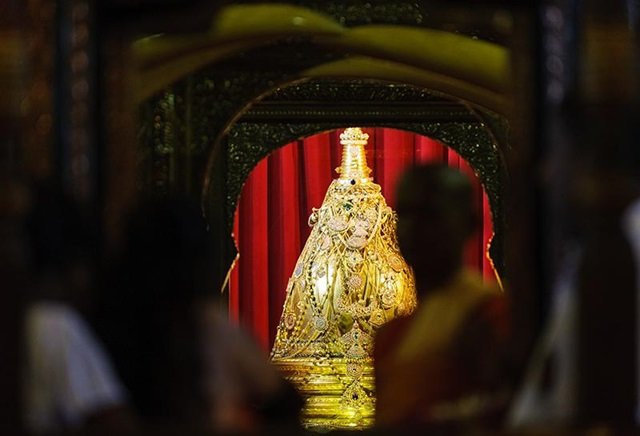
Sri Lanka’s Director General of Archaeology, Senior Professor Anura Manatunga, has said the nearly 300-year-old gold-plated casket formerly used to house the Sacred Tooth Relic at the Sri Dalada Maligawa in Kandy should be treated and preserved as an archaeological heritage artifact, amid a debate over its replacement with a solid gold casket.
Speaking to local media in an interview with “Aruna”, Manatunga said he had personally inspected the matter after receiving an official written inquiry issued under the instructions of the Secretary to the Ministry. He said he visited the Sri Dalada Maligawa, where the Mahanayake Theros of the Asgiriya and Malwatte Chapters and the Diyawadana Nilame explained the circumstances surrounding the casket.
The Director General said his role was to compile the facts concerning the incident and submit them to the Ministry Secretary. “That report was handed over to the Ministry Secretary on the same day,” he said. The matter, he added, was linked with the President’s Office. He said he did not know what action the Ministry Secretary had subsequently taken and could not comment publicly on the investigation or inquiry.
The dispute has centred partly on whether replacing the gold-plated casket with one made of solid gold affected the value associated with the Sacred Tooth Relic or the object used to house it. Manatunga distinguished monetary value from archaeological and heritage value, arguing that the significance of the older casket cannot be assessed simply according to the quantity or price of gold it contains.
“It is true that gold has monetary value. However, if we evaluate value based purely on monetary worth, then nothing matters other than money,” he said. From an archaeological perspective, he said, the casket is an artifact nearly three centuries old and possesses both historical and artistic value. “Therefore, from an archaeological perspective, that casket must be considered a heritage artifact and preserved.”
The interview also touched on speculation that the solid gold casket may have been produced using gold melted down from the older object. Manatunga did not confirm that claim. Instead, he focused on the archaeological status of the earlier casket and the distinction between its material value and its wider heritage significance.
The discussion comes as the Department of Archaeology continues programmes to identify and document sites across Sri Lanka, including areas of the North and East. Manatunga rejected the view that archaeological preservation in those regions should be treated simply as more difficult than in the South, pointing to surveys conducted using GPS technology to establish the locations of archaeological sites.
Those surveys covered ancient Buddhist temples, historic ruins and ancient settlements. According to Manatunga, researchers travelled considerable distances into dense forests to investigate sites and identify those with genuine historical value. The findings indicated that some archaeological sites in the North and East date back more than 3,000 years, providing further evidence of the long historical record of those regions.
Tourism is another area in which the department intends to expand the use and presentation of archaeological heritage. Manatunga said sites such as Sigiriya, Polonnaruwa, Dambulla, Anuradhapura, Kandy and Galle already serve as major attractions for foreign visitors, but argued that many other sites across the island could also be developed. Better infrastructure, accessibility and visitor facilities, he said, could improve the experience for tourists while maintaining the protection and preservation of sacred and historic places.
Manatunga also addressed criticism that the Department of Archaeology has failed to prevent looting and destruction of valuable antiquities. He said the scale of the responsibility was substantial, noting that the Antiquities Ordinance No. 9 of 1940 classifies any object more than 100 years old, or possessing historical and cultural value, as an antiquity.
There are thousands of registered archaeological sites across Sri Lanka, he said, alongside many more that have not yet been formally documented. With limited manpower and resources, the department works with law-enforcement authorities and local communities to protect them. Public awareness and cooperation, he said, remain important in preventing illegal excavations and the smuggling of artifacts.
The department is also implementing “Urumaya” — a nationwide programme intended to identify, document, preserve and manage Sri Lanka’s archaeological heritage. Manatunga said the programme covers sites associated with Buddhist, Hindu, Islamic and Christian traditions, while also introducing professional qualifications under the National Vocational Qualification framework for workers in archaeology. The aim is to raise conservation standards and develop a skilled workforce for heritage management.