by Alebrt Silva
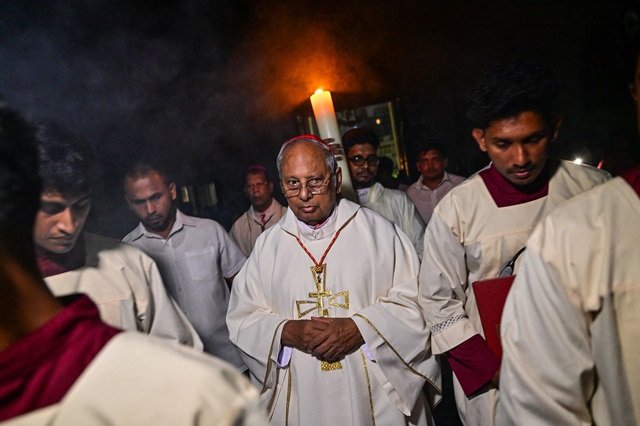
Do you know? “No girls should be invited to serve at the altar.” That was Cardinal Malcolm Ranjith’s instruction to priests of the Archdiocese of Colombo in October 2024. He said altar serving should remain a boys’ role because it is an important source of priestly vocations. His reasoning was blunt. Altar servers can become priests. Priests are male. Therefore, girls should be kept away from the altar. “It should always be young boys” he said. He also told priests that this was not something they could change at their own discretion. The wider Catholic Church had already recognised that girls may serve at the altar, yet Ranjith chose the more restrictive course for Colombo. That decision does not prove a political conspiracy. But it reveals a highly centralised conception of Church authority in which discipline and hierarchy take precedence over local discretion. The question becomes more serious when the same authority enters national politics and religious legitimacy becomes a source of political influence.
Since the Easter Sunday attacks of 2019 Ranjith has become one of Sri Lanka’s most powerful religious voices. His demand for truth and justice is legitimate. The dead deserve justice. The wounded deserve justice. The families deserve justice. But seeking justice is not the same as turning an unresolved theory of political responsibility into a permanent foundation of institutional authority. Sri Lanka must therefore ask whether the continuing search for an alleged mastermind has also become an institutionally useful source of political power. That question requires evidence, not slogans. It requires a transparent chronology and full financial accountability. In 2024 Ranjith himself said that approximately Rs.500 million had been collected for Easter victims and approximately Rs.460 million distributed. He also said audited bank reports existed and were available for verification. That creates a straightforward question. Where are those accounts and what do they show? Victims’ identities must remain protected, but aggregate receipts, expenditure, administrative costs and balances can be disclosed. If audited records exist, independent verification should not threaten the Church. It should strengthen its credibility. The government’s Office for Reparations has demonstrated that substantial sums can be accounted for while protecting beneficiaries’ privacy.
This is where the mastermind question becomes morally dangerous if it becomes an instrument of permanent authority. An unresolved theory can sustain political attention indefinitely. Every unanswered question becomes another demand. Every missing link becomes another reason to continue the campaign. None of this proves that Ranjith deliberately created a mastermind theory for personal advantage, nor does it establish financial misconduct. Those are matters requiring evidence. But the public is entitled to ask whether the continuing political consequences of the unresolved Easter question have strengthened the Archbishop’s institutional authority. His interventions have increasingly extended beyond pastoral advocacy into national political controversy, while the Catholic Bishops’ Conference has continued to support his campaign for truth and justice. The Easter question has therefore become deeply embedded in the public authority of the Catholic hierarchy.
Christianity demands another question. What happens when the pursuit of justice becomes inseparable from the preservation of institutional power? What happens when criticism of a religious leader is treated as criticism of the Church itself? What happens when loyalty to hierarchy begins to replace accountability to the Gospel? These are theological questions as much as political ones. Christ washed feet. He warned against the pursuit of honour. He condemned religious leaders who imposed burdens on others while protecting themselves. He taught that greatness comes through service. Christian authority is therefore not ownership. It is stewardship. It is sacrifice. It is accountability before God.
When religion becomes a mechanism for protecting prestige rather than serving the vulnerable, something has gone profoundly wrong. When political influence becomes more important than repentance, the Church risks confusing the Cross with the throne. When the suffering of victims becomes a permanent political resource rather than a sacred responsibility, the Gospel itself risks being instrumentalised.
This is why 15 November 2027 carries such symbolic significance. Ranjith was born on 15 November 1947 and will turn eighty on that date. Reaching eighty does not automatically remove him as Archbishop of Colombo. The Pope decides when an episcopal resignation becomes effective. But eighty has a separate significance. Under the rules governing papal elections, a cardinal who has reached eighty is no longer a cardinal elector. His theological authority and public voice do not disappear, but he loses the particular power to vote in a conclave. The date is therefore an important institutional milestone, even though it is not itself a canonical retirement date.
So let us not wait until November 2027 to ask questions that should already be answered. Let us not kill the victims’ search for justice. Let us kill the political exploitation of an unanswered question. Let us kill the culture in which religious authority becomes immune from financial scrutiny. Let us kill the assumption that questioning a cardinal is an attack on Catholicism. If a mastermind exists, find him. Name him. Prosecute him. Establish the evidence in court. If there was political interference, prove it. If there were hidden networks, expose them. If there was institutional negligence, document it—without removing your own men from the list. But if after seven years the word “mastermind” has become more powerful than the evidence, Sri Lanka has another problem. An unresolved tragedy may have become a permanent political theology.
The Christian test is brutally simple. Truth must remain truth even when it damages the institution’s reputation. Money received in the name of suffering must be accounted for even when accounting embarrasses the powerful. Victims must be served even when their pain no longer generates headlines. Priests must be treated as brothers rather than instruments in factional struggles. Bishops must remember that authority is not ownership. It is stewardship. No ecclesiastical office makes a man the owner of truth. No political campaign can turn an allegation into a fact. No religious language can transform power into holiness. The Christian faith contains a final judgement against such confusion. Every account must eventually be opened. Every secret eventually faces the light. Every exercise of power eventually faces judgement. The sins of the powerful do not become righteous because they are committed beneath a cross. They remain sins. And if the Church wishes to speak credibly about justice for Easter, it must be prepared to submit its own power to the same uncompromising standard of truth.