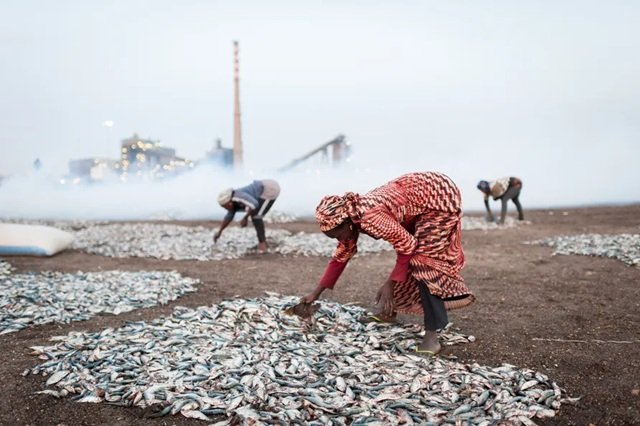
Governments and seafood companies have promoted fish farming as a more sustainable way to feed a growing global population, arguing that raising fish reduces pressure on wild stocks. But a five-year investigation by the German newspaper Die Zeit, conducted in collaboration with the Washington-based non-profit journalism organisation The Outlaw Ocean Project, has found that the industry’s dependence on fishmeal and fish oil can intensify fishing pressure, divert food from vulnerable communities and conceal environmental damage and labour abuses along international supply chains.
The investigation, involving more than 70 reporters working across more than a dozen countries, examined a global industry that generated $371 billion in fish and seafood production in 2024. More than half of the fish and seafood consumed worldwide now comes from aquaculture rather than wild catches. Yet many popular farmed species, particularly salmon and prawns, depend on feed made partly from wild-caught fish that could otherwise be consumed directly by people.
Germany, which imports more than 80 per cent of its fish requirements, illustrates the contradiction. At an EU Agriculture and Fisheries Council meeting in Luxembourg on 22 June 2026, German Agriculture Minister Alois Rainer of the Christian Social Union argued that aquaculture should be prioritised as an important food-production sector. His ministry advocated easier permits for fish farms and a central contact point for producers. Previous German governments had also promoted aquaculture for its environmental potential, describing sustainable fish farming as a possible contributor to regional, climate-friendly and healthy diets.
However, the investigation found that the feed required by many farmed fish complicates these claims. More than a fifth of wild-caught fish worldwide is used for purposes other than direct human consumption, principally to produce animal feed. A 2017 study co-authored by fisheries scientist Daniel Pauly of the University of British Columbia found that at least 90 per cent of fish processed into fishmeal and fish oil was suitable for human consumption. In some production systems, as much as six kilograms of wild fish may be required to produce one kilogram of farmed salmon when fishmeal, fish oil and unusable bycatch associated with obtaining feed are included.
“The advertising promise of the aquaculture industry is simply false,” Pauly told Die Zeit. He argued that any assessment of the sector’s environmental and social consequences must begin with the feed rather than the fish farm itself.
The investigation mapped at least 1,400 fishmeal factories across 65 countries and more than 2,400 vessels supplying them. Almost 10 million people live close enough to fishmeal plants to smell their emissions. Researchers documented at least 50 deaths and injuries associated with the industry, including cases involving sailors exposed to toxic gases from decomposing fish. Satellite analysis also identified vessels entering foreign territorial waters or transferring catches at sea.
West Africa emerged as a particularly significant centre of production. In Senegal, fishmeal factories increasingly compete with local communities for small fish traditionally sold fresh, smoked or dried. These species provide an important source of protein and omega-3 fatty acids, particularly for poorer households. The United Nations Food and Agriculture Organisation classified bonga and two species of sardinella across north-west Africa as overexploited in 2023, describing the two sardinella stocks as being in a critical condition.
Senegal had at least nine fishmeal factories in 2024, according to the investigation. Although some licences restrict production to fish waste and processing remnants, workers and former employees reported that whole, fresh fish were also being processed. In February 2025, an Outlaw Ocean Project reporter filmed deliveries of several tonnes of fresh fish, including large quantities of flat sardinella, to an Omega Fishing plant in Joal. The company did not respond to requests for comment.
The economic consequences extend beyond fishing stocks. Between 2009 and 2018, the quantity of small schooling fish available in Senegal’s local markets fell by a third, while per-capita consumption halved. Between 2019 and 2025, prices for fresh and dried fish more than doubled as fishmeal exports increased. In 2023, when exports reached an eight-year high, more than one million people experienced hunger at crisis levels for the first time, according to the investigation. Researchers cited studies linking the expansion of fishmeal production to worsening food insecurity.
Similar problems were documented in Mauritania, Peru, Russia, Thailand, Turkey and Norway. In Mauritania, activist Ali Bakar spent 58 days in detention after accusing a Turkish trawler of probably engaging in illegal fishing in a protected national park. Satellite images and videos subsequently supported his allegations. In Peru, residents near fishmeal factories in Chimbote reported severe odours and pollution. An explosion at an Exalmar factory on 7 August 2023 shattered windows and prompted protests, although the company later described the incident as an internal operational event without external consequences.
The investigation also documented alleged labour abuses aboard fishing vessels and in processing facilities. In Russia, workers reported withheld wages and dangerous working conditions at remote facilities. In Thailand, where fishmeal supports a major prawn-farming export industry, the United States Department of Labour added Thai fishmeal, fish oil and animal feed to its list of goods associated with forced labour in September 2024.
Certification schemes have not necessarily resolved these problems. The investigation examined 559 seafood companies that promoted their products as ethical or sustainable and found documented misconduct or crimes somewhere in the supply chain of more than half. Audits often failed to cover the vessels and factories supplying fishmeal, while inspectors relied on information from companies they were assessing.
The industry disputes the wider criticism. The International Fishmeal and Fish Oil Organisation says the proportion of fishmeal in aquaculture feed fell from 23 per cent in 2000 to eight per cent in 2020. Its spokesperson, Véronique Jamin, described fish farming as “the most efficient system for producing animal protein”. However, rapid growth has meant that overall consumption of fishmeal and fish oil can still increase. An investor network, Fairr, found that five major salmon producers used up to 39 per cent more fishmeal and fish oil from whole wild fish in 2024 than in 2020.
Alternatives, including seaweed, insect larvae and proteins derived from fungi and bacteria, remain difficult to produce cheaply at scale and may lack nutrients such as omega-3 fatty acids. Meanwhile, the European Union is due to prohibit trade in goods produced using forced labour at any stage of their supply chains from 14 December 2027. Whether enforcement will extend effectively to the fishing vessels supplying fishmeal remains uncertain.