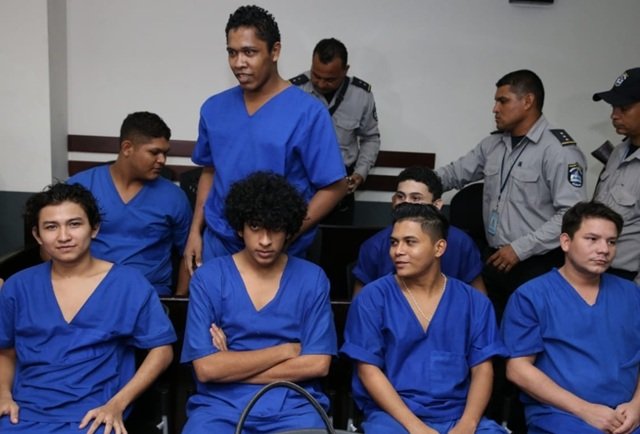
On 1 October 2026, Jeffrey Isaac Jarquin, a 35-year-old Nicaraguan man, was deported from the United States by ICE and, on arrival in Managua, was immediately sent to prison by Nicaraguan authorities. Reports described him as a “torture victim,” a “political prisoner,” and a “prominent figure in the anti-government protests” that occurred in Nicaragua in 2018. His story was covered by the Washington Post, CNN, ABC News, The LA Times and other outlets. It featured on Democracy Now and he received support from the former head of Human Rights Watch, Kenneth Roth.
Not one of the reports, however, investigated Jarquin’s role in those “protests” nor recorded that in November 2018, he was found guilty of various acts of terrorism and sentenced to more than 16 years in prison.
“Tortured” or “torturer”?
Who is Jeffrey Isaac Jarquin, the man being championed by corporate media?
In April 2018, protests began in Nicaragua which were part of a U.S.-led and funded coup attempt. Since the protests were ostensibly “student-led,” several universities in Managua were occupied and used as command centers by paid criminals whose financing originated from USAID and the National Endowment for Democracy.
In May 2018, the authorities of Nicaragua’s free National Autonomous University (UNAN) announced that it had been forcefully occupied by outsiders. One of these was Jarquin, known colloquially as El Nene (“The Baby”). Anti-government groups were filmed in the university carrying firearms and using its facilities to make explosives. During the occupation they fired at vehicles carrying government supporters on a neighboring highway, wounding several (one, Carlos Sanchez, testified from his hospital bed). They also burned down university buildings, including the nursery. Photographic evidence collected afterwards showed in detail the destruction of the UNAN and the weapons recovered there.
President Daniel Ortega, speaking on July 19, 2018, described the UNAN and other occupied universities as “torture centers.” The university students’ union later made a detailed denunciation, pointing out that their leader had been left for dead by opposition thugs.
Arrest, conviction and amnesty
Jarquin was soon arrested and in November 2018 was convicted, along with eight others, of damage and destruction of the UNAN facilities, burning down the childcare center, blocking traffic and disturbing public order, robberies with intimidation, using university building 68 to torture people whom they considered infiltrators, and carrying illegal firearms. Although Jarquin was later sentenced to over 16 years in prison, he served only nine months.
In June 2019, Jarquin was released along with 55 other prisoners in a general amnesty for those who committed crimes during the coup attempt. The amnesty, however, was conditional: if released prisoners re-offended, they were subject to being put back in prison to carry out their original sentences.
Asylum seeker
A year later, Jarquin was briefly detained by Nicaraguan police on suspicion of selling drugs. He then seems to have made his way to the U.S. southern border as an undocumented migrant and claimed asylum. In early 2026, U.S. authorities rejected his asylum claim, following which he was subject to a deportation order.
During his time in the U.S., Jarquin advertised his services in helping Nicaraguans obtain legal residency and political asylum as well as selling Nicaraguan passports, which he bragged about publicly on X (see photo). On February 13, 2026, Jarquín was arrested in Miami and charged with battery following an alleged assault in Little Havana. Although the case didn’t proceed, Jarquin was transferred to ICE custody and deported.
Deficiencies in reporting
We do not pretend to pass judgment on Jeffrey Jarquin and certainly do not condone the way that he and other migrants have suffered at the hands of ICE. It should also be noted that, of more than 6,000 Nicaraguans deported to their country so far this year, the vast majority have been welcomed by Nicaraguan authorities on their arrival and helped to return to their families.
Rather, our argument is about the way that the reporting of Jarquin’s case reflects the unquestioning attitudes of corporate media in its coverage of Nicaragua. Every one of the reports had two glaring deficiencies.
First, Jarquin’s portrayal of himself as a torture victim was accepted as fact, something that would not have occurred without further investigation if his claims had related to the U.S. or to another Western country. Yet, while Nicaraguan opposition media (in most cases, funded by U.S. agencies) have convinced human rights bodies to accept the torture narrative as true, there was plenty of contrary evidence from the time when Jarquin was in a Nicaraguan prison.
For example, the Inter-American Commission on Human Rights, Nicaragua’s own human rights commissioner, and a Nicaraguan parliamentary commission all separately investigated torture allegations in 2018, inspecting prisons and interviewing “political” prisoners. All found no truth in the claims after their visits, even though the IACHR changed its stance later.
Second, reports on Jarquin’s case ignored plentiful evidence that Nicaragua’s universities – including the UNAN – were used as torture centers by the opposition. The Grayzone’s Max Blumenthal, the first international journalist to report from Nicaragua after the coup came to an end in July 2018, visited the UNAN, interviewed displaced students and photographed the destruction:
“Western media paints Nicaragua’s opposition as basically peaceful, democratic victims of unprovoked repression. I visited UNAN today, a public university in Managua they occupied & ransacked. They burned this campus childcare center before they were driven out by police on 7/13.”
The violence at the UNAN was hardly exceptional. A detailed critique of Amnesty International’s reporting on the Nicaragua coup attempt, Dismissing the Truth, provided detailed evidence of killings and torture by opposition operatives and contrasted their findings with false testimony in Amnesty’s reports. As authors, we have met torture victims ourselves and verified their claims.
Manufacturing consent
There is therefore no excuse for lax reporting by media such as the Washington Post, CNN or the LA Times. There is even less excuse for the biased analyses presented by what international lawyer Alfred de Zayas calls “the Human Rights Industry”, because the key organizations have been sent detailed refutations of their reports by groups such as the Nicaragua Solidarity Coalition.
But it seems corporate media are willing participants in helping to manufacture consent for regime change in Nicaragua, knowing that they have successfully persuaded their readers that it is a “brutal dictatorship.” At a time when Nicaragua’s sovereignty and its revolution are under increasing threat, propaganda like that surrounding Jarquin’s deportation can be expected to increase.