Spain’s far-right extremist scene has produced organisations that thrive on provocation, online propaganda and street mobilisation. But Núcleo Nacional, a neo-Nazi group dismantled by judicial order in November, sought to move beyond demonstrations and digital agitation. According to police investigations and telephone intercepts obtained by EL PAÍS, its members discussed an armed seizure of power, accumulated an arsenal that included assault rifles, organised surveillance of law-enforcement agencies and pursued paramilitary contacts abroad.
The group’s ideological commitments were not merely rhetorical. In one conversation on 7 October, a member suggested that the organisation should reconsider its openly antisemitic approach if it wanted to gain political power. “We cannot use the same tactics as in 1930. The Jews have learned,” he argued. Isabel Peralta, the group’s leading ideologue, rejected the proposal, invoking Adolf Hitler’s refusal to compromise and insisting that “the Jewish question is the Jewish question”. The exchange, reported by EL PAÍS from police intercepts, illustrates the extent to which antisemitism remained central to the organisation, even as some members considered whether it might obstruct their ambitions.
Núcleo Nacional emerged from the nationalist and far-right demonstrations outside the Socialist Party’s headquarters on Madrid’s Ferraz street in November 2023. The protests opposed the government’s amnesty agreement with Catalan separatists. Among the demonstrators was Iván Rico, a neo-Nazi known as El Rana, who began developing the organisational structure that would become Núcleo. He approached Peralta, then 22, who had previously been associated with Falange and Bastión Frontal, two organisations in Spain’s far-right milieu.
Peralta brought ideological visibility and an established reputation within extremist circles. Germany had barred her entry in 2022 after she carried a copy of Hitler’s Mein Kampf, while a Spanish court had sentenced her to one year in prison for a hate crime connected with a 2021 protest outside the Moroccan embassy in Madrid. A source familiar with the movement told EL PAÍS that Rico was highly radicalised and that Peralta was used because of her influence among far-right activists.
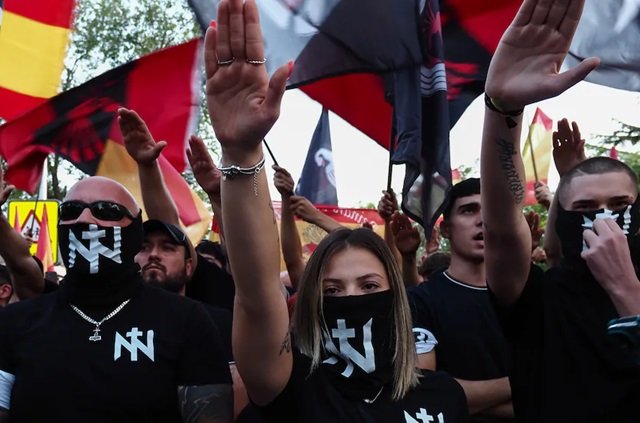
The group’s expansion depended heavily on social media. Videos featuring masked teenagers carrying torches and marching in formations modelled on Nazi-era spectacles attracted millions of views. A source quoted by EL PAÍS compared the person responsible for the digital strategy to Joseph Goebbels, Hitler’s propaganda minister. The imagery was designed to convey discipline, militancy and collective strength, helping the organisation recruit young followers and attract older figures from Spain’s neo-fascist networks.
Among those who joined was Enrique Lemus, a lawyer and sociologist formerly associated with Democracia Nacional, who died shortly before the investigation was published. Another recruit, Jesús Ruiz, helped attract teenagers through the Asturias-based White Boys association. Some recruits were reportedly as young as 14. Members travelled across Spain to establish the group’s presence and draw supporters from the remnants of organisations such as Bastión Frontal.
By August 2024, Núcleo had registered itself as an association and subsequently established branches in Madrid, Murcia, Valladolid, Barcelona, Asturias, Burgos and Valencia. The Valencia branch alone reportedly had around 200 members. Recruits were required to take an 11-point oath, including a commitment not to have sexual relations with people outside the so-called European race. The organisation also developed procedures intended to identify police officers and anti-fascist infiltrators. A counter-surveillance unit reportedly had 260 members and was tasked with monitoring the activities of Spain’s security forces.
The group also sought to protect itself against potential legal action. To reduce the risk of being outlawed as an association involved in hate crimes, its members registered a political party under the name Noviembre Nacional, referring to the month in which the Ferraz protests had taken place. Its public campaigns against immigration helped sustain its visibility, while some leaders began appearing without the masks that had characterised its earlier demonstrations.
Yet the organisation’s financial foundations were less clear. It reportedly relied on clothing sales and monthly membership payments of €50, €20 and €10. Sources familiar with the far-right scene questioned whether these revenues could sustain El Nido, a substantial headquarters in Madrid’s Las Tablas district. One veteran extremist acknowledged to EL PAÍS that organisations of this kind could not survive solely on contributions from their members.
Its ambitions also extended beyond Spain. Núcleo joined the Pan-European Struggle for a Europe of Nations, a network bringing together 15 organisations, including Der Dritte Weg in Germany, Prevrat in Croatia and Triangle Noir in France. Its leaders considered links with Save Europe, a far-right network campaigning against immigration and what it describes as the continent’s “ethnic suicide”. Peralta reportedly rejected the possibility of softening the group’s antisemitism even in exchange for substantial financial support.
More concerning were the reported connections with Ukraine. According to investigators, members travelled there for paramilitary training involving AK-47 rifles and maintained contact with the 12th Special Forces Brigade Azov, a unit formed in 2014 during the war in Donbas and now part of Ukraine’s National Guard. Telephone intercepts cited by EL PAÍS also recorded a Núcleo leader repeating antisemitic claims about Ukrainian authorities and Jewish communities. These statements reflect the group’s own rhetoric; they do not independently establish the nature or extent of any relationship with the Ukrainian military unit.
Police investigators intensified their scrutiny after examining the organisation’s foreign contacts and discussions about an armed coup. The investigation also exposed the group’s weapons holdings. Peralta, according to a separate EL PAÍS report, had 13 long firearms at her home in Pinto, near Madrid, including 10 rifles, as well as three pistols and a declaration of allegiance to Hitler.
The group’s leadership appeared to regard controversy as evidence of ideological commitment rather than a political liability. Peralta reportedly boasted to followers about her record of antisemitic statements and the attention they had attracted from organisations monitoring anti-Jewish extremism. Even as the leadership discussed the possibility of the organisation’s dissolution, it rejected the idea of abandoning antisemitism to broaden its political appeal.
The dismantling of Núcleo Nacional therefore exposed more than the activities of a small extremist organisation. It revealed an attempt to combine online recruitment, youth mobilisation, formal political structures, international networking and preparations for violence within a single movement. Its leaders debated how to acquire power, but remained unwilling to reconsider the ideology that defined them. The result was an organisation whose ambitions reached well beyond street protest, and whose internal conversations, as documented by EL PAÍS, provide a disturbing account of how contemporary neo-Nazi networks seek to organise, recruit and prepare for confrontation.