Germany’s struggling Free Democratic Party (FDP) faces a political problem that goes beyond declining electoral support: it is struggling to explain what liberalism can offer a generation increasingly concerned about affordable housing, economic insecurity, education and its relationship with the state. That contradiction became apparent during a debate in Berlin between FDP chairman Wolfgang Kubicki and Marxist commentator Wolfgang M. Schmitt, where the future of liberalism was examined against the backdrop of youth protests spreading across Europe.
The discussion took place at the Philo.live! philosophy festival, held at the Silent Green cultural centre in Wedding, a former crematorium. Its setting provided an unusually appropriate backdrop for a debate about the possible death of liberalism. Kubicki, who assumed leadership of the weakened FDP in May, appeared determined to defend the party’s intellectual foundations, even as the questions raised during the event exposed the difficulties of translating those principles into convincing political answers.
The exchange, moderated by philosopher Wolfram Eilenberger, lasted approximately 90 minutes and moved quickly from freedom of expression to economic opportunity, compulsory military service and the changing expectations of younger generations. Kubicki adopted his familiar confrontational style, opening with the declaration: “Wo ich bin, ist vorn” — where I am, is the front. Yet the more consequential moments came when he was challenged to explain how liberalism could address problems that cannot easily be resolved through individual initiative or market competition.
Freedom of expression was among the first issues to generate disagreement. Schmitt questioned whether the FDP consistently defended the principle, particularly when political speech came from groups whose positions were unpopular. He pointed to the party’s apparent lack of support for the right of pro-Palestinian activists to express their views. He also recalled that Kubicki had called on prosecutors two years earlier to investigate comedian Sebastian Hotz, known as El Hotzo, following a controversial social media post about the attempted assassination of Donald Trump.
Schmitt asked whether Kubicki should therefore be prepared to represent Hotz legally to protect his right to express an opinion. Kubicki responded that he would do so if Hotz appointed and paid him as his lawyer. The exchange illustrated the distinction between defending freedom of expression as a political principle and accepting the practical responsibilities that accompany its application, particularly when the speech involved is controversial.
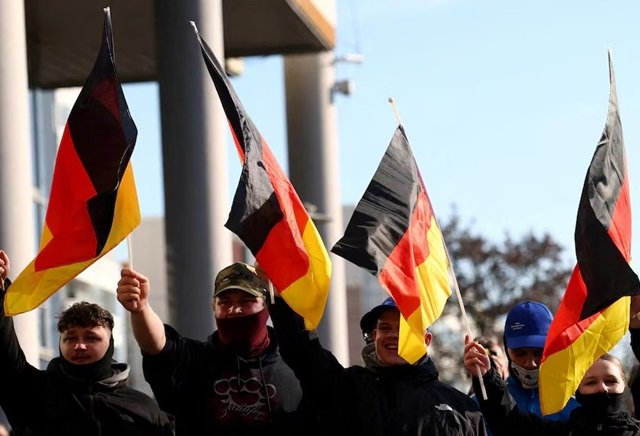
The debate became more revealing when it turned towards the concerns driving younger people into public demonstrations. Housing affordability, government debt, educational opportunities, compulsory military service and the weakening promise of social advancement were all raised. These are issues that have increasingly challenged established political parties across Europe, while exposing the limitations of traditional ideological divisions.
The FDP once appeared particularly well positioned to attract younger voters. In the previous but one federal election, it achieved its strongest result among first-time and young voters. Its appeal had been reinforced by opposition to some of the restrictive measures introduced during the coronavirus pandemic, which had disproportionately affected younger people. The party seemed to possess an opportunity to build a new generation of liberal supporters around individual freedom, personal autonomy and resistance to excessive state intervention.
Yet that potential has not translated into a sustained political movement. As the discussion suggested, a renewed liberal programme would need to connect freedom with the material conditions that determine whether individuals can actually exercise it. Affordable housing, independent digital infrastructure and the ability to shape one’s own future could provide the foundations for such a project. Without these elements, the promise of personal freedom risks becoming an abstract political slogan.
Kubicki acknowledged some of the frustrations experienced by younger people but resisted aligning himself with the Gen Z protest movement. He described a recent visit to the lecture hall of his former university, which he found almost unchanged after four decades apart from the addition of a ceiling-mounted projector. The experience prompted him to question why educational environments had changed so little. He also expressed scepticism towards young people who, in his account, had become convinced that there was little reason to work hard because the world was destined to burn by 2050.
His reluctance to embrace the protests was striking because the discussion revealed considerable common ground between him and Schmitt. Despite their different political traditions, both repeatedly returned to the question of individual autonomy and the relationship between citizens and collective authority. Schmitt, however, approached the issue through a suspicion of obligations imposed on individuals, while Kubicki defended personal responsibility, market confidence and individual freedom.
Their disagreement became particularly clear during the discussion of compulsory military service. Schmitt argued that young people were increasingly recognising that their personal identities and interests should not automatically be subordinated to the objectives of the state. Liberalism, he maintained, must protect the right to refuse military service, including the possibility of fleeing or deserting during wartime.
Kubicki rejected that position, arguing that national defence was not simply a matter of patriotism but a question of the state’s ability to preserve itself. His response was blunt: “Der Liberalismus endet dort, wo Sie erschossen werden” — liberalism ends where you are shot. The exchange exposed a fundamental tension within liberal political thought: how far individual freedom can extend when the survival and security of the state are at stake.
The difficulties confronting the FDP were also reflected in an internal strategy document circulated during the same week. According to the report in Die Zeit, the document acknowledged that the party had suffered a substantial loss of public visibility and trust, with its electoral base eroding and its finances under pressure. Its position outside the federal parliament had further restricted its ability to attract attention. The party has set a target of reaching seven per cent in national opinion polls.
The stakes are particularly significant ahead of elections scheduled for 2027 in North Rhine-Westphalia and Schleswig-Holstein, where the FDP remains represented in the state parliaments. Rebuilding support will require more than recovering voters who previously identified with its economic and political principles. It will also require convincing people that liberalism can respond to the pressures shaping their everyday lives.
Perhaps the most revealing moment came from an audience member who challenged Kubicki over the practical meaning of financial freedom. The man identified himself as a cook working 40 hours a week in Berlin. Despite his full-time employment, he said, he had nothing left at the end of the month to invest in shares or build financial security for himself and his children. How, he asked, was he supposed to prepare for the future under those circumstances?
Kubicki offered little beyond references to collective bargaining, tax reductions and opportunities to supplement income. The response exposed the limitations of a political philosophy that places considerable emphasis on individual responsibility when many people lack the financial resources to exercise meaningful choice.
That exchange captured the central difficulty confronting the FDP more effectively than the philosophical arguments about freedom and the state. The party continues to defend individual autonomy, but the audience member’s question was about the economic conditions necessary to make autonomy possible. A person unable to afford housing, save money or secure opportunities for their children may formally enjoy freedom while possessing little practical capacity to use it.
The Berlin debate therefore revealed more than a disagreement between a liberal politician and a Marxist commentator. It exposed a crisis of political relevance for Germany’s liberals. The FDP can continue to defend freedom as an organising principle, but its future appeal may depend on whether it can demonstrate how that freedom translates into economic security and genuine opportunities for younger generations. For a party facing declining trust and an uncertain electoral future, the question is no longer simply how to defend liberalism. It is whether liberalism can still offer a convincing answer to the problems people actually face.