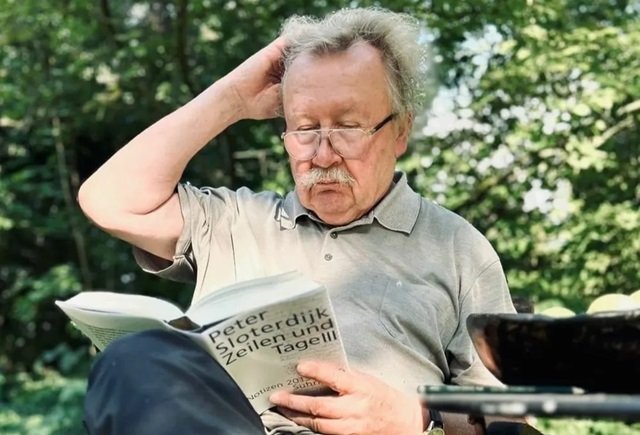
The most revealing political commentary does not always come from politicians, journalists or public intellectuals responding to events as they unfold. Sometimes it emerges from private observations recorded without the expectation of immediate publication. The German philosopher Peter Sloterdijk’s diaries, covering the years 2017 to 2020, offer precisely this perspective. His entries move between political judgement, cultural criticism, technological speculation and personal encounters, presenting a distinctive intellectual account of a period marked by Donald Trump’s presidency, growing political polarisation and the accelerating influence of technology and concentrated wealth.
Published in an exclusive selection by the German newspaper Die Zeit, the notes reveal a thinker unwilling to separate philosophical reflection from contemporary political conflict. Their tone is frequently provocative, occasionally dismissive and consistently sceptical of established intellectual conventions. Sloterdijk’s central preoccupation is not simply the behaviour of individual political leaders but the deeper cultural and institutional conditions that allow particular forms of power, ideology and public discourse to flourish.
His observations on Trump begin in February 2017, shortly after the American president took office. Sloterdijk describes the mass political movements of the 20th century as demonstrations of what happens when social restraint collapses and uninhibited self-expression becomes politically successful. He sees 21st-century mass culture as continuing this process of dismantling restraints. Trump, whom he characterises in exceptionally harsh terms as a habitual liar, manipulator, misogynist and political bully, becomes an example of this transformation. Sloterdijk draws attention to the 63 million votes Trump received in the November 2016 election, suggesting that the phenomenon cannot be explained merely through the personality of one political leader. Its significance lies in the substantial public support that made his political style electorally successful.
One of Sloterdijk’s more revealing observations concerns the relationship between philosophy and political respectability. In a June 2017 entry, he writes: “Ein Philosoph, der nicht den Vorwurf auf sich zieht, reaktionär zu sein, ist zu Lebzeiten tot” — a philosopher who does not attract accusations of being reactionary is, while still alive, dead. The remark encapsulates his preference for intellectual confrontation over conformity. It also reflects his suspicion that philosophy loses its critical purpose when it becomes too concerned with maintaining an acceptable position within prevailing cultural and political expectations.
This confrontational approach extends to Germany’s political debates. In July 2017, Sloterdijk criticises a speech by then Federal President Frank-Walter Steinmeier for explicitly rejecting the establishment of an upper limit on refugee admissions. His argument centres on the concept of borders, which he regards as more than geographical or political boundaries. For him, acknowledging limits is also a question of intellectual honesty, particularly when debates involve territorial capacity and financial resources. He argues that those unwilling to discuss borders should be cautious about presenting themselves as advocates of honesty in public debate. The entry illustrates his tendency to challenge the assumptions underlying political language rather than simply accept the moral framing of an argument.
His reflections on ideology are equally uncompromising. Looking back at the period following the First World War, Sloterdijk describes November 1918 as the beginning of a new understanding of political failure: the failure to prevent war. He also portrays the post-war period as an explosion of ideological rhetoric, recalling the Austrian writer Robert Musil’s description of Europe as a helpless collection of competing voices, each proclaiming its own worldview. Borrowing an observation by linguist Max Weinreich about the relationship between languages and dialects, Sloterdijk develops his own distinction between ideology and empty political rhetoric. An ideology, he suggests, is essentially political nonsense supported by an organised party apparatus and sometimes backed by a world power. The institutional machinery behind an idea, rather than its intellectual substance alone, helps determine its political influence.
Russia also features in his observations. In April 2018, he describes Vladimir Putin’s approach to realpolitik as the simultaneous commission of two crimes, followed by the offer to abandon one in exchange for a negotiating advantage. The compressed formulation reflects his interest in political strategy conducted through coercion and calculated bargaining rather than conventional diplomatic principles.
Technology and the future of economic power occupy an increasingly important place in the diaries. Sloterdijk’s March 2019 reflection on digital networks is particularly striking. He recalls how, two decades earlier, networks were celebrated as instruments of liberation, when they could also become mechanisms through which freedom itself was restricted. His criticism anticipates the tension between the emancipatory promises associated with digital technology and its capacity to enable surveillance and control.
In May 2019, he considers a proposal by Nathan Gardels and Nicolas Berggruen in their book Renovating Democracy. Their approach to economic redistribution involves widening ownership rather than relying exclusively on taxation of the results of labour. Sloterdijk explores the implications of a system in which people displaced by automation could own shares in the robots and artificial intelligence systems replacing their jobs, thereby receiving income from automated production. He even considers whether robots might eventually become taxpayers. Another possibility would be to assign a human beneficiary entitled to a share of profits to every robot replacing an employee.
These reflections connect technological transformation with the future of economic citizenship. Rather than treating automation solely as a problem of unemployment, Sloterdijk considers whether ownership structures could distribute the benefits of technological progress more widely.
His July 2018 observations on wealthy Californians introduce another dimension of this concern. He describes the construction of what amounts to escape infrastructure for the financial elite, allowing the super-rich to protect themselves from collective disasters. Nuclear catastrophe, climate collapse and destructive cyberattacks are among the scenarios he identifies. His argument is that, as problems become increasingly difficult to solve collectively, wealthy individuals become more interested in technological means of separating themselves from shared risks. He connects this pursuit of escape technology with the broader ambitions of transhumanism.
An encounter with technology investor Peter Thiel in California in December 2019 provides a more personal illustration of the world he is examining. Sloterdijk records a meeting at Thiel’s residence, followed by an expensive dinner and further hospitality at the investor’s mansion. His account is deliberately observational, focusing on the atmosphere of extreme luxury and the social environment surrounding influential figures in the technology sector. The episode sits alongside his broader reflections on the concentration of wealth and the growing capacity of technological elites to shape their own futures.
Artificial intelligence receives perhaps his most intriguing treatment in November 2020. Sloterdijk considers the possibility that AI will eventually determine how the past is interpreted and remembered. Algorithms, he observes, initially depend on existing information about previous successes and failures. They then increasingly incorporate their own calculated accounts of success. His conclusion is expressed in a striking formulation: “Mit den künstlichen Gedächtnissen kommt die artifizielle Amnesie” — with artificial memories comes artificial amnesia. The paradox suggests that systems designed to preserve and process information may also produce new forms of forgetting by determining which versions of the past are retained and reinforced.
His November 2020 entry on Trump returns to the relationship between political defeat and authoritarian tendencies. Sloterdijk argues that fascism can emerge from the refusal to acknowledge defeat. He interprets Trump’s inability to accept electoral failure as evidence of a personality and political method organised around an insistent demand for victory. The president’s resentment, he warns, remains available as a political force capable of returning.
Taken together, the diaries present Sloterdijk as a philosopher concerned with the instability of modern political culture, the institutional power of ideology and the technological transformation of society. They are not systematic political analyses, nor should their compressed observations be mistaken for established conclusions. Some are deliberately provocative judgements; others are speculative propositions that invite further examination. Their value lies partly in the tensions between them.
What emerges from Die Zeit‘s selection is a record of a philosopher attempting to understand a world in which political performance increasingly competes with intellectual substance, technological progress challenges established economic arrangements and wealth offers unprecedented possibilities for private escape from collective problems. Sloterdijk’s observations do not provide a settled theory of this transformation. They offer something less comfortable: a series of questions about the direction in which modern societies are moving, recorded before many of the consequences became fully apparent.