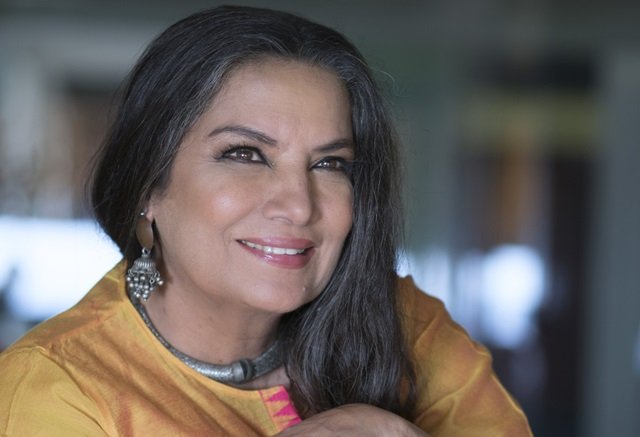
The debate over the hijab is often presented as a contest between religious tradition and women’s emancipation. But veteran Indian actor Shabana Azmi has challenged that framing, questioning both the religious interpretations used to justify compulsory veiling and the political arguments deployed to restrict it. Her position raises a question with implications well beyond India: who has the authority to decide how a woman dresses, and can opposition to religious conservatism become another form of coercion?
Speaking on a recent podcast hosted by Usha Kakade, Azmi argued that the Quran does not explicitly instruct women to wear the burqa, challenging what she described as the distortion of religious teachings by intermediaries. According to her interpretation, the Quran calls for modesty in one’s eyes, an obligation that applies equally to men and women. She criticised those who present the covering of women as an unambiguous religious requirement, suggesting that the confusion surrounding the issue stems partly from people misrepresenting the text.
Azmi’s argument was not, however, an endorsement of prohibiting religious dress. Although she does not wear the burqa, she said she would resist any attempt to prevent her from doing so. “I don’t wear a burqa, but I also believe that if someone tells me I can’t wear a burqa, I’ll wear three of them. Who are you to tell me that?” she said. Her distinction was between choosing to wear religious clothing and being compelled to wear it, whether through religious pressure or political authority.
It was a position that also exposed the contradictions within debates about secularism. Azmi warned against using secular principles as a cover for the spread of fundamentalism, but equally rejected the assumption that opposition to religious conservatism gives political authorities the right to dictate women’s clothing. Her intervention places individual choice at the centre of an argument frequently dominated by competing religious and ideological claims.
This is not the first time Azmi has entered India’s increasingly contentious debate over the hijab. In 2022, she responded to the controversy surrounding six girls who were allegedly prevented from entering a college in Udupi, Karnataka, because they wore the hijab. The dispute attracted political attention and exposed the difficulty of reconciling institutional dress regulations, religious expression and individual rights.
Actor Kangana Ranaut, who subsequently entered politics and became a Member of Parliament for the Bharatiya Janata Party, responded to the wider discussion by arguing that women should demonstrate courage by refusing to wear the burqa in Afghanistan. Referring to changes affecting women in Iran following its revolution, Ranaut urged women to break free rather than confine themselves through religious clothing.
Azmi rejected the comparison, questioning its relevance to India’s constitutional and political framework. Responding on X, she wrote: “Correct me if I’m wrong but Afghanistan is a theocratic state and when I last checked India was a secular democratic republic??”
The exchange illustrated a fundamental disagreement over the political meaning of religious dress. Ranaut’s argument associated the veil with restrictions on women’s freedom in countries governed through religious authority. Azmi, by contrast, insisted that the political circumstances of such countries should not be used to justify restrictions on personal choice in a secular democracy. For her, the right to reject compulsory veiling must coexist with the right to wear religious clothing without state interference.
Her husband, poet and screenwriter Javed Akhtar, has also opposed the practice of wearing the hijab. Yet he has questioned the legitimacy of objections raised by Hindu right-wing groups that do not themselves subscribe to secular principles. Their respective positions reflect a distinction between opposing a religious practice and opposing the coercion of individuals who choose to observe it.
The podcast also addressed another increasingly visible feature of Indian public life: the entry of actors into electoral politics. Azmi described political participation as a matter of personal choice but cautioned against treating political office as an honorary distinction or an extension of celebrity status.
She argued that actors who enter politics should do so with a genuine commitment to public service. Those who have received considerable public affection and recognition, she suggested, have a responsibility to use that influence constructively rather than merely acquire political titles. Her comments were directed at the substance of political participation, rather than the professional backgrounds of those seeking public office.
Azmi’s own experience includes a period in India’s Parliament. Although she has never contested an election, she was nominated by the President to the Rajya Sabha in 1997, serving as an honorary member of the Upper House. During her tenure, she regularly attended parliamentary sessions despite maintaining her acting career.
Her parliamentary interventions focused primarily on women’s rights, child welfare and primary healthcare. She also raised concerns affecting slum dwellers and other marginalised communities. Through the Members of Parliament Local Area Development Scheme, she directed resources towards improvements in public spaces, including the restoration of Mumbai’s seafront.
These two strands of her podcast intervention — religious freedom and political responsibility — converge around the question of individual agency. In the hijab debate, Azmi challenges the authority of those who seek to impose religious or secular restrictions on women’s clothing. In politics, she questions the assumption that public recognition alone qualifies someone to exercise political responsibility.
Neither argument resolves the wider disputes surrounding religious dress, secularism or celebrity participation in government. But her position draws a clear distinction between personal choice and institutional coercion. In a debate where women’s clothing has repeatedly become a proxy for larger ideological battles, Azmi’s central question remains difficult to avoid: if a woman cannot decide for herself whether to wear the veil, who is really exercising control over her freedom?