The Houthi movement’s territorial advances along Yemen’s Red Sea coast and its missile attacks on Saudi Arabia are prompting a reassessment of military involvement by several countries previously reluctant to join the Saudi-backed campaign. Pakistan has begun participating in air strikes against Houthi targets, the United States is considering a joint retaliatory operation with Saudi Arabia, and the United Arab Emirates is reportedly directing forces it has trained to support the Saudi-led ground campaign. Türkiye, however, has ruled out military operations in Yemen, while Syria has yet to decide whether to contribute troops.
The developments, outlined by the Soufan Center in its analysis of the expanding conflict, highlight the growing strategic importance of the Red Sea and the difficulties facing governments seeking to contain the Houthis without widening the regional confrontation with Iran. The Houthi advance towards the Bab el-Mandeb Strait, through which nearly 10 per cent of global trade passes, has heightened concerns about maritime security, trade disruption and the vulnerability of neighbouring states.
The renewed fighting is also unfolding alongside the confrontation between the United States and Iran over the Strait of Hormuz, the strategic passage linking the Persian Gulf with international waters. Together, the two crises are increasing the pressure on regional governments already confronting competing security priorities and disputes over influence in the Red Sea region.
On Yemen’s eastern side of the Red Sea, Saudi-backed Yemeni forces have launched counteroffensive operations aimed at recovering coastal positions captured by the Houthis in September. The ground war resumed over the summer as the Iran-backed movement intensified its military campaign to break a decade-long Saudi blockade of ports and airfields under Houthi control. The offensive also appeared intended to assist Iran in its confrontation with the United States.
The Houthis are reportedly close to encircling Ta’iz, a strategically important city whose capture would represent a significant setback for Saudi Arabia and its Yemeni partners. The movement has also intensified attacks on Saudi infrastructure. According to the Soufan Center’s account, a ballistic missile strike on passenger terminals at King Khaled Airport in Riyadh on Saturday killed 12 people, including an American, and injured 300 civilians. A further attack was reported on Sunday, following two Houthi strikes on the airport on Thursday that killed three Saudi nationals, including a pilot, according to Saudi aviation authorities. The attacks followed several days of strikes against Saudi Aramco energy infrastructure.
The escalating threat has placed Washington under pressure to reconsider its initially limited response. During the September Houthi advance, US President Donald Trump declined direct requests from Saudi Crown Prince Mohammed bin Salman to conduct air strikes against advancing Houthi units. Washington instead expanded the targeting intelligence it supplied to Saudi forces. Asked on Saturday whether the United States would retaliate for the Riyadh airport attack, Trump said a decision would be made after reviewing the latest developments. Reports on Sunday indicated that he was considering a joint US-Saudi retaliatory operation.
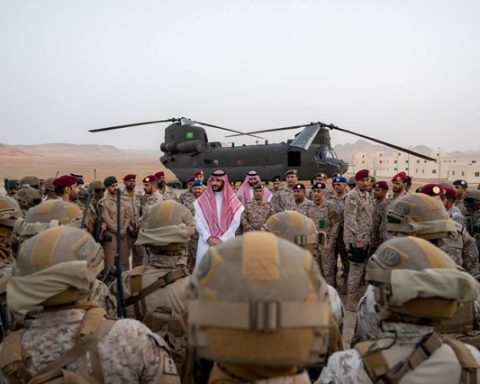
The United Arab Emirates is also moving towards renewed involvement, despite the damage and political disagreements associated with its participation in the Yemen war between 2015 and 2022. Abu Dhabi reportedly fears that the Houthis’ latest gains could embolden the movement to resume attacks against the UAE. It has therefore directed some Yemeni units it previously mentored to join the Saudi-commanded ground campaign.
Yet a closer military partnership between Riyadh and Abu Dhabi remains complicated by differences over Yemen’s southern factions and the strategy for defeating the Houthis. The UAE considers Mohammed bin Salman too willing to accept a compromise with the movement, while Saudi Arabia remains critical of Abu Dhabi’s close cooperation with Israel and its regional policies. These include its support for the Ethiopian government and alleged military assistance to Sudan’s Rapid Support Forces, which are fighting the Sudanese Armed Forces.
The rivalry extends across the western side of the Red Sea. UAE President Mohammed bin Zayed has sought to expand his country’s influence on both sides of the waterway while limiting Iran’s presence in eastern Africa. That ambition has brought Abu Dhabi into conflict with Saudi Arabia and Egyptian President Abdel Fattah el-Sisi, who supports Sudan’s armed forces against the Rapid Support Forces.
A meeting in Egypt’s New Alamein City last week brought together Sisi, Sudanese Armed Forces commander Abdel Fattah al-Burhan, and the leaders of Somalia and Eritrea. Their Joint Alamein Declaration called for regional stability, territorial integrity, cooperation against terrorist groups and violent non-state actors, and freedom of navigation. It also stated that governance of the Red Sea was the exclusive responsibility of its littoral states, an apparent rebuke to outside powers seeking a greater role in the region.
Tensions have also risen over Ethiopia’s ambition to secure access to the Red Sea. Prime Minister Abiy Ahmed has vowed to obtain an outlet for his landlocked country, with Eritrea’s Assab Port a possible focus. The issue has become more volatile as fighting between Ethiopian government forces and rebels based in Tigray and neighbouring provinces has expanded to include Eritrean forces, whom Addis Ababa accuses of supporting the rebellion.
Although the Ethiopian conflict is not directly connected to the war in Yemen, the Soufan Center warns that the two crises are producing overlapping humanitarian and economic consequences. Disruptions to humanitarian assistance and refugee movements across the Red Sea are adding to pressures on countries dependent on regional ports, including Eritrea and Djibouti.
Saudi Arabia has also consulted Syria’s interim President Ahmad al-Sharaa about possible assistance. The new Syrian government is committed to reducing Iranian influence following the fall of Bashar al-Assad, whose regime was backed by Tehran. However, Damascus has not decided whether to send troops to Yemen. Such a deployment could reinforce perceptions that the conflict is part of a wider Sunni-Shia confrontation, potentially deepening regional divisions.
Pakistan has taken a more direct step. Despite indicating last month that it would not intervene in Yemen, Islamabad has reassessed its position following the Houthi advances. Prime Minister Shehbaz Sharif said on Friday that Pakistan would stand “shoulder to shoulder” with Saudi Arabia, while describing its role as purely defensive. A senior Pakistani military official told The New York Times that Pakistani warplanes were participating in air strikes against Houthi forces, focusing on missile and unmanned aerial vehicle installations. Pakistan would not deploy ground troops, according to the newspaper’s reporting.
The intervention follows the signing in August of the Mecca Defense Agreement, a trilateral pact committing Saudi Arabia, Pakistan and Türkiye to mutual defence. Türkiye’s Foreign Minister Hakan Fidan said on Friday that the agreement was defensive in nature and that Ankara would not conduct military operations in Yemen. Turkish officials are concerned that confronting the Houthis, an ally of Iran, could jeopardise cooperation with Tehran over Kurdish organisations and expose Türkiye to retaliation.
Whether the growing involvement of Saudi partners can reverse the Houthi advance remains uncertain. Air strikes without accompanying ground deployments may prove insufficient to change the military balance, while additional foreign involvement risks extending the conflict across an already unstable region. The essential challenge for Saudi Arabia and its partners is to contain the Houthi threat without turning Yemen’s war into a wider confrontation over control of the Red Sea and influence across the Middle East and eastern Africa.