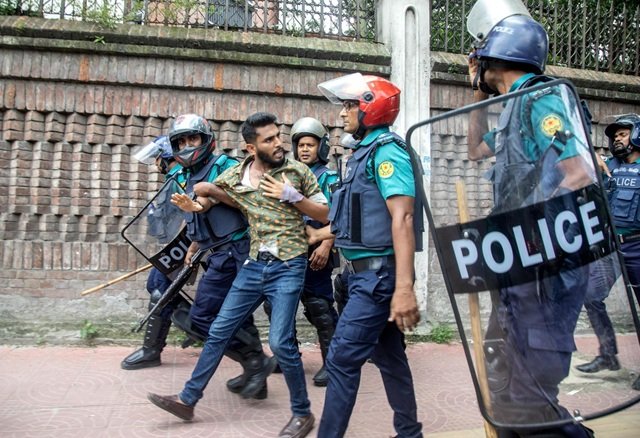
From October 8 to 9, 2026, Police detained 252 people in a single night during an operation against teenage gangs in Comilla District. The drive was conducted by Police from all 18 Police Stations in the district, in coordination with the Detective Branch (DB).
On October 5, 2026, Police arrested 42 people in a special operation against juvenile gangs in Brahmanbaria city in Brahmanbaria District. All of them were later released on bail, taking into account their minor age and social circumstances.
From October 3 to 4, 2026, operations against juvenile gangs led to 723 detentions. By District, 253 teen gang members were detained in Chittagong, 170 in Noakhali, 119 in Chandpur, 47 in Lakshmipur, 43 in Khagrachhari, 36 in Cox’s Bazar, 29 in Feni, 17 in Brahmanbaria, and nine in Rangamati. Of these, 631 persons were released into the custody of their guardians after signing bonds.
On October 3, 2026, Police arrested three people, Mohammad Abdul Hannan, Mohammad Monir Hossain alias Emon, and Sabiha Begum, associates of Wakil Hossain Boga, the leader of the ‘Kishore Gang’ (teen gang) in the area, in an operation in the Jalalabad area of Khulshi in Chittagong District. Police added that Wakil Hossain Boga, the former joint convener of Nagar Swechchhasebak Dal, linked with, but expelled from, the Bangladesh Nationalist Party (BNP), was the controller of several juvenile gangs.
On September 29 and 30, 2026, Police arrested 184 people in an anti-teen gang operation in Lakshmipur District. Of these, 159 were later released on bail and handed over to their guardians by the Police.
On September 29 and 30, 2026, Police arrested 163 people in an anti-teen gang operation in Noakhali District. Of these, 152 were released on bail and handed over to their guardians.
On September 27, 2026, 415 people were arrested in an operation against juvenile gangs that continues in Comilla District, conducted simultaneously in 18 Police Stations in the district. Additional Superintendent of Police Lutfar Rahman disclosed, “Raids have been conducted in various places where juvenile gangs are active, juvenile hangouts, and crime-prone areas. As a result of the continuous raids in the past few days, on the one hand, peace has returned among the people of Comilla, and on the other hand, crime is also decreasing. We want to continue this campaign to control juvenile crime.”
On September 23, 2026, 624 suspected members of juvenile gangs were detained in separate operations across Comilla District. Additional Superintendent of Police (Media) Lutfar Rahman stated that the operations were conducted amid growing concern over juvenile crime in different parts of the district.
The anti-teen gang operation has been underway since September 23, 2026, in a joint operation between 18 police stations and DB in Comilla District. According to the Police, 624 people were arrested in the first phase of the five-phase campaign, 254 in the second phase, 415 in the third phase, 379 in the fourth phase and 370 in the fifth phase. A total of 2,042 people have thus been arrested in the five phases (through October 4, 2026). Another five active members were arrested on October 5, 2026, in separate operations in Comilla District. They were members of the ‘Smash Squad’, ‘1207’, and ‘PX 10’ gang.
The latest operation against teen gangs began on September 23, 2026, after the killing of a schoolboy. On the afternoon of 18 September, 2026, a 13-year-old schoolboy, Ishayat Shahriar Apratim, was taken to a secluded forest in the Sananda area of Lalmai Hills in Comilla District and killed. It was reported that one of the arrested suspects, Saiful Islam Tuhin, was a member of a gang called RZ-36. On September 26, 2026, a report reviewed 32 incidents and Police operations involving teenage gangs and related organised crime in Comilla District and identified 12 teenage gangs and sub-groups: Ratan or R Squad, Eagle, Cumilla Brothers Community (CBC) or Cumilla Brothers King (CBK), CBK Danger Zone, CBK Junior, CBK Special, RDX, RZ-36, CDX, King Squad, Red 999 and BGM.
Gang culture in Bangladesh essentially took root in Uttara, Dhaka, in 2001 with the rise of a short-lived group known as ‘Kankra’, according to Commander Mufti Mahmud Khan, the Rapid Action Battalion (RAB) media wing director in 2017. While gangs have existed for decades in Bangladesh, juvenile gang activities began attracting significant national attention after names such as ‘Nine Star’ and ‘Disco Boys’ came to public attention, especially after the murder of 15-year-old eighth-grader Adnan Kabir in Uttara on January 6, 2017. Adnan was reportedly a member of ‘Nine Star’, which was involved in a rivalry with ‘Disco Boys’. This killing triggered public concern.
By 2021, Police and RAB estimated that around 50 juvenile gangs were active in Dhaka. Later, in 2025, according to a published report, Police stated that the teen gang members carried out their activities under different names on an area basis. In the Mohammadpur area of Dhaka, the Dailla Group, Alex Group, Emon Group, Anwar alias Shooter Anwar Group, Akash Group, The King of Law Thela Group, Diamond Group, I Don’t Care (IDC), Murgi Group, Sabbir Group, Shaon Group, Film Jhirjhir, Star Bond, Group Twenty Five, Lada De, Level High, Deke Law-Chine Law and the Kopaiya De Group were active. Gangs in the Uttara area included Nine Star, Power Boys, Bill Boss, Nine MM Boys, Sujan Fighter, Castle Boys, Altaf Zero, Viper, Tufan. Additionally, in the Mirpur area, active gangs included: Suman Gang, Picchi Babu, Bihari Russell, Bicchu Bahini, Saiful Gang, Babu Rajan, Ripon Gang, Sabbir Gang, Nayan Gang and Mobarak Gang. The AK-47, Nine MM and Five Star Bond gangs operate in Dhanmondi. The Jummon Gang is in Bangshal, the Mainuddin Gang in Tejgaon, and the Chan Jadu, David King Fall Party, Volume Two and Bhandari gangs in Mugda. In the areas surrounding Sadarghat, including Shankhari Bazar, Kaltabazar, Panitola, Lalkuthi, Shyambazar, Islampur, Babubazar and Sadarghat, members of Ferdous Group, Saju Group, Senior Group, Junior Group, Tiger Group, and Cheeta Group have been at the top of the crime list. According to reports, 1,925 members of juvenile gangs have been arrested between 2017 and January 31, 2025.
Political connections have emerged as another concern. On September 23, 2026, Imran Hossain alias Ratan, identified as the leader of the ‘Ratan Group’ or ‘Squad’, was seen right behind Mohammad Mohsin, Vice-President of the Comilla Metropolitan Chhatra Dal, the students wing affiliated with the BNP, during a procession in Comilla. His presence generated discussion and criticism after images of the procession circulated.
Earlier reporting had also linked teenage gangs in Dhaka to political patronage. According to a report published in March 2024, it was suspected that the Tousef Group, one of the active teen gangs at the time, was led by the son of a son of Ward 15 Councillor Rafiqul Islam (Babla) of Dhaka South City Corporation, affiliated with the then ruling Awami League in Dhaka’s Dhanmondi area. During the Awami League’s government, most gangs were patronised by Masudur Rahman Biplob, personal secretary of Awami League leader Jahangir Kabir Nanak, former councillor S. Tarekuzzaman Rajib, and Asif Ahmed.
Social media has added another dimension to the teen gang problem, further facilitating the organisation and recruitment of teenage gangs. An investigation into gangs in Comilla found that members were often brought together through TikTok videos and social-media groups. Most gang members carry iPhones or other expensive-brand mobile phones and use these phones to make videos, adding provocative messages before posting them online.
According to a report published in 2026, teenagers are increasingly becoming involved in serious crimes, with underworld criminals and politically influential groups using them to carry out criminal activities. Influential individuals recruit teenagers for drug dealing, illegal occupation and other offences. Dhaka University Associate Professor Towohidul Haque notes that poverty, inadequate family and social education, and drug abuse have been driving the spread of teenage gangs across Bangladesh. Police reports have found adults leading teenagers in some networks, while some gangs have become involved in territorial control, flogged out as hired muscle, and for land grabbing. The issue has clearly evolved beyond mere loosely organised adolescent groups.
The extensive law enforcement response to the problem of teenage gangs underscores the seriousness of the issue. However, legal complications have become a hurdle for law enforcement agencies to prosecute juvenile offenders, especially under the Children Act 2013. Teen gangs spread from Dhaka to districts such as Comilla, and across the Chittagong Range, their involvement in violent incidents, criminal activity, social-media recruitment and suspected political connections, have transformed the issue into a wider law-and-order challenge. There is also a long-term security concern that vulnerable gang members could potentially be drawn toward more serious forms of extremism. The nationwide expansion of the 2026 crackdown reflects the authorities’ recognition that teenage gangs have become a significant security concern in Bangladesh.