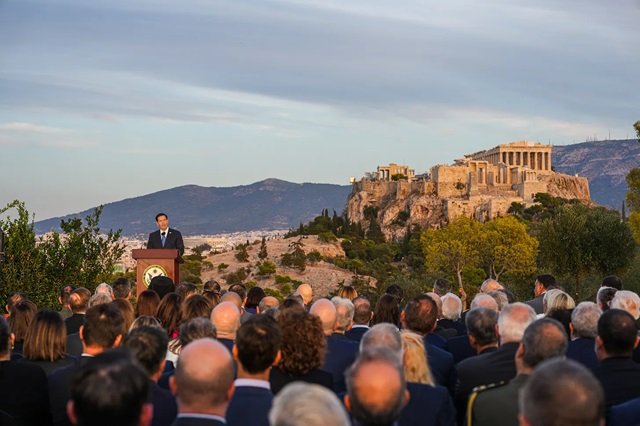
Secretary of State Marco Rubio gave a speech at the Pnyx in Athens on October 7, a place just below the Parthenon that I spoke at a few years ago. It sounds as if one of his speechwriters has been reading my books, because at the heart of his address he talks about thymos (he transliterates it as thumos) as the core value of Western civilization. This is correct in some fashion, but Rubio’s understanding of the idea is very deficient.
The Secretary of States says the following:
For the Greeks of antiquity, the pursuit of excellence was the very principle of man’s existence. They organized all of civic life around contest, ambition, competition: in philosophy and poetry, in sculpture and drama, in athletics and art, in war and statecraft. The classical Greek city was an arena for great men to test and prove themselves, to hone their potential through perpetual struggle—to be the best, the strongest, the most beautiful, straining to inch ever closer to perfection.
Now I know that to modern ears, what I just described, this way of life, may sound odd; it may even sound cruel. The ideal of many ideologies in our time has, frankly, become a world of perfect safety, devoid of risk or failure, with neither the glory of victory nor the shame of defeat …
The ancient Greek city-states were filled … with intense passion and rivalry and faction and conflict. But from that constant struggle for distinction—from that came the great flowering of art and philosophy and political and intellectual energy that would transform a collective of Mediterranean cities into the birthplace of the greatest civilization in the world.
The thumos, as the ancient Greeks called it—the fire of passion, strength, courage, pride—is the heart of great civilization. And without it? Without it, nations lose their will to fight, the will to strive, the will to survive.
I spoke of thymos at some length back in 1992 in The End of History and the Last Man, and have returned to it in In the Realm of the Last Man, my new memoir. Thymos—pride, spiritedness, the desire for recognition—is indeed important for Western civilization. But Rubio has a very attenuated understanding of it, and does not understand how it is a double-edged sword.
Thymos is at the core not just of Western civilization, but, as Hegel and his interpreter Alexandre Kojève noted, of politics as a whole. The first bloody battle between early human beings was driven by the desire for dominance and recognition, by the willingness to risk one’s life. This struggle for dominance leads to a society of masters and slaves, in which neither party is fully satisfied—the slave for obvious reasons, but the master as well because he is recognized by someone who is only a slave. The solution to this problem unfolds over historical time, with the emergence of a society based on mutual and equal recognition of all human beings. Such a society was articulated for the first time in the Declaration of the Rights of Man and Citizen in the French Revolution, as well as the U.S. Constitution’s Bill of Rights. Both rest on a fundamental Christian idea, the universal equality of all human beings under God. Liberal societies recognize equality of dignity by granting and protecting basic human rights.
In The End of History and the Last Man, I created two neologisms, isothymia and megalothymia. Isothymia is the desire for equal recognition, which is fundamentally at the base of any modern democracy. Human beings universally feel resentful and angry when they are disrespected, when their fundamental dignity is held to be lower than that of another group or individual. Today’s polarized politics is driven by isothymia: left-wing identity politics by the demand of marginalized groups for equal recognition, and an emerging right-wing version based on a narrative of white or Christian victimization.
Megalothymia, by contrast, is Janus-faced. It can be the source either of human progress, or of the greatest crimes and tyrannies human societies have had to endure. Secretary Rubio is correct that the striving to be better than other people is the source of all human excellences, in the arts, in sports, in the economy, or in politics. But the will to be better than other people can lead to domination, tyranny, and unspeakable crimes. George Washington, Abraham Lincoln, and Winston Churchill were clearly driven by megalothymia—but so were Hitler, Stalin, and Pol Pot.
Thymos thus presents a conundrum for democracies. The equal rights protected by a liberal state rest on isothymia, the demand for the equal recognition of human dignity. But a successful society also needs megalothymia for all the reasons Rubio outlines: it needs risk-takers, innovators, and brave citizens willing to fight on behalf of their fellows. The problem is, first, distinguishing between the good and bad forms of megalothymia, and second, channeling this passion into activities that benefit the broader society.
I wrote about Donald Trump back in 1992 in The End of History and the Last Man. I was looking for positive outlets for megalothymia, and argued that a capitalist economy would bleed off the desire for dominance and channel it into business. Little did I realize that, some decades later, Donald Trump would not be content with being rich, but would want political power as well.
Trump is a perfect example of unconstrained megalothymia. He cannot distinguish between good and bad attributes that deserve recognition, nor does he care about the quality of judgment of those recognizing him. He wants his face to be carved into Mount Rushmore as one of the greatest of American presidents, but also seeks pettier acclaim like the Nobel Peace Prize or his name on the Kennedy Center. He recently showed Maggie Haberman a list of history’s most powerful rulers, whom he clearly admired and wished to equal. The list included Genghis Khan, Attila the Hun, Napoleon, Mao, and Stalin, and not a single democratic statesman.
Secretary Rubio’s desire to stay on his boss’ good side leads him to twist reality like a pretzel. He speaks about an alliance between the United States and Europe based on shared values, gliding over a president who clearly admires Vladimir Putin and Xi Jinping far more than those of other democratic countries. He talks about the wonders of science and technology created by Western civilization, even as his administration is cutting funding for scientific research across the board. He celebrates the agreement over Greenland, without mentioning his desire to grab it away from Denmark.
Secretary Rubio praises thymos without regard to the ends to which it is directed. He would do well to remember that it was an excess of megalothymia that led Alcibiades and the Athenians into the disastrous Sicilian Expedition, which Thucydides explains was the beginning of their defeat in the Peloponnesian War. The Secretary should also focus a bit on the lines from the Declaration of Independence: “We hold these truths to be self-evident, that all Men are created equal.” It is this principle of human equality, and not the celebration of great individuals, that has underlined a lot of American foreign policy over the decades.
It is to this principle that the Founding Fathers, as well as many subsequent generations of Americans, vowed to sacrifice their lives, their fortunes, and their sacred honor.