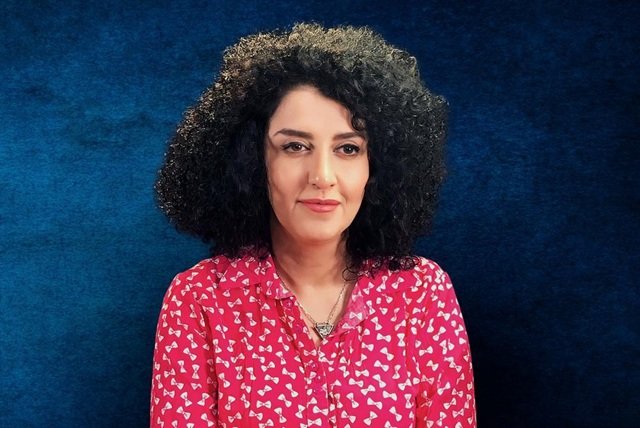
Narges Mohammadi, the Iranian human rights activist awarded the 2023 Nobel Peace Prize, says decades of repression have failed to extinguish demands for democracy, equality and freedom in Iran. “Iranian society no longer tolerates the Islamic Republic,” she said, arguing that movements led by women, young people and students have fundamentally transformed public consciousness despite the authorities’ continued use of imprisonment, executions and other forms of punishment.
Mohammadi, 54, made the remarks in an interview with the Spanish newspaper EL PAÍS after publishing a memoir written in prison. Her book, A Woman Never Stops Fighting: My Struggle for Freedom, Democracy and Human Rights in Iran, has been published in Spanish and Catalan by Finestres Ensayos and Folch i Folch, respectively. Her own freedom remains temporary: she was released from prison in May after suffering two heart attacks, but faces at least 18 years of imprisonment under outstanding sentences.
Her record of persecution includes 14 arrests, 10 trials, a total of 44 years in prison imposed through her convictions, 154 lashes and 161 days in solitary confinement. She has also been separated from her twin children, Ali and Kiana, since 2015. Now 19, they live in exile in Paris with their father.
Mohammadi said she had understood that writing her memoir while detained at Evin prison in Tehran, a facility known for holding political prisoners, could bring further consequences. She smuggled the manuscript out of prison and regarded completing the book as a duty. During her most recent arrest in Mashhad on 12 December 2025, she said, she suffered serious injuries after repeated blows to the head and spent two months in solitary confinement. She was subsequently transferred to a prison in Zanjan, where she said she received no medical assistance despite serious lung and heart conditions. After her sentence was suspended, she was hospitalised in three Iranian provinces and remains under treatment.
The Nobel Prize, she said, did not bring the protection she had expected. Instead, pressure on her and her family intensified. According to Mohammadi, the director of her prison told her that decisions about providing urgent medical care had partly been within his authority before she received the award. After the Nobel was announced, she said, such decisions were transferred to much higher state authorities. Conditions became more severe, and statements or protests she participated in while imprisoned resulted in additional sentences, including one of seven and a half years.
In her memoir, Mohammadi describes solitary confinement as a systematic instrument of torture designed to break prisoners’ will and force confessions. Prolonged isolation, without information from the outside world, family contact or sunlight, can cause what she described as spiritual and psychological disintegration. She said she had reached the point of speaking to the walls and door of her cell.
Many prisoners, she argued, confess under such conditions, sometimes after physical torture, and courts subsequently impose death sentences on the basis of forced confessions. Mohammadi linked this practice to the recent increase in executions in Iran, describing solitary confinement as “the mother of executions in Iran”.
She regards capital punishment as a collective wound that has remained unhealed throughout the 47 years since the establishment of the Islamic Republic. The executions of the 1980s, including those carried out in the summer of 1988, remain part of that history. Amnesty International estimates that approximately 4,500 people, many of them teenagers and left-wing militants, were executed in Iran during that summer alone.
For Mohammadi, executions continue to punish society beyond the individuals who are killed. She said people increasingly woke each morning to news of another hanging, often following proceedings held behind closed doors, without a lawyer and on ambiguous charges. Public executions, she added, serve to intimidate a population that the authorities have been unable to bring back into submission.
She attributes the transformation in Iranian society to two decades of activism by women, young people and students, alongside workers and human rights and environmental campaigners. These movements, she said, have advanced demands for fundamental rights, including freedom, justice, democracy and equality, despite the heavy price paid by those involved. Although change takes time, she believes the movements have already achieved a fundamental shift.
The “Woman, Life, Freedom” movement, which emerged after the death of the young woman known as Jina Mahsa Amini in police custody in 2022 following her arrest over the way she wore her headscarf, represents one of its clearest achievements. Mohammadi said the movement had helped many Iranian women stop wearing the hijab, a development that might otherwise have required decades of struggle. The law requiring the veil has not been abolished, but she argued that women had established a practical right through collective resistance. She said the authorities were determined to suppress the movement because of that achievement.
For Mohammadi, resistance to compulsory hijab extends far beyond clothing or religious practice. She sees it as a challenge to the political authority of a system that seeks to consolidate control over half the population through restrictions on women. Women’s resistance to the Islamic Republic, she said, must therefore be understood as a broader political struggle against authoritarian rule.
The war involving the United States and Israel against Iran has complicated that struggle. Having experienced the Iran-Iraq war of 1980–1988 as a child, Mohammadi said the conflict had caused enormous losses from which the country had still not recovered. She believes war also helped silence public attention to executions and human rights violations. The current conflict, she said, has strengthened the Islamic Republic’s repressive practices, increased pressure on civil society and political activists, and weakened social movements by creating an atmosphere of insecurity in which protests are more difficult to organise.
Despite the separation from her children and the prospect of returning to prison, Mohammadi said she had not abandoned hope. She acknowledged that hope did not mean ignoring suffering or reality, but continuing the struggle without surrendering. She did not know when she would see Ali and Kiana again, she said, but remained convinced that the moment would come.