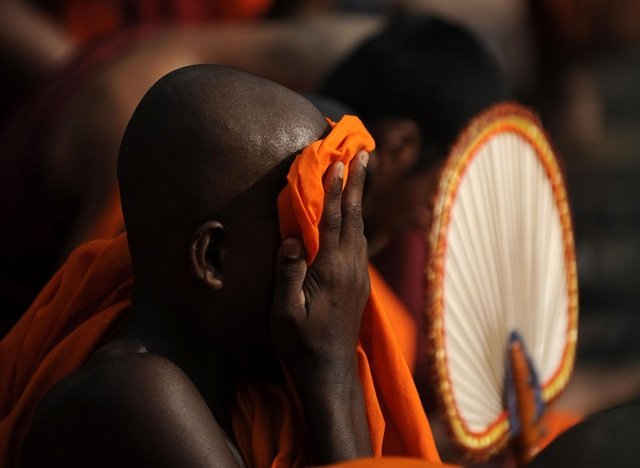
“We have brought clay and made a figurine and are planning to stick uguressa thorns and other poisonous thorns into it… I will murmur a spell… We have prepared an offering to the demon Mahasona. The figurine is in there. We hand it over to the demon. It will do what it wants.” ~ Monk Samanthabadra of Umandawa
From the NPP government’s draconian Protection from Organised Crime Bill to the preventable death of the magnificent tusker, Kawantissa – so much has been overshadowed by the spectacle at the Vihara Maha Devi Park demanding instant freedom for Galagoda-Atte Gnanasara.
A piece of news about a series of WhatsApp messages threatening Buddhist places of worship too was among the momentous developments lost in the monk-led brouhaha.
The senders of these messages had Muslim identities and the places threatened included the Temple of Tooth Relic, Sri Maha Bodhi, Tuparamaya, and the Rangiri Dambulu Vihara. When the chief incumbent of the Dambulu Vihara lodged a complaint with the police, a rapid investigation ensued leading to the arrest of a 21-year-old man from Ibbagamuwa, Kurunegala. The suspect’s phone contained “several manipulated images depicting the Buddha,” birthing fears of a national security threat.
Then came the discovery which upturned the investigation. The suspect was a Sinhalese who had assumed multiple Muslim identities to send his incendiary messages. He reportedly accepted his guilt and said that he did what he did “purely for entertainment purposes”.
Whether the man is a lone pyromaniac or a part of a larger network is unclear. But what could have happened if his messages reached fellow pyromaniacs, especially the ones cavorting in the Vihara Maha Devi Park, is all too clear. After all, the Davatagaha Mosque is but a stone’s throw away.
Gintota November 2017: A Sinhala cyclist accidentally knocks down a Muslim mother and child. A fracas ensues and is settled. Then suddenly, violence breaks out targeting Muslim residents and their properties. According to police, the violence was triggered by “social media rumours about Muslims planning to attack a Buddhist temple”.
Ampara February 2018: A group of Sinhala customers find a lump of flour in their beef curry. They release a social media post claiming that the substance was sterilisation pills. Violence against Muslim properties break out almost immediately.
The police were late on the scene despite the station’s proximity to the hotel. “Violence has been pre-planned and well organised,” wrote the peerless DBS Jeyaraj. “Hundreds of youths could not have assembled in the Ampara town at such short notice unless preparations had been made beforehand.
Digana went up in flames less than a month later, followed by the horrendous Easter massacre a year and a month on.
In 2015, the Rajapaksas tried to win presidential and parliamentary elections by weaponising minority phobia. It didn’t work. After losing, they accused the Sirisena-Wickremesinghe government of being pro-minority and anti-Sinhala-Buddhist. In late 2015, the Sinha Le movement came into being, with the same suddenness as the Bodu Bala Sena’s emergence in late 2012. The movement failed to gain traction but it did release the toxin of ethno-religious racism back into the political and societal atmosphere.
Madille Pannaloka thero was the livewire behind Sinha Le movement. In 2020, during an interview with the You Tube channel A5News, he claimed that Gotabaya Rajapaksa had a hand in its birth. Mr Rajapaksa had lengthy discussions and gave “little, little guidelines,” the monk said, adding, “For one and a half hours, he taught us tricks”.
Sinha Le failed to ignite violence because the Sirisena-Wickremesinghe government was still popular. But as hope died and economic discontent re-emerged, anti-Muslim hysteria caught on. The administration had no political will to resist the madness. It allowed its political enemies to set the country on a downhill path to national disaster.
Saffron pawns
The Buddha condemned superstitious practices, from auguring and fortune telling to demonology, as ‘animal arts’. He warned Bhikkus against engaging in such practices (for example, Brahmajala Sutta and Sammannapala sutta).
Sinhala-Buddhist monks, followers of a different, violent, creed, consider these animal arts condemned by the Buddha as part of their religio-national heritage.
According to Sinhala folklore, Mahasona is “122feet high, has the head of a bear, with a pike in his left hand, and in his right an elephant whose blood he squeezes out to drink. He inflicts cholera and dystentry and presides over graveyards and junctions where three roads meet. He is said to appear riding on a pig… The Sinhalese believe that a man struck down by this demon would exhibit, on the back of his body, the mark of a hand with the palm and fingers standing out of the flesh, embossed as it were” (Dictionary of Proverbs of the Sinhalese together with the connected myths, legends, and folktales – John M Senaveratna).
Last week, monks led by Umandawe Samanthabadra (who claims to have attained Arhathood and even Buddhahood) summoned his Mahasona to the Vihara Maha Devi Park. A clay figurine representing President Anura Kumara Dissanayake was consigned to the tender care of the demon.
This is not the first time Mahasona played a key role in the perverted blood-and-faith Sinhala-Buddhism dominant in this country. In March 2018, an organisation called Mahason Balakaya and its leader Amith Weerasinghe helped ignite Digana anti-Muslim violence. Mr Weerasinghe was arrested but was never charged, despite the presence of ample evidence in the public domain.
Three days after the Rajapaksa-led anti-constitutional coup of 26 October 2018, Amith Weerasinghe and his followers were enlarged on bail. They were thus as free as the wind to ignite anti-Muslim violence in the aftermath of the Easter Sunday Massacre. When courts banned an incendiary demonstration by the Mahason Balakaya in May 2019, Amith Weerasinghe asked, “If fifty thousand, sixty thousand monks of this country get on to the road, what will you do?”.
Monks as weapon and shield, that was the way to power for many a politician, from SWRD Bandaranaike to the Rajapaksas.
Galagoda-Atte Gnanasara is in prison for his thuggish conduct in the Homagama Magistrate Court in January 2017, but he should have been jailed long before for his role in inciting the Aluthgama riot. In Aluthgama in 2014, a road accident was utilised rile up Sinhala-Buddhist anger. As tempers heated, the Rajapaksa administration allowed the Bodu Bala Sena to hold a meeting in Aluthgama town. Addressing the mostly white-clad gathering, Galagoda-Atte Gnanasara declared open season on Muslims. “In this country we still have a Sinhala police; we still have a Sinhala army. After today if a single Marakkalaya or some other paraya (alien) touches a single Sinhalese…it will be their end”. Over the next 48 hours, Buddhist men (and some women), often dressed in the white garb of piety, attacked Muslim homes, businesses and mosques, undeterred by a curfew and unimpeded by the presence of thousands of armed policemen and soldiers.
“Whoever dons the saffron robe with mind full of defilements, unrestrained, and untruthful – never is he worthy of the saffron robe,” the Buddha said (Yamaka Vagga – Dhammapada). Unfortunately, Sinhala-Buddhism (a vastly different creed birthed by monk Mahanama via Mahavamsa and nourished by some of monk Buddhaghosa’s commentaries) creates and is sustained by monks whose minds are full of defilements, who are unrestrained and untruthful. Perhaps the best exposition of this dichotomy was by President Ranil Wickremesinghe when he corrected Sajith Premadasa about equating Buddhism with the monks of today. “There is the Buddha, the dhamma, and the sangha. Premadasa has mixed Buddhism with Buddhist monks… Sometimes there are laypersons as well as monks who do not follow Buddhism. That is why there are many issues in the Buddha Sasana… No one is entitled to special protection just because they are wearing a robe” (Speech in Parliament – 29 November 2022 https://dbsjeyaraj.com/dbsj/?p=80449).
Former president Ranil Wickremesinghe is singing a vastly different tune today, but what he said then remains valid. Equating the likes of Galagoda-Atte Gnanasara and Umandawe Samanthabadra with Buddhism is an obscenity. The state’s constitutional duty to protect Buddhism should begin with the drawing of a clear line of demarcation between these saffron-clad imposters and the Buddha’s Sasana.
False flag operations?
On 30 August 2009, the Colombo Crimes Division (CCD) discovered an explosive-laden van in Vavuniya. The van was about to be sent to Colombo on a suicide mission, the police claimed. The Tiger seemed not only undead but also fighting fit.
Less than 24 hours later, Nimal Lewke, DIG of the Northern Province (and former STF Commandant) dismissed the story, calling it ‘suspicious and questionable.’ The CCD while arresting the van had allowed the driver to go free, it was revealed subsequently. The suicide-van was not heard of again. The first attempt to resurrect the Tiger to provide the Rajapaksas with a suitable enemy ended in failure.
The Rajapaksas are nothing if not persistent in the pursuit and protection of power. When the dead Tiger remained dead and attempts at recreating the Christian enemy failed, they focused on the Muslims. Picketing Muslim-owned shops, organising anti-Muslim demonstrations, and attacking mosques began in the second half of 2012. The campaign was well-financed and monk-led. Just as racist monks and the likes of Champaka Ranawaka and Udaya Gammanpila howled about a plan to turn Sri Lanka into a Christian nation via conversions in the late 1990’s and early 2000’s, the anti-Muslim campaigners of 2012 on warned about plans to turn Sri Lanka into a Muslim country via sterilisation and conversion.
As hatemongers, led by Galagoda-Atte Gnanasara, ran amok, the Rajapaksas watched winking and nodding. “The Maha Sanga and all Buddhists are free of racialism and regionalism, Mahinda assured,” assured Mahinda Rajapaksa (Daily Mirror – 21.1.2013). When the Bodu Bala Sena opened a Leadership Training Academy (incongruously named Meth Sevana), Gotabaya Rajapaksa attended as the chief guest, declaring, “These Buddhist clergy who are engaged in a nationally important task should not be feared or doubted by anyone” (Sri Lanka Mirror – 10.3.2013).
In early 2013, Galagoda-Atte Gnanasara began accusing the owners of Fashion Bug of conspiring to turn pure Sinhala-Buddhist maidens into harem-inmates. A few weeks later, a monk-led mob torched the Fashion Bug outlet in Piliyandala, subsequent to a false rumour of a 15- year-old Sinhala-Buddhist employee being raped, within the premises, by a Muslim fellow-employee. Questioned about it, Mahinda Rajapaksa repeated the lie, with his own toxic twist. “What was in the background? Why were they attacked? Now see a girl was raped. Seven years old girl was raped. Then naturally they will go and attack them whether they belong to any community or any religion… All incidents have some background to that”.
Fearmongering, especially via social media, played a key role in much of the anti-minority violence of the last 15 years. Which is why the underreported news about a Sinhala man sending WhatsApp messages under Muslim identities threatening Buddhist places of worship needs to be taken seriously and investigated thoroughly.
At the 12 September 2026 SLPP rally in Anuradhapura, Rohitha Abeygunawardane made clear the goal. “I have only one request. Are (you) ready to do it? Are you people of Rajarata ready? What should be done? You have to do only one thing. The leader who unified this country, the leader who built the entire country, we have a duty to perform for that leader. All of us born must die. But we have a responsibility to unite all the people of this country and make Namal Rajapaksa the president of this country before Mr Mahinda Rajapaksa’s eyes. Only that will be the way to honour Mr Mahinda Rajapaksa”.
Enable Mahinda Rajapaksa to see his son Namal as president. If that is the politico-temporal destination, did the path to it begin at the Tissa Vihara in 2025? The planting of a Sri Maha Bodhi sapling (donated by child-rape suspect Pallegama Hemaratana thero to Sarath Weerasekara) in Vadunnagala and the ongoing spectacle at the Vihara Maha Devi Park – are they milestones in this journey? If so, another Aluthgama, another Digana, via a false flag operation targeting monks/temples, might not be far away. When humans are willing to set countries on fire to gain their ends, who needs demons?