The street defeated Shiekh Hasina; it is in the street that she now seeks her restoration to political legitimacy.
Bangladesh is once again confronting the prospect of a political convulsion, as the announcement by ousted Prime Minister Sheikh Hasina that she intends to return from exile in India in December 2026 has triggered violent street mobilisation, arson, crude bomb attacks and nationwide blockades. The immediate confrontation is between supporters of the banned Awami League and the security establishment of Prime Minister Tarique Rahman’s government. But the emerging crisis is wider, reflecting the unresolved struggle over the ideological character of Bangladesh, the survival of the political constituencies associated with the Liberation War, and the increasingly assertive mobilisation of radical Islamist forces.
The uprising of August 2024, which ended Hasina’s rule, was a watershed, but it did not extinguish the political and ideological constituencies that sustained the Awami League for decades. Nor did Hasina’s removal translate into the disappearance of the party’s social base. The Awami League’s organisational networks, its historical association with the independence struggle of 1971, and the secular-nationalist political inheritance of Sheikh Mujibur Rahman continue to command support among large sections of the population. This constituency is an expression of resistance to the political transformation that has followed her departure.
The present mobilisation is an effort by Awami League cadres that have survived the post-2024 repression, including elements of its student organisation, the Bangladesh Chhatra League, to demonstrate that the party cannot simply be erased from the country’s political landscape. It also reflects a growing apprehension among sections of Bangladeshi society that Hasina’s overthrow has opened political and social space for forces seeking to redefine the country along explicitly Islamist lines. These anxieties have acquired substance from the increased political visibility of Jamaat-e-Islami and other conservative Islamist formations, the mobilisation against liberal and secular cultural institutions, and the persecution and intimidation of religious minorities.
For many Bangladeshis, particularly those who identify with the country’s Liberation War traditions, the secular-nationalist foundations of the state remain important political commitments. The prospect of their displacement by an increasingly assertive religious nationalism generates a counter-mobilisation that cannot be dismissed simply as an attempt by a discredited ruling party to recover lost power. It would, of course, be a mistake to romanticise the Awami League’s return as a revival of democratic politics. The very character of the last years of Hasina’s rule – despite the developmental and security consolidation she achieved – remains central to understanding why the mass movement against her acquired such extraordinary momentum.
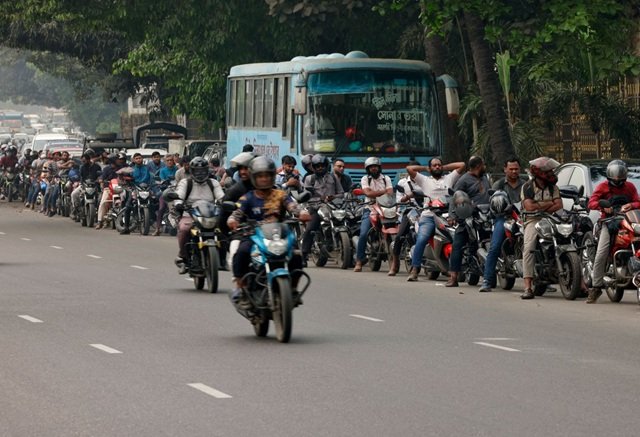
The security implications are already becoming evident. Crude bomb explosions, attacks on vehicles, arson and road blockades have demonstrated the capacity of Awami League networks to generate disruption even under circumstances imposed by prohibition and sustained arrests. Reports of attacks by members of the banned student organisation, clashes with police and fatalities demonstrate that the mobilisation is not merely rhetorical. The government, meanwhile, faces a difficult operational and political choice. An indiscriminate crackdown could reinforce the narrative of political persecution and drive a larger constituency towards underground resistance. A failure to contain organised violence would further erode public confidence in the state’s capacity to maintain order.
There is a further danger that the confrontation will become self-reinforcing. Islamist groups could exploit the mobilisation and violence to consolidate their own political position, portraying the Awami League’s return as an attempt to restore an allegedly anti-Islamic order. Conversely, the excesses of radical Islamist mobilisation could strengthen the appeal of the Awami League’s secular-nationalist constituency, including among sections that had previously become alienated by Hasina’s authoritarianism. The result could be an even more completely polarised political environment.
For Tarique Rahman’s government, the challenge considerably is more complex than containing an attempted political comeback by Hasina. It must accommodate political plurality without permitting the restoration of authoritarianism, even while preventing the capture of public institutions and social space by radical Islamist forces. The legitimacy conferred by electoral victory cannot substitute for this larger task of state reconstruction.
Bangladesh is confronted with something more fundamental than the return, or attempted return, of an ousted prime minister. The August 2024 uprising destroyed an entrenched political order but did not produce a settled political consensus about what should replace it. The persistence of Awami League support and the reaction against Islamist resurgence are manifestations of this unresolved contest. The danger is that the country’s political actors, unable or unwilling to negotiate a pluralist settlement, will increasingly resort to the street, coercion and ideological mobilisation as instruments of political survival. In that eventuality, December may become not the moment of Hasina’s return, but another milestone in Bangladesh’s protracted crisis of state legitimacy.