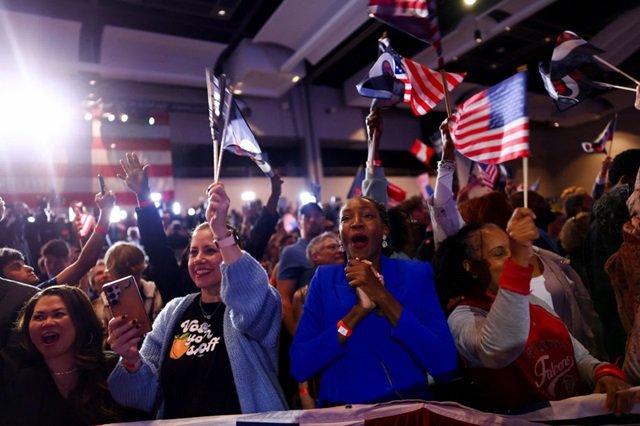
The 2026 midterms ended in a rout. Democrats won both chambers of Congress, the first time since Barack Obama’s second term that a sitting president has had neither. Islamabad’s anxiety is understandable. Al Jazeera noted before the vote that Pakistan was one country likely to prefer a Republican win, since its recovery in Washington was built through direct engagement with Trump. But the greater danger is not a Democratic majority. It is a relationship that was never designed to outlast one man’s goodwill.
The scale of the result matters. Democrats flipped seats Republicans had held for decades: James Talarico became the first Democrat to win statewide in Texas in 32 years, and Adam Hamilton won in Kansas, a seat Democrats last held in 1932. Once the new Congress sits, Democrats will control committees, subpoenas and confirmations. Even so, Trump has already promised to “veto everything,” and former ambassador Maleeha Lodhi expects him to retain considerable authority over foreign policy. Washington’s politics will change, but the presidency will not disappear.
Pakistan should also keep faith with a structural point. The interests that make it relevant to Washington are not partisan. A recent Geo News analysis argued that American concerns about China, nuclear security, terrorism and regional stability have substantial bipartisan foundations. Parties differ on emphasis and method. A Kenneth Holland briefing at CRSS in Islamabad made a similar point, that strategic competition with China remains a bipartisan concern.
The nearer risk is scrutiny of the Trump family’s business empire. Democrats are expected to investigate its expansion into cryptocurrency, drones and other ventures. Pakistan was among the first to sign with the Trump-linked World Liberty Financial, and Al Jazeera reports that officials confirmed no pilot, licences or transactions have followed the January memorandum. The same report notes the White House has said there were no conflicts of interest. None of this implies wrongdoing by Pakistan. But it could pull Islamabad into Washington’s partisan fights, and that calls for careful handling rather than alarm.
Pakistan’s real asset is its diplomacy on Iran. It brokered the April ceasefire and hosted the highest-level direct US-Iran talks since 1979, and Vice President JD Vance credited Field Marshal Asim Munir with helping build a peace framework. The picture is not simple, though. The 60-day window for further talks lapsed in mid-August, and Munir’s fifth Tehran visit on October 20 produced no breakthrough. Still, Lodhi notes that over 70 percent of voters said the Iran war influenced their ballot and believes Trump will now favour diplomacy over escalation. Ex-ambassador Masood Khan adds that Congress could use its war powers to resist renewed strikes. A Congress wary of war is a natural audience for Pakistan’s case that de-escalation serves everyone.
The deeper weakness is domestic and diplomatic. Lodhi put it plainly: because the recent warming rested on a personalised relationship, there will be question marks about its future with a weakened president. Analyst Imran Khan told Al Jazeera that Pakistan has gained little directly beyond intangibles, namely a higher diplomatic profile and geopolitical relevance. There have been real gains, including a trade deal that cut tariffs on Pakistani goods from 29 to 19 percent. But access is not architecture, and a relationship that depends on the Oval Office is a temporary arrangement.
The remedy is unglamorous. The Geo analysis urges Islamabad to broaden engagement beyond the presidency, toward Congress, the State Department, Treasury, Commerce, American businesses and policy institutions. Masood Khan says Pakistan wants to institutionalise the areas where it has built a solid threshold. That should begin with a sustained congressional outreach programme by the embassy in Washington, not a wait for White House invitations.
The economic track needs the same discipline. Secretary of State Marco Rubio has said Washington looks forward to cooperation on critical minerals and hydrocarbons, but announcements are not investment. Holland told the CRSS audience that Pakistan needs security and stability to attract American investment in mining. A Congress that is slower and more conditional may prove a more durable partner for that work than a presidential handshake.
Pakistan should avoid two mistakes. It should not distance itself from Trump, who remains president until 2029. Nor should it assume Democratic control brings warmer treatment. Imran Khan expects a Democratic Congress to lean more towards India than Pakistan, and a US analyst told Business Today that Democrats will keep leaning into Quad ties. Pakistan’s task is not to compete with New Delhi for American affection. It is to be useful on its own terms.
The Foreign Office has called the result an “internal matter” for the United States. As a statement of principle that is correct, but as a strategy it is not enough. The midterms are not a verdict on Pakistan. They are a stress test, and the next two years will show whether Islamabad has built a relationship or only enjoyed a moment.