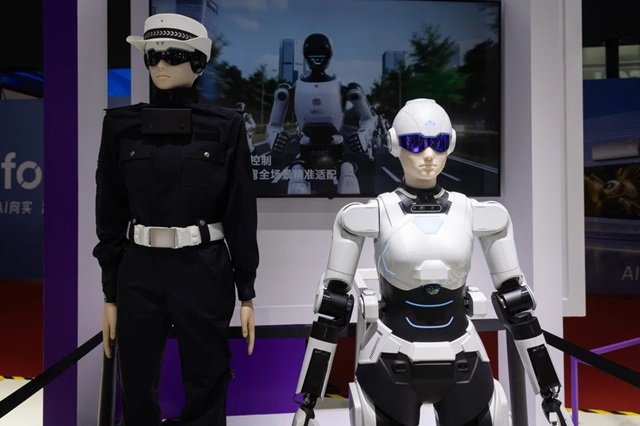
A decade ago, the prospect of China becoming the dominant force in the global automotive industry appeared unlikely. Today, the country produces more than half of the electric vehicles sold worldwide and has surpassed Germany and Japan to become the world’s largest automobile exporter. That transformation is now serving as a reference point for another emerging industry, as humanoid robots and advanced robotics show signs of following a similar trajectory within China’s export-driven manufacturing model.
The pattern reflects a broader trend that extends well beyond automobiles. China has secured significant positions across several of the world’s largest manufacturing sectors, accounting for 47 per cent of global battery exports, 43 per cent of mobile phone exports and 36 per cent of semiconductor component exports. Based on World Bank data, the country is estimated to have captured a 19 per cent incremental market share across the world’s 15 fastest-growing export segments, reinforcing its expanding role in international manufacturing.
That momentum is expected to continue. Projections indicate China’s share of global exports could rise from 15 per cent today to 16.5 per cent by 2030, supported by a strategy of identifying new high-growth industries before they reach maturity. Humanoid robots and robotics are increasingly viewed as the latest example of that approach.
Export figures suggest the sector is still in its early stages but is expanding rapidly. In the 12 months to March, Chinese exports of humanoid robots and related robotics products reached US$1.5 billion. The comparison with electric vehicles has attracted attention because EV exports stood at a similar level in early 2020 before expanding dramatically over the following years to an annualised run rate of US$86 billion. Electric vehicles also climbed from being a relatively minor export category in 2017 to becoming one of China’s leading exports, and observers see parallels in the development of the robotics industry.
Several structural factors underpin expectations that China will retain its manufacturing advantage as robotics expands. One of the most significant is the country’s record of identifying emerging industries early and directing policy support toward them. Intelligent robots were designated as a priority industry as early as 2021, and by 2023 China’s Ministry of Industry and Information Technology had classified humanoid robots as a strategic emerging sector. That early focus has helped manufacturers establish a substantial lead in production capacity.
Industry estimates illustrate the scale of that lead. According to estimates by technology research and advisory firm Omdia, as reported by Bloomberg, Chinese manufacturers produced about 90 per cent of the humanoid robots installed globally during 2025. The figures highlight the country’s growing influence over a market that is still developing but is attracting increasing global investment.
The expansion has been reinforced by China’s integrated manufacturing ecosystem. Domestic content in Chinese-made robots has risen from roughly 30 per cent to more than 50 per cent over the past five years, reflecting a growing ability to source key components locally. China also produces around 90 per cent of certain rare-earth magnet types that are essential to the hardware used in robotics, strengthening control over critical parts of the supply chain.
The country’s manufacturing capability extends beyond component production to the assembly of finished products. That combination has enabled China to capture an estimated 50 per cent of incremental global market share across industrial robot-related segments, reflecting the depth of its production network and its capacity to scale manufacturing across interconnected industries.
Financial support has also played a central role in the sector’s development. Local governments and financial institutions have provided incentives and funding to companies operating in high-growth industries, allowing firms to absorb early losses while expanding production and pursuing larger market share. The alignment between industrial policy and financial support has become a recurring feature of China’s manufacturing strategy.
Research and development spending provides another pillar of that approach. National investment in R&D reached approximately 2.8 per cent of gross domestic product in 2025, equivalent to about US$550 billion. While still below the United States as a share of GDP, the scale of investment places China second globally in overall spending. Robotics and artificial intelligence have also been incorporated into the country’s 15th Five-Year Plan as strategic emerging industries, embedding the sectors within long-term national development priorities.
Workforce development has complemented those investments. Around 41 per cent of China’s tertiary graduates hold degrees in science, technology, engineering and mathematics, compared with about 20 per cent in the United States. The concentration of technical graduates provides manufacturers with a large pool of engineers and specialists capable of supporting advanced industrial production as new technologies move from development into commercial manufacturing.
These factors coincide with expectations of rising industrial investment across Asia. Increased spending on artificial intelligence, AI-related infrastructure, energy transition projects, defence and broader industrial capital expenditure is expected to drive what has been described as an industrial supercycle across the region. As production capacity expands alongside demand for capital goods, China is positioned to benefit both from domestic manufacturing strength and growing regional investment.
The country’s strategy has consistently centred on scaling emerging industries faster than many competing economies. That model has already reshaped global markets for consumer electronics, solar products, batteries and electric vehicles. Humanoid robots and advanced robotics are now widely viewed as the next industries where China aims to apply the same formula of early investment, integrated supply chains, manufacturing scale and technological development.
The rapid pace of expansion, however, also presents challenges. When large numbers of companies enter the same sector simultaneously, manufacturing capacity can grow faster than demand. Such conditions may place downward pressure on prices, reduce profit margins and weaken investment returns as competition intensifies.
The expansion of production capacity also has broader economic implications. Persistent excess capacity can contribute to deflationary pressures and reinforce reliance on exports rather than domestic demand as a primary driver of economic growth. Policymakers have become increasingly aware of these risks as industries continue to expand, although the balance between accelerating growth, maintaining profitability and avoiding systemic deflation remains an ongoing consideration as China’s robotics sector moves into its next phase of development.