


A gambling and real estate empire owned by a prominent Cambodian businessman leased buildings that were later used as the base for large-scale online fraud and human trafficking operations, according to a Reuters investigation that uncovered rental agreements, witness accounts and physical evidence inside a compound abandoned after military action along the Thai-Cambodian border.
The findings centre on the Royal Hill Resort and Casino in O’Smach, a Cambodian border town opposite Thailand, where Reuters examined documents, interviewed investigators and former workers, and twice visited the site after it was abandoned following Thai military strikes in December. The investigation found that three buildings on land shared with the casino had been leased to a Chinese national under a contract worth $200,000 per month, with the facilities subsequently used for sophisticated online scam operations targeting victims around the world.
Reuters reported that the lease agreement, dated March 2024, identified Lim Heng Group, the company behind the Royal Hill Resort and Casino, as the landlord. The contract covered three buildings located within the casino complex and was signed by a representative of Royal Hill and a Chinese tenant whose identity Reuters withheld because it could not independently verify his role in the alleged criminal activities.
The news agency found no evidence that Lim Heng Group was directly involved in the trafficking or fraud conducted inside the leased buildings. However, Reuters established commercial links between the company and the compound that investigators say became one of the region’s largest scam centres.
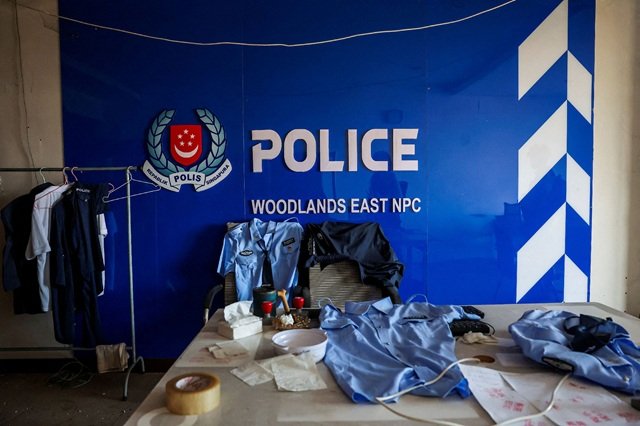
Inside the abandoned buildings, Reuters documented elaborate sets designed to imitate police stations and bank branches from several countries. Rooms decorated with official insignia, customer service counters and police emblems were allegedly used as convincing backdrops during impersonation scams targeting victims overseas. Small soundproof booths lined with acoustic foam appeared to have been built specifically for making fraudulent phone calls, while larger office areas contained desks, computers and documents linked to scam operations.
The compound also functioned as a residential facility. According to Thai security officials and people who said they had been trafficked there, dormitories filled with bunk beds housed workers who were allegedly forced to participate in fraudulent schemes. Reuters found abandoned personal belongings, police uniforms, paperwork and scripts intended for scam calls, including materials targeting victims in Australia.
The physical layout of the site reinforced the connection between the casino and the neighbouring buildings. Reuters reported that a paved road ran directly from the entrance of the Royal Hill Resort and Casino to the structures identified in the lease agreement. Satellite imagery reviewed for Reuters by architect Rizvi Hassan matched the dimensions described in the contract, while Thai military surveys found that two of the buildings contained approximately 250 rooms, consistent with the lease documentation.
The investigation also uncovered evidence suggesting Lim Heng Group had been alerted to allegations surrounding the property months before the compound was abandoned. Reuters reported that a representative of the company filed legal complaints in September 2024 against two Cambodian publishers whose media outlets had reported that foreigners were being confined inside the Royal Hill complex. Court summonses reviewed by Reuters did not specify which claims the company disputed.
One of the publishers, Penn Nuon, told Reuters that the reporting about foreign nationals being held at Royal Hill was accurate but that he removed the article after receiving legal advice in order to resolve the dispute. Reuters was unable to confirm whether the legal complaint was later withdrawn, and the Phnom Penh court involved did not respond to questions.
Thai authorities have since identified the property as part of a wider investigation into cyber fraud. General Thatchai Pitaneelaboot of the Royal Thai Police told reporters visiting the site that Chinese criminal groups had operated scams from the Royal Hill compound, although he did not identify the organisations involved. Reuters also reviewed two Thai security agency reports stating that investigators had established Lim Heng Group’s ownership of the property.
The case highlights the broader role that casino complexes have played in the expansion of organised online fraud across Southeast Asia. Reuters reported that many scam operations in the region are run by predominantly Chinese-led criminal syndicates that traffic people into heavily guarded compounds where they are allegedly forced to carry out romance scams, investment fraud and police impersonation schemes.
Jason Tower of the Global Initiative against Transnational Organized Crime told Reuters that casino businesses often provide criminal syndicates with opportunities to conceal illicit financial proceeds. Reuters also cited an Amnesty International investigation alleging that casino owners in Cambodia directly controlled at least a dozen scam centres, although Reuters said it had not independently verified those findings.
The Cambodian government has repeatedly pledged to eliminate scam compounds and has taken several enforcement measures, including extraditing casino owner and alleged scam kingpin Chen Zhi to China and introducing legislation targeting online fraud. Nevertheless, Reuters noted that officials have continued to describe Royal Hill as a hotel even after images from inside the compound showing fake police stations and bank branches were widely broadcast.
Responding to Reuters, senior Cambodian minister Chhay Sinarith said authorities remained committed to working with international partners to combat online fraud. He confirmed that Cambodia was investigating alleged scam operations in the Royal Hill area but said Thai forces should return control of the seized locations to facilitate those investigations. Cambodia’s military did not respond to Reuters’ questions regarding its relationship with Lim Heng.
Thailand has offered a sharply different account of the compound’s recent history. Reuters reported that the Thai military invited journalists to inspect the site after occupying it, stating that the complex had been targeted because soldiers believed casino buildings had been taken over by Cambodian military forces and used to launch drone and sniper attacks during the border conflict. Cambodian Information Minister Neth Pheaktra rejected those allegations, telling Reuters that Thailand had instead attacked civilian infrastructure.
Human trafficking survivors have provided further accounts of conditions inside the compound. Pornpen Aimhun, a Thai woman interviewed by Reuters, said she accepted what appeared to be a legitimate job advertisement for a web administrator position on Facebook in 2022 before being trafficked to Royal Hill. Instead of the promised employment, she said she was forced to participate in police impersonation scams while being monitored by guards carrying truncheons. Workers who failed to meet targets were punished, she told Reuters, before eventually escaping.
Reuters corroborated her account through another individual who said they had also been trafficked to Royal Hill and by Thai police, who confirmed that Pornpen had served as a witness in a court case connected to fraud carried out at the complex. Thai authorities later secured the conviction of a Thai national who admitted voluntarily working as a low-level scammer at Royal Hill. According to a police statement cited by Reuters, the individual was sentenced to five years in prison, although the statement did not identify the employers behind the operation.
The abandoned compound now stands as both a crime scene and an active focus of investigations spanning multiple countries. Documents, staged offices, deserted dormitories and lease agreements examined by Reuters continue to form part of inquiries into one of Southeast Asia’s largest alleged scam operations, while authorities in Cambodia and Thailand pursue separate investigations into the network that once operated behind the walls of the Royal Hill complex.









