


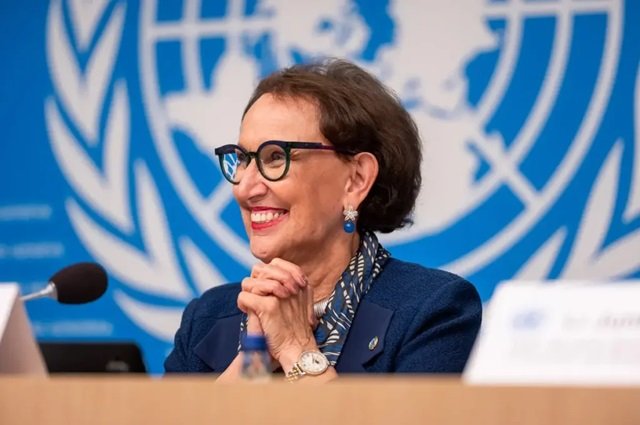
Rebeca Grynspan has strengthened her position in the race to succeed António Guterres as United Nations secretary-general, winning a fourth informal vote in the Security Council and widening her lead over Guyana’s Carolyn Rodrigues-Birkett.
Grynspan, 70, secured the backing of 10 of the council’s 15 members, according to diplomatic leaks cited in reports on the closed-door process. Three countries voted against her and two abstained. She has now emerged as the leading candidate in two of the four informal consultations, while the results of the other two also placed her prominently in the contest.
The result gives Grynspan several advantages. Her 10 supporting votes put her above the nine votes required for a candidate to prevail in the Security Council. She also reduced the number of negative votes recorded against her compared with the previous consultation. Rodrigues-Birkett, who again finished second, received eight votes in favour, six against and one abstention.
The figures do not, however, reveal the most consequential element of the contest: whether any of the three countries opposing Grynspan is one of the five permanent members of the Security Council — the United States, China, France, the United Kingdom and Russia. Their veto power means that a candidate’s overall support among the 15 council members does not by itself determine the outcome.
That distinction will become clearer in the next stage of the process, when the Security Council conducts the so-called “colour” votes. At that point, the positions of the permanent five become identifiable and candidates facing opposition from them begin to be eliminated. The Security Council conducts the selection process behind closed doors, without formally publishing the results, leaving diplomats as the main source of information about the informal ballots.
A major unresolved factor is the position of US President Donald Trump, who has not disclosed whom he might support for the post beginning in 2027. The rules governing the selection do not establish a fixed timetable or prevent a candidate from being introduced at any stage. Some foreign ministries therefore consider it possible that an additional candidate could emerge in the coming days or weeks. At the same time, reaching agreement among the five permanent members becomes more difficult as the process advances.
Grynspan is secretary-general of the United Nations Conference on Trade and Development, although she is currently on leave from that position while pursuing the UN post. She previously headed the Ibero-American General Secretariat and served as second vice-president of Costa Rica under President José María Figueres Olsen in the 1990s.
The regional rotation convention also favours a Latin American candidate. The secretaries-general of the past three decades have come from Europe, Asia and Africa, with Guterres, Ban Ki-moon, Kofi Annan and Boutros Boutros-Ghali representing those regions. Regional rotation, however, is not a written rule, and a candidate from another region could be selected if they secured the necessary support.
There is also broad advocacy for the appointment of a woman as UN secretary-general for the first time. Once the Security Council agrees on a candidate, the General Assembly, which comprises all UN member states, would vote to confirm the nomination. That stage is generally regarded as largely procedural.
Argentina’s Rafael Grossi, director-general of the International Atomic Energy Agency, recovered slightly in the latest vote after losing momentum following an initially strong showing. With former Chilean president Michelle Bachelet having withdrawn for lack of support, seven candidates remain, although further eliminations are expected as the next consultations expose which candidacies cannot secure sufficient backing.









