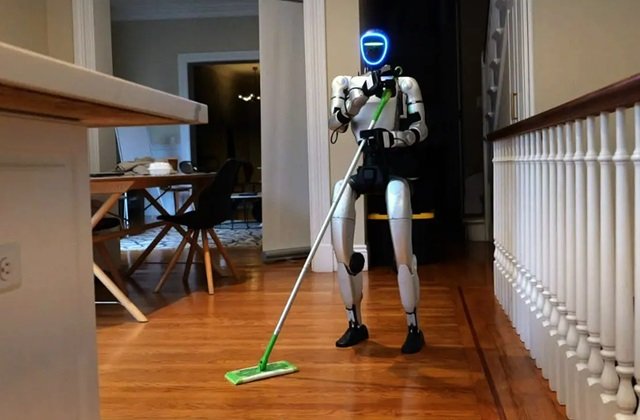
A humanoid robot that cleans kitchens, scrubs toilets and folds laundry is now being rented to households in San Francisco, offering an early test of whether machines designed for factories can eventually cope with the unpredictable conditions of everyday domestic life.
The service is being offered by Tau Robotics, a small start-up founded by two graduates of the Technical University of Munich, Alex Koch and Cornelia Weinzierl. Since launching the service in July, the company has deployed eight cleaning robots. Customers pay $30 an hour to have a machine perform household tasks, although the robots are currently far slower than human cleaners and the service does not yet cover its costs.
The account was reported by German newspaper Die Zeit, which observed one of the robots during a cleaning session. The machine initially struggled to cross the threshold of the entrance, repeatedly slipping on a slightly inclined strip that would barely register to a person. On its sixth attempt, an operator remotely intervened and guided it over the obstacle. The robot then entered the flat and headed towards the kitchen.
Despite its humanoid appearance and ability to move around a home, the machine is not yet fully autonomous. A remote operator watches through a virtual-reality headset from the company’s office, effectively seeing through the robot’s cameras and intervening when necessary. The company’s own description, printed on the robot’s T-shirt, is “Human + AI Operated”.
Tau’s business model resembles the model already used by autonomous taxi services in San Francisco: customers do not buy the expensive machine but pay for the service it provides. For the company, however, the household visits are about more than earning revenue. The $30 hourly charge is not enough to cover operating costs, but the assignments provide publicity and, more importantly, a stream of data from real homes.
Unlike a standard industrial environment, a household presents the robot with constantly changing surroundings. Every unfamiliar room can contain objects, obstacles and situations that were not encountered during previous operations. Weinzierl, who is responsible for the company’s software, described herself as being “in research heaven”. Each working day produces information about where the robot struggled and which unexpected situations it encountered, allowing those experiences to be incorporated into its models.
During the Die Zeit test, the robot managed several kitchen tasks with relatively little intervention. It sprayed cleaning fluid onto work surfaces, wiped them, moved objects out of its way, picked up a vacuum cleaner, cleaned the floor and then used a mop. But the session also demonstrated the limitations of the technology. In the bathroom, the robot attempted to clean a chest of drawers that it had been instructed to avoid because fragile objects were sitting on it. When a person tried to stop it, the robot did not respond until Weinzierl intervened. The robot then apologised, although the voice belonged to the operator. Weinzierl explained that the microphones were not yet sufficiently effective and that, in this case, the operator had simply failed to hear the instruction.
Tau develops its own gripping hands and software but uses a Chinese Unitree G1 robot as the underlying hardware. Each machine costs about €25,000, making it cheaper than most robots manufactured in the United States. That dependence could become a problem: the source reports that the US Commerce Department banned imports of Chinese robots in July over security concerns. Tau could nevertheless potentially switch to another manufacturer because, according to the company, hardware is no longer the principal obstacle in humanoid robotics.
The greater challenge lies in software. Industrial robots generally operate in controlled environments where the surroundings and tasks remain predictable. A domestic robot must determine whether an object blocking its path is a baby, a pet or a discarded blanket. It must also perform movements such as folding a T-shirt or removing fragile crystal glasses from a dishwasher, tasks considerably more complicated than retrieving a standardised package from a warehouse shelf.
Artificial intelligence is being developed to address this problem through so-called “world models”, which allow robots to learn from large quantities of physical-world data rather than receiving explicit instructions for every movement. Tau is developing its own model, adapted to its robots and household tasks, and is seeking to accumulate data as early as possible.
The technology still has basic weaknesses. A glass table, Weinzierl noted, is an example for which the company has very little data. Folding a teenager’s freshly washed pyjamas also proved difficult when one leg of the trousers was inside out. With human assistance, the robot eventually corrected the problem and folded the garment surprisingly well.
Tau currently faces limited competition in the household-robot market. Major companies including Samsung and Amazon have reduced their ambitions in this area and are concentrating for now on industrial applications, where robots can already operate with comparatively high levels of autonomy. The potential market for household humanoids remains uncertain, with forecasts for 2035 ranging from $8 billion to $165 billion. Morgan Stanley has projected a global population of one billion robots worth $5 trillion by 2050.
For now, the practical gap between human and robotic household labour remains substantial. At the end of the Die Zeit test, the robot had vacuumed and mopped but was not trusted with porcelain. It completed no more than one-fifth of what a human equivalent could have achieved in the same period. Tau’s objective is to make the machines faster and sufficiently autonomous that one operator can eventually supervise two, three or even ten robots simultaneously.