


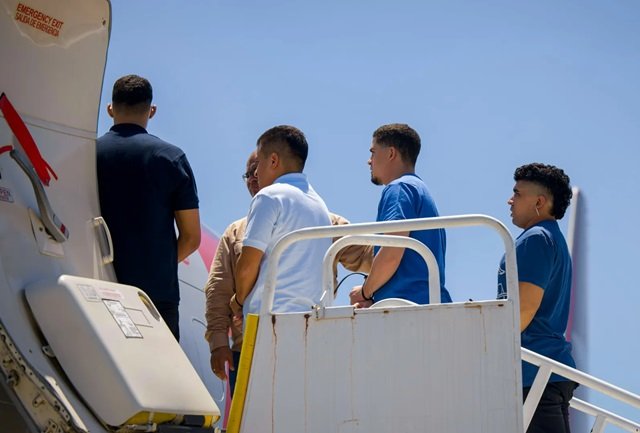
The US Supreme Court has temporarily allowed the administration of President Donald Trump to resume deporting people who entered the country without legal permission to countries other than their own, without providing them with meaningful advance notice in many cases.
The court’s conservative majority granted the administration’s request on Tuesday, over the objections of the three liberal justices, and put on hold an order by a federal judge requiring migrants facing removal to receive notice and a meaningful opportunity to argue that they could face persecution or torture in the country to which they were being sent. The Supreme Court is due to hear arguments over the policy in December, and Tuesday’s order will remain in effect while the government appeals the lower-court ruling.
The justices did not explain their decision. They did, however, identify several issues for both sides to address in written briefs, including whether the lower court had jurisdiction over the case and authority to impose a broad injunction, and whether the government’s policy violates federal immigration law or constitutional due process protections.
Justices Sonia Sotomayor, Elena Kagan and Ketanji Brown Jackson said they would have rejected the government’s request but did not issue a dissenting opinion. Trina Realmuto of the National Immigration Litigation Alliance, a lead attorney for the migrants challenging the policy, said the order did not determine whether the deportation programme was lawful. Allowing the policy to resume, she said, was “a devastating result for people who may be put on a plane before they ever have notice or an opportunity to raise a fear claim”.
White House spokesperson Lauren Bis said the decision “yet again affirms the lawfulness of the president’s homeland security agenda”. She said it was the third time in the past year and a half that the Supreme Court had intervened in the case in favour of the administration.
The government has argued that court intervention has disrupted deportation operations. Solicitor General D. John Sauer told the justices that a federal appeals court had created “chaos” by allowing the lower-court ruling to take effect the previous week. He said the government had been forced to cancel a flight carrying 70 migrants to three countries, creating logistical and financial difficulties as well as potential diplomatic problems.
The litigation comes as the administration pursues arrangements with countries willing to accept migrants who are not their citizens. According to the Washington Post, the administration has reached agreements with 31 countries. The migrants challenging the policy told the Supreme Court that people deported to third countries had faced indefinite detention, disappearance, abuse and what they described as “chain refoulement”, in which a third country sends migrants onwards to their country of origin.
The policy emerged from the administration’s efforts to deport people who cannot be sent directly to their home countries because they fear persecution or torture there. Under a Department of Homeland Security policy, migrants are not guaranteed notice before being sent to a third country. A June 2025 Immigration and Customs Enforcement memo said officials would “generally wait at least 24 hours” before deporting someone to a country that had not disavowed persecution or torture.
The Supreme Court had already intervened twice in the case. In June 2025, it lifted a preliminary order by US District Judge Brian Murphy in Boston that required 10 days’ notice and an opportunity to be heard before migrants could be sent to third countries. A subsequent order allowed eight migrants to be deported to South Sudan, which was then on the State Department’s “Do Not Travel” list amid armed conflict.
Murphy later ruled that the administration’s expedited deportation policy violated federal immigration law and the Constitution’s due process clause. The 1st US Circuit Court of Appeals largely upheld his ruling on September 18. Judge Seth Aframe wrote that the right to challenge removal based on fear of persecution “means little” without prior notice of the intended destination and a meaningful opportunity to contest it. The Supreme Court case is Department of Homeland Security v. D.V.D., 26a406.









