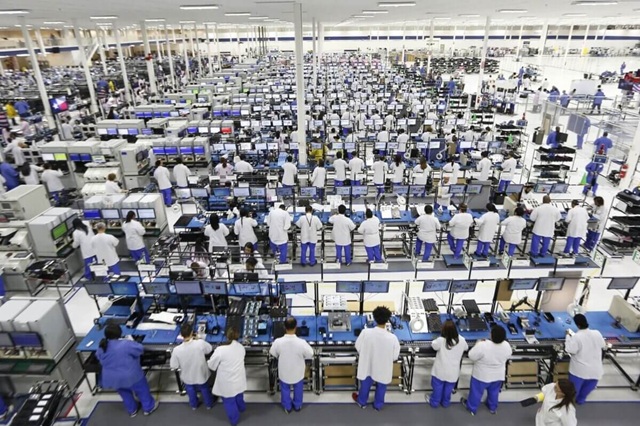
As global trade tensions escalate, Beijing is taking sweeping measures to tighten control over its advanced technologies, critical minerals, and skilled workforce. In an effort to prevent key industrial know-how from leaving the country, Chinese authorities have imposed stricter controls on the movement of engineers and equipment, introduced new export restrictions on cutting-edge battery technologies, and moved to curb foreign access to vital mineral processing capabilities.
According to the Financial Times, these restrictions have already impacted major global companies, including Apple’s primary contractor, Foxconn. The Taiwanese-owned manufacturer, which has been leading Apple’s efforts to diversify its supply chain into India, has faced significant hurdles in transferring machinery and experienced Chinese technical managers to its Indian operations. Sources familiar with the matter suggest that Chinese officials have made it increasingly difficult for companies to move essential manufacturing resources abroad, particularly to India. An Indian government official, who spoke anonymously, alleged that China was deliberately using customs delays to impede the shipment of key components and equipment to India, further complicating efforts to shift production out of China.
The restrictions are not limited to Foxconn. Other Taiwanese electronics manufacturers have also encountered obstacles in exporting equipment from China to their Indian facilities, although shipments to Southeast Asia reportedly remain unaffected. This selective approach suggests that Beijing is particularly targeting India—one of its main geopolitical and economic rivals—while maintaining relatively open trade flows with other regions such as Southeast Asia and the Middle East.
Beyond manufacturing, China is implementing increasingly rigid controls over its leadership in high-tech industries, particularly in battery production. The country’s commerce ministry recently proposed new restrictions on the export of lithium extraction technology and advanced battery materials—areas where China holds a dominant position. Analysts warn that if these controls are fully enforced, Chinese battery giants such as CATL, which operate factories in Europe, may struggle to transfer their entire supply chains overseas. Instead, they may be forced to continue importing advanced lithium iron phosphate (LFP) cathodes and other key battery materials from China, limiting the ability of foreign manufacturers to develop independent supply chains.
The proposed restrictions could also disrupt global efforts to diversify lithium production. According to the Financial Times, a $1.4 billion lithium extraction project in Bolivia, backed by CATL, would require special export licenses to use Chinese-developed technology. This move underscores China’s increasing leverage over the global battery supply chain at a time when Western and South Korean manufacturers are scrambling to secure alternative sources of lithium and other critical materials.
China’s grip extends beyond batteries. Over the past few years, Beijing has gradually expanded its controls over strategic minerals such as rare earths, tungsten, and tellurium. These restrictions now not only limit the export of raw materials but also the technology needed for their extraction, refining, and processing. In December 2023, China took this a step further by imposing new curbs on the processes required to turn refined rare earth elements into the high-performance magnets used in electric vehicles, wind turbines, and advanced electronics.
Given that China produces an estimated 95% of the world’s permanent magnets, these measures could have far-reaching implications. A U.S.-based executive working on alternative supply chains told the Financial Times that these new restrictions would make it even more difficult for Western companies to build independent industrial ecosystems, as China continues to hold a near-monopoly over the materials and processing technologies essential for high-tech manufacturing.
Experts believe Beijing’s ultimate strategy is to maintain its central role in global supply chains while countering Western attempts to reduce dependence on Chinese technology. “China is building up a large export control muscle and being quite deliberate in what they choose to control,” said Antonia Hmaidi, a senior analyst at the Mercator Institute for China Studies. Rather than restricting finished products, Beijing is targeting upstream supply chain segments where Chinese firms dominate both material resources and technological processes.
While China has long criticized U.S. and European restrictions on its tech sector as unfair trade barriers, its own tightening of export controls mirrors the very policies it opposes. As these measures take effect, global manufacturers, particularly in the electronics and energy sectors, are likely to face mounting challenges in securing critical resources, further exacerbating the ongoing trade war and deepening the fragmentation of global supply chains.