Across Europe, young people are increasingly taking to the streets to demand change, confronting governments over everything from unaffordable housing and underfunded education to corruption, economic insecurity and a perceived lack of political accountability.
In recent days, hundreds of thousands of young people and other protesters have demonstrated in France, Italy, Albania, Spain, Serbia, Portugal, Britain, Belgium, Ireland and Greece, according to Die Zeit, the German newspaper that reported on the wave of unrest.
Although the protests differ in their immediate causes and political contexts, they reveal a common frustration: many young Europeans believe the systems governing their lives are failing to offer them a credible future.
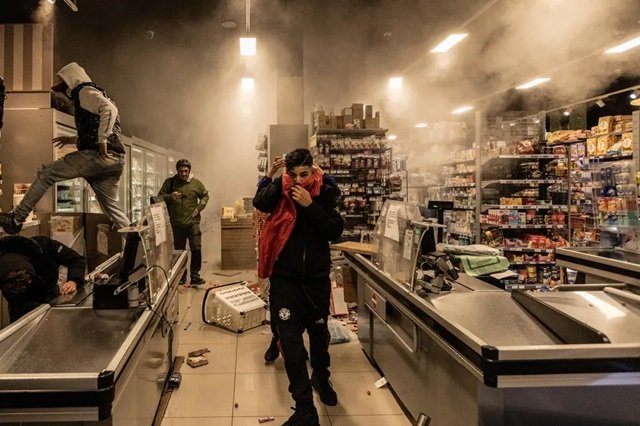
Some demonstrations have remained peaceful, while others have descended into violence, looting and arson. In France, rioters reportedly looted thousands of businesses, while the historic town hall in Limoges was almost completely destroyed by fire. In Albania, demonstrators threw incendiary devices at government buildings, including the Education Ministry.
Yet the violence, which has attracted international attention, risks obscuring the grievances that initially brought many protesters onto the streets.
France: Education demands overshadowed by unrest
France has witnessed some of the largest youth demonstrations. Secondary-school students initially mobilised to demand smaller classes, shorter school days and more secure university places.
However, widespread disorder in cities including Paris, Marseille and Lyon has shifted the political debate towards public security.
Prime Minister Sébastien Lecornu described the absence of fatalities during a particularly turbulent weekend as extraordinary. The unrest also left young demonstrators seriously injured, including a 17-year-old student who lost an eye after being struck by a police projectile and another teenager who lost his right hand after a grenade-related injury, according to the source report.
Authorities have considered stricter security measures, while business owners have sought compensation for damage. The renewed focus on policing has pushed the students’ original education demands into the background.
The episode illustrates a wider dilemma facing protest movements: once demonstrations turn violent, their underlying social and political demands can be eclipsed by the struggle to restore public order.
Spain: Housing becomes a generational battleground
In Spain, the cost of housing has become a central source of anger. Protest camps in Madrid and other cities have highlighted the difficulties faced by tenants struggling with soaring rents and insecure accommodation.
The movement has attracted many young people, but its grievances extend across generations.
According to Die Zeit, nationwide protests gained momentum after an 87-year-old woman was forced to leave her home when a new property owner sought to increase her monthly rent from €500 to €2,650. The woman subsequently died in early October.
Tenant organisations have demanded lower rents, more secure rental contracts and measures targeting large property investment funds. Major trade unions have also called for higher wages to help workers cope with rising housing costs.
With housing emerging as a major issue in Spain’s political debate, the protests expose a fundamental tension between property ownership, investment and the right to affordable accommodation.
Italy: A generation without hope?
In Italy, students have demanded greater public investment in education, while demonstrations in Turin, Milan and Bologna have been accompanied by looting and clashes.
Authorities attributed some of the violence to anarchist groups associated with the so-called Black Bloc. The participation of very young people, including minors, has intensified debate over social exclusion, migration and integration.
But the protests have also prompted a deeper question about generational inequality.
Philosopher and politician Massimo Cacciari, cited by Die Zeit, described the demonstrators as “young Europeans without hope”, reflecting a broader perception that younger generations have been betrayed by the political choices of their elders.
Albania: Rising prices, shrinking opportunities
In Albania, protests have expanded from opposition to controversial development projects into a broader challenge to economic inequality and government accountability.
Demonstrators in Tirana have criticised luxury developments and the transformation of urban and coastal areas while ordinary citizens struggle with low wages and rising living costs.
Three young women interviewed by Die Zeit described earning or expecting monthly salaries of €300 to €400 while rents in Tirana begin at around €500. Many young people therefore remain dependent on their families for housing.
The grievances extend beyond property prices to expensive food, limited employment opportunities and concerns about development benefiting wealthy investors rather than local communities.
A slogan painted on a wall in Tirana captured the mood: “When prices rise, expect a revolution.”
Serbia: Corruption and demands for accountability
In Serbia, the collapse of a railway station canopy in Novi Sad on 1 November 2024, which killed 16 people, triggered a protest movement led initially by students and school pupils.
The demonstrators accused the authorities of corruption and mismanagement, pointing to the fact that the structure had been renovated only months before the fatal collapse.
The movement subsequently expanded, drawing large sections of society into demonstrations demanding accountability and the resignation of President Aleksandar Vučić. At its peak in March 2025, more than 300,000 people reportedly demonstrated in Belgrade.
Students have continued to organise without a clearly identifiable leadership, demanding transparency, the rule of law and action against corruption. The movement has also exposed the depth of frustration among young Serbians who fear that their prospects will remain limited if the current political system persists.
A common crisis beneath different protests
The protests across Europe cannot be reduced to a single movement or ideology. Their demands range from education reform and affordable housing to anti-corruption measures and opposition to political leadership.
Nor are all demonstrators young, and participation in the protests does not necessarily indicate agreement on a common political programme.
Nevertheless, the recurring themes are difficult to ignore. Housing is increasingly unaffordable, wages often fail to keep pace with living costs, educational opportunities appear inadequate to some students, and allegations of corruption have undermined trust in political institutions.
For many young people, the problem is not simply that life is expensive. It is that the traditional promise of progress through education, employment and civic participation appears increasingly uncertain.
The violence accompanying some demonstrations presents an additional challenge. Governments must address public safety and criminal damage, but a response focused exclusively on policing risks leaving the underlying grievances unresolved.
Europe’s youth protests therefore represent more than a succession of national disturbances. They expose a growing crisis of confidence in the continent’s social and political arrangements.
Whether the demonstrations lead to meaningful reforms or deepen political polarisation will depend on how governments respond to the demands for opportunity, accountability and a more secure future.
As Die Zeit’s reporting across the continent suggests, the question facing Europe is no longer simply why young people are protesting. It is whether its political institutions can persuade a new generation that change is possible without taking to the streets.