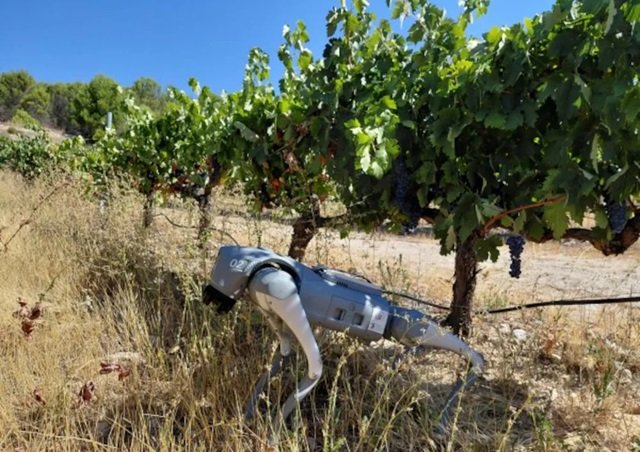
A four-legged robot designed to move autonomously through agricultural land and analyse crops using artificial intelligence is being developed in Spain, with researchers aiming to give farmers more precise information about fruit maturity, expected yields and harvesting conditions. The project, led by the National Agri-Food Technology Centre (CTAEX) in Extremadura, is intended to help agricultural professionals make better-informed decisions by collecting and processing data directly from fields.
Known as AGRHOUND, the initiative seeks to change how farmers monitor their holdings by combining robotic mobility, sensors and artificial intelligence algorithms to gather and analyse information in real time. The system is intended to identify variations between different areas of a field, assess crop development and eventually help determine which sections are ready for harvesting. Its developers say the technology could also make it easier to estimate the quantity of produce available and identify potential differences in quality across a farm.
Luis Muñoz, research and development project manager in CTAEX’s Agriculture Department, describes the objective as putting “legs on precision agriculture”. The concept involves a robot that can navigate agricultural plots independently, collect information through sensors and process the resulting data into practical knowledge for farmers. According to CTAEX, its four-legged design should enable it to explore terrain and cultivated spaces where other mobile platforms may encounter difficulties.
The project remains in its early stages, having begun in June, with development expected to continue until early 2029. Researchers are initially concentrating on establishing reliable autonomous movement across different agricultural environments, including open fields, polytunnels and greenhouses. Muñoz says the first phase is focused on ensuring that the robot can navigate these settings independently before additional analytical capabilities are introduced.
Once the mobility system has been developed, the next objective is to enable the robot to characterise crops and produce spectral maps in real time. These maps are expected to provide information about variations in crop conditions and fruit maturity across individual plots. In a subsequent phase, researchers hope to equip the system to distinguish between different areas of a field, decide autonomously where it should travel and collect samples without human intervention.
Initial trials are taking place in two distinct agricultural settings: vineyards used for wine production and blackberry plantations cultivated under polytunnels. The vineyard work is being conducted in collaboration with Bodegas Familiares Matarromera in the province of Valladolid, while the trials involving soft fruit are taking place at facilities operated by Social Berries in Huelva.
Progress differs between the two crops, reflecting the amount of relevant information already available to researchers. Muñoz says the team has developed a relatively advanced algorithm for the Tempranillo grape variety, drawing on data accumulated during previous precision agriculture projects. Adapting the technology to blackberry cultivation, by contrast, effectively requires researchers to start from scratch.
During 2026, the principal efforts are focused on gathering information and establishing the algorithms needed to interpret it. The data collected during this period will provide the foundation for further development, with the agricultural campaigns of 2027 and 2028 intended to supply additional information and allow researchers to assess the system under real operating conditions. These stages will be important in determining whether the robot can deliver reliable results beyond the initial development environment.
One of the intended applications is the production of maps showing the maturity of fruit across an agricultural holding. By identifying differences between areas, the system could help farmers estimate available production, establish which sections are ready for harvesting and assess possible variations in crop quality. Such information could support decisions about where harvesting should begin and how agricultural work should be organised across a plantation.
The developers also plan to make the results accessible through an application with a straightforward interface. Farmers and agricultural technicians would be able to interpret the information without requiring specialised technical knowledge. The approach is intended to make the analytical capabilities of the robot usable in everyday farming rather than restricting them to researchers or technology specialists.
The proposed technology also raises the question of how greater automation might affect agricultural employment. CTAEX maintains that the robot is being developed to support agricultural professionals rather than replace them. Muñoz says the system could allow farmers to inspect more plots in less time and collect information that is currently difficult to obtain. Its role, according to the project team, would be to provide additional evidence for decisions that remain central to the work of farmers and technicians.
However, the project’s developers acknowledge that technical performance alone will not establish its value. One of the principal challenges will be demonstrating that the robot is genuinely useful and economically worthwhile for agricultural businesses. Researchers must also ensure that operating the technology is sufficiently straightforward for it to become part of routine farm management.
Although the first trials concentrate on vineyards and blackberry plantations, CTAEX hopes the system can eventually be adapted to other agricultural crops. Its broader application will depend on the results of development and testing during the coming agricultural campaigns. For now, the project remains an experimental system whose practical benefits must be established through field trials, including whether the information collected by the robot can reliably help farmers determine harvesting times, estimate production and identify differences in crop quality.