
by Durga
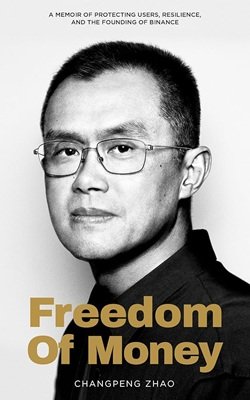
Changpeng Zhao’s Freedom of Money is an unusually self-reflexive work for a figure so deeply entangled in the infrastructural power struggles of contemporary finance. It is at once memoir, apologia, and philosophical tract, attempting to stabilise a reputation that has been repeatedly destabilised by regulatory action, market crisis, and ideological controversy. Yet its most striking feature is not its confessional tone, but the tension it cannot resolve: between an account of technical idealism and an institutional history marked by systematic compliance failure, between a libertarian rhetoric of “freedom” and the coercive realities of global financial regulation. The book is therefore less a settled narrative than a site of ongoing contestation over what cryptocurrency was, what Binance became, and what Zhao himself now believes it ought to mean.
From its opening pages, the text is framed by the spectacle of legal consequence and personal disruption. Zhao recalls the moment of stepping down as CEO with a strikingly cinematic quietude: “I wrote those words on X at 2:47 PM Pacific Time, sitting in a hotel room in Seattle… What it didn’t capture—what no press release could capture—was the strange silence that followed after I hit send” (p.11). The emphasis here is not on culpability but on affective dislocation, a managerial subject suddenly estranged from its own institutional role. Yet this existential framing is immediately complicated by a legal admission: “I had pleaded guilty to one count of violating the Bank Secrecy Act… I had made mistakes. I had prioritized growth over compliance” (p.11). The rhetorical move is characteristic of the book as a whole: confession is acknowledged, but carefully bounded within the language of “mistake,” a term Zhao himself later problematises as too trivial for what occurred.
What emerges early is a dual narrative structure: personal introspection layered over institutional rationalisation. The $4.3 billion settlement is described as “a number that sounds abstract until you realize it represents every transaction, every user, every decision made over six years of building” (p.208). This attempt to humanise financial penalty simultaneously disperses responsibility across an entire organisational ecosystem, diluting agency even as it acknowledges it. Zhao’s reflection—“I had been paying attention. Just not to the right things” (p.209)—is perhaps the book’s most revealing sentence, not because it denies intent, but because it redefines failure as misallocated attention rather than structural negligence.
The question of structure is central. The book repeatedly returns to the claim that compliance failures were not intentional evasion but institutional lag: “Our compliance team was understaffed relative to our growth. This was not a deliberate choice to ignore compliance” (p.186). Yet this assertion sits uneasily alongside regulatory findings cited in the text itself, including allegations of “over 100,000 suspicious transactions tied to designated terrorist organizations” and the failure to file “a single Suspicious Activity Report with FinCEN” (p.110). The disjunction between scale and explanation is never fully reconciled. Zhao’s framing oscillates between technocratic overwhelm and moral acknowledgement: “these aren’t abstract violations… every transaction we should have flagged but didn’t… had consequences in the real world” (p.111). The text thus stages a persistent ambiguity: was Binance overwhelmed by its own success, or structurally indifferent to the obligations that success entailed?
This ambiguity becomes sharper when Zhao addresses intent. He insists, for example, that while communications on Signal were cited in regulatory complaints, “the framing suggested intent to hide evidence, which was not my intent at all” (p.186). Yet elsewhere he concedes that “we did discuss how to address these issues… the gap between knowing about a problem and deliberately evading the law is significant” (p.194). The argument rests on a distinction between awareness and intentionality that regulators explicitly reject, but Zhao treats as ethically decisive. The result is a moral grammar in which intent is privileged over outcome, even as the consequences—systemic regulatory breach, sanctions exposure, and user harm—are acknowledged.
Nowhere is this tension more pronounced than in his reflection on enforcement itself. The SEC’s allegations are described as applying laws “written in the 1930s… designed for a world of stock certificates and broker-dealers” (p.198). Zhao’s frustration is not with regulation per se but with interpretive certainty: “the implication that anyone who disagreed was either stupid or criminal” (p.199). This rhetorical move reframes regulatory disagreement as epistemological conflict rather than legal adjudication. Yet it also risks obscuring the fact that regulatory systems routinely evolve through precisely such interpretive enforcement. What Zhao presents as rigidity may also be read as the ordinary operation of law confronting technological novelty.
The book’s most dramatic ethical episode—the FTX collapse—introduces a comparative frame that subtly rehabilitates Binance by contrast. Zhao recounts receiving a request for assistance: “Sam was asking for help. The number was $8 billion” (p.196). The eventual withdrawal is framed as reluctant necessity: “We tried to help. We discovered we couldn’t. We withdrew” (p.200). The moral lesson Zhao extracts is procedural rather than structural: “due diligence isn’t bureaucracy—it’s the difference between responsibility and complicity” (p.199). Yet this insight sits in tension with earlier accounts of Binance’s own rapid expansion, where due diligence is repeatedly described as lagging behind growth. The reader is left to ask whether Binance avoided catastrophe by principle or by distance from a more immediately insolvent counterpart.
A recurring interpretive strategy in Freedom of Money is temporal deferral: problems are most clearly understood “after the crisis occurs” (p.187). This retrospective clarity becomes a defence against present accountability. The claim that “the changes that would have prevented the crisis are obvious after the crisis occurs” (p.187) is empirically plausible but analytically insufficient; it risks collapsing critique into hindsight. The deeper issue is not that problems are only visible later, but that institutional design consistently prioritised scalability over precaution. Zhao himself partially acknowledges this when he writes: “If you celebrate deal-makers and ignore compliance officers, your culture is clear regardless of what values you publish” (p.188). Here, structural critique briefly displaces personal exculpation, though it is not sustained.
The philosophical core of the book lies in its evolving concept of “freedom of money.” Initially defined as “people should be able to access, move, and use their wealth without arbitrary restrictions” (p.100), it gradually expands into a broader ontology of autonomy. By the end, Zhao reframes freedom itself: “freedom is not the absence of constraint. It is the intelligent navigation of constraint” (p.296). This shift is significant, marking a move from libertarian minimalism to pragmatic realism. Yet it also introduces conceptual instability. If freedom is navigation rather than absence, then the earlier critique of regulatory constraint becomes harder to sustain. Constraint is no longer merely an obstacle but a condition of meaning.
This philosophical recalibration is clearly shaped by lived experience, particularly incarceration. Zhao’s description of prison life emphasises temporal and existential transformation: “Time moves differently here… the slow, grinding removal of autonomy” (p.243). The insight that “freedom wasn’t just the ability to go where you want… it was the ability to decide your own time” (p.246) is one of the book’s most compelling passages, precisely because it universalises rather than exceptionalises experience. Yet even here, the reflection is ultimately individualised: “they could control my body… but they couldn’t control what I thought about” (p.248). The persistence of internal sovereignty becomes a compensatory space for external constraint, reinforcing a familiar liberal distinction between body and mind.
If the prison sections offer philosophical depth, the sections on media and narrative reveal a more defensive posture. The “4” meme, initially described as “efficient” communication, is later reinterpreted as “a form of surrender” (p.157). Zhao acknowledges that “not all criticism is FUD” (p.180), and that reflexive dismissal undermines institutional learning. Yet this recognition arrives late in the narrative and does not fully address earlier communication strategies that arguably contributed to adversarial regulatory and media relationships. The assertion that “the damage was done in the first paragraph; the correction was read by no one” (p.156) is rhetorically powerful but analytically one-sided, attributing asymmetry to media structure rather than institutional opacity.
A further tension emerges in the discussion of decentralisation. Binance’s blockchain initiatives are defended as pragmatic: “developers need something that runs. Perfection isn’t the starting point; functionality is” (p.136). Critics’ accusations of “centralized decentralization” are acknowledged as “not entirely wrong” (p.135). Yet this admission is never fully integrated into a theory of governance. Instead, decentralisation becomes a sliding scale of trade-offs, where performance repeatedly justifies centralisation. The philosophical question—whether decentralisation is a principle or a branding layer—remains unresolved.
What ultimately distinguishes Freedom of Money is not its admissions, which are extensive, but its interpretive discipline. Zhao repeatedly insists on moral complexity: “I do not know… I believe that financial exclusion is a form of violence… But I also believe that this tool can be misused” (p.173). This equivocation is intellectually honest but politically evasive. It allows contradictory positions to coexist without adjudication. Similarly, his claim that “I had not built a house of cards designed to enrich me at others’ expense” (p.210) asserts moral distinction without fully engaging structural critique of risk externalisation.
The book’s final reflections attempt synthesis: “freedom is not the absence of constraint. It is the intelligent navigation of constraint” (p.296). Yet this conclusion, while philosophically mature, also functions as a retrospective rationalisation of a career defined by operating at the edge of regulatory constraint. The transformation from “exchange the world” idealism to constrained navigation mirrors Binance’s trajectory from insurgent exchange to regulated financial actor. Whether this represents genuine intellectual evolution or post hoc reconciliation remains an open question.
Freedom of Money is most compelling when it inadvertently exceeds its author’s control—when it reveals, rather than resolves, the contradictions of crypto capitalism. Zhao’s insistence on intent, complexity, and evolution is persuasive at the level of individual psychology, but less so at the level of institutional accountability. The book thus stands as both confession and defence, critique and justification. Its greatest achievement may be its unintended honesty: in attempting to narrate a life of financial disruption, it exposes the structural instability of the very freedom it seeks to defend.