by Durga Velayudham
In Changsha, the capital of Hunan province, the traces of Hui Ka Yan’s extraordinary rise and fall can be found in the unfinished buildings, abandoned construction sites and apartment developments that once represented the promise of China’s property boom. Among them is Changsha Evergrande Oasis, where a resident known as Yang bought an apartment for Rmb615,000 ($85,000) in 2009. At the time, Yang knew “nothing about Evergrande” or “where its money came from”. More than a decade later, the company founded by Hui would become synonymous with one of the largest corporate collapses in China’s history.
Hui, who was China’s richest person in 2017, has now been sentenced to life in prison by the Shenzhen Intermediate People’s Court. The court said he was being punished for “multiple crimes” and ordered his assets confiscated. Evergrande was fined Rmb8.8bn ($1.3bn), while Evergrande Real Estate, its mainland business, was fined Rmb7bn.
The sentence closes a remarkable chapter in the career of a man whose rise was closely connected to the forces that transformed China’s economy. Born in rural Henan in 1958, Hui lost his mother as an infant and was raised by his paternal grandmother. He later worked at Wuyang Iron and Steel, rising from the heat-treatment shop to become a director before entering business.
He built Evergrande in 1996 and developed an expansion model based on low-priced housing, rapid sales and aggressive borrowing. The strategy helped propel the company into one of China’s largest property developers. By 2010, when Yang moved into Changsha Evergrande Oasis, the project generated Rmb1.7bn ($230mn) in sales. On its opening day, it collected more than half a billion renminbi in downpayments. Across 62 Evergrande projects that year, homebuyers provided Rmb50bn.
But homebuyers were only one source of the money powering the expansion. Evergrande was also drawing increasingly on international capital. Before the company listed in Hong Kong in 2009, it had already raised money from outside China. One former investor recalled participating in a private debt placement that raised more than $500mn in the mid-2000s.
In 2011, Evergrande issued more than $1bn of dollar-settled bonds to overseas investors. The offer document mentioned Changsha Evergrande Oasis nine times and carried the logos of Bank of America, Deutsche Bank, Citi and state-owned Bank of China International. The bonds offered coupons of up to 9.25 per cent, highly attractive in a post-crisis world of near-zero interest rates.
The structure created a financial bridge between China’s property boom and international investors. Because of restrictions on foreign borrowing for property purposes, Evergrande frequently used offshore entities, often in the British Virgin Islands. Money raised abroad was sent into China largely as equity investments in subsidiaries, which were expected to generate dividends to meet obligations to offshore investors.
Yet the structure also created what S&P director Lawrence Lu called “structural subordination”. Investors could hold bonds issued by an offshore entity without having a straightforward claim over the underlying property assets inside China. As one investor later put it, money could be raised against particular projects without necessarily being spent on those projects.
The international financial system nevertheless continued to support the expansion. Investment banks arranged pre-IPO bonds, the Hong Kong listing and subsequent high-yield bond issues. One former investor described the arrangement as a “fee machine”, with banks earning fees at different stages of Evergrande’s growth. The company’s Hong Kong presence also created what the investor described as the “veneer” that investors were protected by Hong Kong law and that the bonds looked normal.
“They were always going to be the part that didn’t get paid,” the investor said.
Hui’s rise was not confined to property. Evergrande expanded into football, electric vehicles, bottled water and other businesses. The company bought Guangzhou’s football club in 2010 for 100 million yuan and renamed it Guangzhou Evergrande. Hui also cultivated relationships among Hong Kong’s business elite. Reuters reported that he became part of a Hong Kong poker club involving prominent tycoons and that one relationship helped secure a $150mn investment from Cheng Yu Tung, the late founder of New World Development, a year before Evergrande’s 2009 Hong Kong IPO.
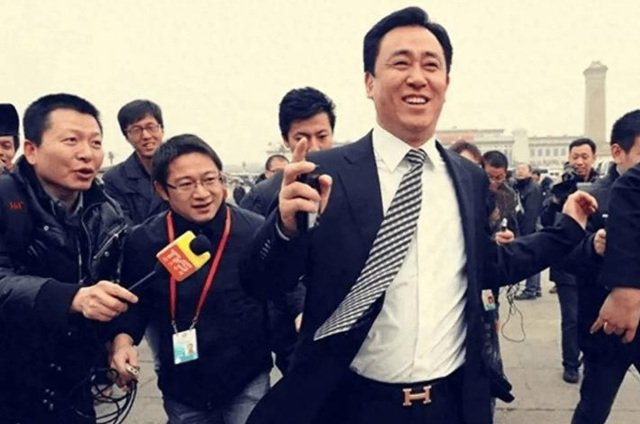
At the height of his success, Hui was also a prominent political and philanthropic figure. He became a member of the Chinese People’s Political Consultative Conference National Committee in 2008 and later joined its Standing Committee. He attended celebrations marking the centenary of the Chinese Communist Party in Tiananmen Square in 2021. In 2018, when receiving the China Charity Award for the eighth consecutive year, Hui attributed his success to China’s reform and opening-up and said that what Evergrande and he possessed had been given by “the party, the country, and society”.
His political prominence and corporate power, however, could not protect Evergrande from the mounting pressures created by its business model. The company expanded rapidly under a debt-driven system that depended on continued property sales and access to financing. When Beijing began tightening controls on excessive borrowing, the model became increasingly vulnerable.
Evergrande stopped making interest payments to overseas investors in late 2021, the first clear sign that something was seriously wrong. By then, it had become the world’s most indebted developer, with liabilities of more than $300bn. Its international default helped expose a much broader crisis across China’s property sector, where developers had spent years expanding through debt.
The collapse also revealed serious problems in Evergrande’s financial reporting. China’s financial regulator found that Evergrande had inflated revenues by almost $80bn in 2019 and 2020. The mainland business was fined about $580mn in 2024. The Shenzhen court said Hui was the “actual controller” and found that between 2016 and 2021 he, Evergrande and Evergrande Real Estate had “violated national laws and regulations by continuously and extensively fabricating financial statements to inflate assets and conceal liabilities”.
Hui pleaded guilty in April to charges ranging from embezzlement of assets to bribery. The court also cited illegal absorption of public funds and fraudulent issuance of securities among his offences.
The consequences have extended far beyond Hui himself. Evergrande’s Hong Kong entity is being liquidated, while overseas investors have been left attempting to recover value from a complex network of subsidiaries and assets. At the time of default, Evergrande had more than $20bn of offshore bond debt held by investors including BlackRock, HSBC and Ashmore. Its failure has also brought scrutiny of PwC, which was fined by Chinese authorities and Hong Kong regulators over its work for the developer. Evergrande’s liquidators, Alvarez & Marsal, are pursuing PwC for more than $8bn for audit negligence.
Meanwhile, the human consequences remain visible in places such as Changsha. Some projects were completed, others were taken over by state-owned developers, and some remained unfinished. At one site, an employee of a state-owned company said construction had been suspended for three or four years. At another, a former Evergrande employee was selling apartments while receiving his wages from the government.
Hui’s transformation from a rural childhood to China’s richest person and finally to a life sentence encapsulates the dramatic reversal of the property boom that made him powerful. His empire connected homebuyers, Chinese finance, international banks and global investors in a system built on the assumption that property values and sales would continue rising.
That assumption ultimately failed. Hui’s personal fortune disappeared, Evergrande collapsed under more than $300bn of liabilities, international investors were left fighting over complex claims, and the founder who once stood among China’s wealthiest and most politically prominent businessmen is now serving a life sentence.
The apartment in Changsha remains perhaps the simplest symbol of the entire story: a home bought by an ordinary family in the expectation that the system behind it would keep working. Behind that home stood a financial machine of extraordinary scale. Its collapse has taken years to unravel, and Hui Ka Yan’s imprisonment is only one of its consequences.