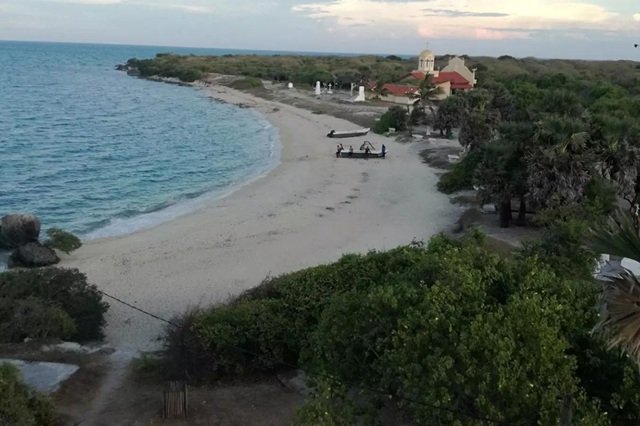
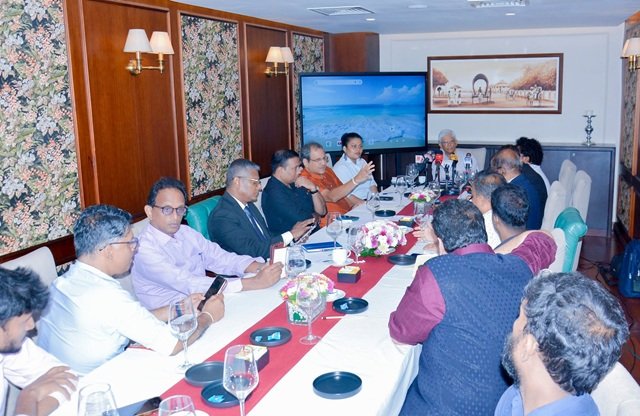
The discussion held in Colombo on Tuesday, 20 October 2026, concerning the Pathfinder Foundation’s proposal to establish a fisheries research institute on Kachchativu Island may be described as a fertile discourse on barren land. It is also commendable that the round-table discussion approached the subject not through a mythologised narrative, but within a forward-looking framework.
The discussion was based, in essence, on the following propositions:
- Sri Lanka holds sovereignty over the island.
- That sovereignty should be given practical meaning, rather than being recognised solely in legal terms.
- A fisheries research laboratory should therefore be established on the island.
The Pathfinder Foundation first published its proposal on 3 February 2017. The proposal reads as follows:
“… to establish a marine science research centre on Kachchativu, which is severely affected by illegal fishing, since the island is home to a number of rare marine plant and animal species. The government should request the National Aquatic Resources Research and Development Agency (NARA) and the Department of Fisheries to prepare a plan to commence such a project without delay. To keep the research centre operational, accommodation, communication facilities and research equipment will be required. The rotation of staff, as well as transport and emergency services, must be organised. If resources are difficult to secure in the short term, the support of the private sector may be sought to start the project. Meanwhile, every effort should be made for the two countries to cooperate in resolving the fisheries problem and in conserving and sustainably utilising marine resources on their respective sides of the International Maritime Boundary Line.”
The Pathfinder Foundation’s decision to revive its proposal more than nine years later may have been prompted by the renewed hearing of the Kachchativu question before the Supreme Court of India on 6 October 2026, before a bench comprising Justices Sanjay Kumar and Sanjiv Sachdeva. Although the court delivered no final ruling, several significant observations were made. With further consideration of the petitions adjourned until February 2027, the desire to offer a lasting resolution to the dispute may have provided the impetus for the proposal’s re-emergence.
Alternatively, the revival may have been prompted by political considerations, given the proximity of elections to both junctures. The Indian general election of 2019 took place approximately 26 months after the Pathfinder Foundation first tabled its proposal in February 2017. This time, the Indian general election is scheduled to take place approximately 31 months after the proposal re-entered the Foundation’s discourse.
India has a land area of approximately 8.12 billion acres, while its maritime domain extends across approximately 6.47 billion acres. Yet Indian political opinion periodically fixes its attention, with considerable intensity, on an island measuring just 285 acres. There are two principal reasons for this.
The first is that, in Indian politics, Kachchativu serves as a means of accusing political opponents of having surrendered national sovereignty.
Since Prime Minister Indira Gandhi signed the agreement concerning the island, the issue has been used as a political weapon against the Congress party. On 31 March 2024, Prime Minister Narendra Modi accused the Congress of compromising India’s interests during an election campaign rally. The first phase of the Tamil Nadu general election was scheduled for 19 April that year.
It is important to recognise that the issue was raised in this instance as an election campaign argument. The response from the Congress party illustrates the political nature of the exchange.
Congress president Mallikarjun Kharge, in a post on X and in statements to the media, argued that the Prime Minister, after remaining silent for ten years, had suddenly developed a concern for the island on the eve of an election, purely to secure votes. He also accused Modi of raising an old agreement as an electoral tactic while remaining silent, in Kharge’s view, about Chinese incursions along India’s borders. Similarly, DMK spokesperson Manuraj Shanmugasundaram described the move as a “desperate and misguided attempt to raise an issue where there is no issue, in order to win over the voters of Tamil Nadu”.
Two years have now passed since Modi made his statement. During that period, despite leading a government with a parliamentary majority, the Bharatiya Janata Party has made no significant progress towards changing Kachchativu’s status.
Moreover, the political circumstances in Tamil Nadu have evolved. The Congress, an ally of the state’s ruling party, has a stake in the political future of the state. Having helped its alliance retain political influence after a prolonged period, the party may increasingly be compelled to address Kachchativu in a manner consistent with its own political interests in Tamil Nadu.
The second reason for the recurring controversy over Kachchativu is Tamil Nadu’s substantial commercial fishing interests. The dispute is rooted in the conflict between fishing practices in the waters surrounding the island and Sri Lanka’s efforts to protect its maritime resources. The incursions of large commercial vessels associated with powerful fishing interests, which scour the seabed, are a particular source of concern. Sri Lanka’s opposition to these practices lies at the heart of the dispute. The commercial interests involved periodically turn this otherwise barren island into a fertile subject for political debate.
This is neither an exceptional nor an especially unusual situation. Where maritime boundaries and fishing rights remain contested, disputes of this kind between neighbouring states are hardly surprising.
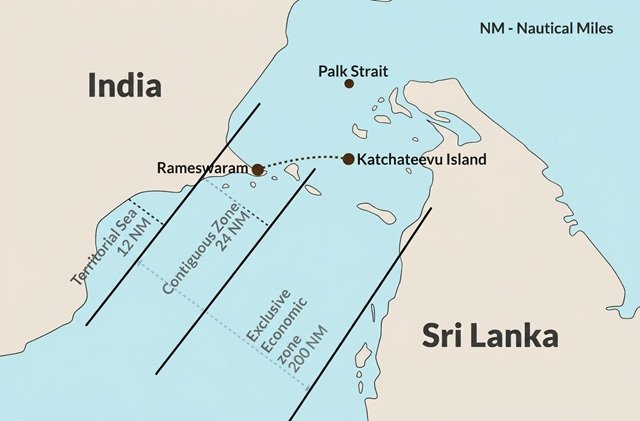
The fisheries disputes between Sri Lanka and India extend well beyond Kachchativu. They also affect the waters around Delft Island, the Gulf of Mannar, Palk Bay and the maritime boundary off Mullaitivu. If the fisheries question is considered the primary concern, the waters surrounding Kachchativu arguably present a lower level of risk than some of these other areas. The following table may help illustrate the differences.
| Comparative feature | Kachchativu zone | Other zones (Delft, Mannar, Mullaitivu) |
| Principal nature | A political and diplomatic symbol. | A direct economic and livelihood crisis. |
| Location | Situated closest to the International Maritime Boundary Line. | Closest to Sri Lanka’s mainland and inner islands. |
| Nature of environmental damage | Because of its shallow, sandy bed, damage to the seabed is comparatively low. | Highly destructive bottom trawling completely destroys valuable coral reefs and seagrass beds. |
| Impact on biodiversity | Being a zone of low fish breeding, the impact on the ecosystem is limited. | In areas of exceptionally high biodiversity such as Mannar, large numbers of endangered dugongs, sea turtles and rare fish species perish. |
| Depletion of fish stocks | Because fish migrate through this zone, resource depletion is not concentrated here. | Scraping of breeding grounds and the seabed destroys the eggs of prawns, crabs and valuable fish species, entirely wiping out future fish stocks. |
| Core issue | Merely a statement on India’s election platform. | A real struggle over the daily livelihoods of Sri Lankan fishers in the Northern Province and the protection of Sri Lanka’s marine ecosystem. |
In light of these considerations, Kachchativu is not necessarily an issue that requires an elaborate new initiative to resolve. Successive Sri Lankan governments have managed the question of the small, uninhabited island and its relationship with India with a degree of prudence. In politics, as in ordinary life, some disputes are best managed through restraint rather than continually brought back into the public arena. Introducing a new dimension to the issue could create further complications instead of resolving existing ones.
The Pathfinder Foundation’s proposal is to establish a fisheries research laboratory on this barren, uninhabited island. In an article published in The Morning, Milinda Moragoda outlined the proposed fisheries research institute as follows:
Kachchativu: Turning It into a Platform for Science
A marine research centre would offer Sri Lanka a practical means of exercising responsible stewardship while contributing to the conservation of the ecosystem of the wider Palk Strait.
It could monitor marine biodiversity and environmental degradation, assess the long-term impact of bot-tom-trawl fishing, track migratory patterns and spawning cycles, and provide scientific data for fisheries policy. It could also serve as a platform for maritime diplomacy and dialogue between India and Sri Lanka.
India already possesses significant marine research capabilities. Sri Lanka should develop a complementary capability on its own side of the maritime boundary.
Advances in solar energy, desalination and modular construction have reduced the supply barriers that once made establishing such a facility difficult. A low-impact, high-value research station is now a feasible proposal.
From Dispute to Cooperation
The current debate offers an opportunity to change the nature of the dialogue.
The concerns for Tamil Nadu’s fishers are legitimate. Sri Lanka’s concerns over illegal fishing and the degradation of its marine resources are equally legitimate. Treating one concern as valid and the other as an obstacle will not yield a lasting solution. Nor will it avoid returning, again and again, to the question of sovereignty.
Instead, India and Sri Lanka should focus on managing the Palk Bay as a shared ecological system. Joint scientific monitoring, conservation programmes, and discussions on regulated and sustainable fishing could provide the foundation for practical arrangements that phase out destructive practices such as bottom trawling while protecting livelihoods.
Such cooperation would require neither country to surrender its sovereignty or legal position. It would require both to recognise that marine ecosystems do not respect political boundaries.”
The proposal envisages a regional marine research centre that would introduce a scientific approach to maritime issues in the Palk Strait. Under the model outlined by Moragoda, the institute would be owned by Sri Lanka, while India, with its advanced research capabilities in the relevant fields, would also contribute.
The central problem with this proposal is that it could amount to maintaining a costly institution on an island that is inherently unsuitable for such a purpose. Kachchativu is uninhabited partly because it lacks the infrastructure and facilities required to sustain a permanent population. Establishing and maintaining a research centre there would be considerably more expensive than locating it elsewhere in Sri Lanka.
Nor would working at such an isolated facility be easy for scientists and other personnel. Could they reasonably be expected to live on the island with their spouses and children for extended periods? Without adequate educational, medical and other essential facilities, those stationed there would face severe restrictions on their personal lives. What is presented as a scientific opportunity could become an arrangement in which personnel feel effectively confined to the island.
Sri Lanka already has an institutional model that could be developed to support marine research. The Ocean University, established under Act No. 31 of 2014 following the reorganisation of the former National Institute of Fisheries and Nautical Engineering, is one such example. Even this institution, based in Colombo, an accessible and densely populated urban centre, has yet to realise its full potential. Establishing another institution in a far more challenging location would therefore require a compelling justification.
Even a leading scientist travelling from the airport or Colombo would face an arduous journey to Kachchativu. The island lies approximately 460 kilometres from Colombo, and reaching it involves a sea passage of nearly sixty kilometres.
The difficulties would extend beyond transportation. The energy, water and construction systems required to sustain the facility would entail substantial expenditure, while transporting the necessary materials and equipment to the island would be complicated and costly. Exposure to strong sea winds and salt-laden air would also require specialised maintenance procedures and corrosion-resistant equipment.
A preliminary assessment of the construction challenges illustrates the scale of the problem.
No point on Kachchativu lies more than a few metres from the shore. Within approximately 100 metres of the shoreline, buildings are exposed to what is known as the splash and atmospheric zone, where salt particles carried by breaking waves accumulate on exposed surfaces. Steel that corrodes at a rate of approximately 1–5 microns per year in an ordinary inland environment may corrode at rates of 80–200 microns per year, or even higher, under such marine conditions. This represents a rate of deterioration more than twenty times greater at the upper end of the comparison.
Salt-laden winds can carry chloride particles into the outer layers of concrete. When these chlorides reach the reinforcing steel, corrosion causes the steel to expand, resulting in cracking and the eventual spalling of the surrounding concrete. The deterioration of reinforced concrete can consequently accelerate substantially in a marine environment.
Preventing such damage would require expensive materials, specialised construction techniques and a carefully designed maintenance regime. When these costs are combined with the requirements for energy, water, transport and the daily supplies needed by personnel stationed on the island, the proposed laboratory could become an expensive and difficult-to-sustain undertaking.
Its fate might resemble that of the luxury hotel and entertainment complex subsequently established at No Man’s Land Fort, the massive Victorian sea fort constructed offshore in British waters. Projects built on isolated islands around the world have encountered serious difficulties or failed altogether. If Sri Lanka wishes to avoid adding another such example to that list, the financial and operational feasibility of the proposed marine research centre must be examined rigorously.
State-funded research facilities that lack a clear and sustainable operational basis can become expensive burdens. Sri Lanka has experience of institutions struggling to fulfil their intended purposes even in accessible locations, including Sri Jayawardenepura Kotte. A remote island location would magnify, rather than eliminate, such challenges.
A further difficulty concerns India’s proposed contribution. India would participate through financial assistance and research personnel. As a result, a Sri Lankan island could become dependent on Indian assistance to sustain an institution established in its own territory. This raises questions that extend beyond the financial viability of the project to the political implications of such a dependency.
The 285 acres of barren land that Sri Lanka secured through the maritime arrangements with India, in a spirit of neighbourly accommodation and through the relationship between the two women leaders of the time, could thereby become the basis for renewed claims or political arguments concerning the island.
In 2014, J. Jayalalithaa, then Chief Minister of Tamil Nadu, and M. Karunanidhi pursued efforts to have Kachchativu returned to India through proceedings before the Supreme Court of India. Appearing on behalf of the Modi government, Attorney General Mukul Rohatgi submitted that the island had been lawfully ceded to Sri Lanka under the 1974 bilateral agreement. He argued that, because an agreement of this nature could not simply be annulled unilaterally under international law, India would have to go to war with Sri Lanka if it sought to recover the island by force.
The concern, therefore, is that the proposed marine research laboratory could provide an alternative means of establishing a stronger Indian presence on the island without resorting to war. In that sense, the arrangement could create a precedent with political implications comparable, in the author’s view, to those associated with the Kandyan Convention.
Another difficulty is that construction on Kachchativu would not take place in a political vacuum. It could intensify the very tensions that the project is intended to address. For the island to cease being an issue in Indian election campaigns, its ownership would, in effect, have to become an uncontested matter. Yet the involvement of India in establishing and operating a marine research institute on Sri Lankan territory could provoke a backlash in Sri Lanka long before construction began.
Any government or political party associated with the proposal could face the accusation that the island secured for Sri Lanka by Sirimavo Bandaranaike had been given away to India. Kachchativu, which has so far remained largely a political talking point in India, could become an active and contentious issue in Sri Lankan politics as well. The resulting tensions could ultimately damage the goodwill between the two countries.
Nor would the construction of a marine research laboratory, by itself, safeguard the island’s fish stocks or prevent incursions by large commercial fishing vessels. Unless the underlying disputes over fishing rights, enforcement and the protection of marine resources are addressed, the vessels of powerful fishing interests will have little reason to stop coming.
The essential question, therefore, is whether establishing a research institution on Kachchativu would resolve the existing fisheries dispute or introduce new financial, administrative and political complications. Scientific cooperation between Sri Lanka and India is undoubtedly valuable, but it need not depend on constructing an expensive facility on a small, uninhabited island.
In the final analysis, the proposed construction could transform an issue that is currently contained and relatively inactive into a major political problem. Rather than offering a lasting resolution, the project risks making Kachchativu a more contentious subject in both countries, undermining the very goodwill that has helped keep the dispute under control.