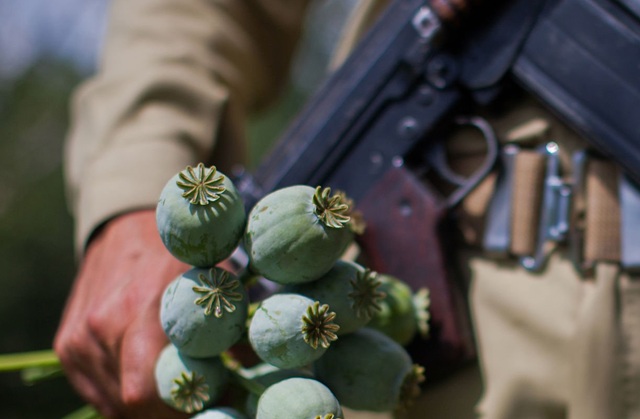
On November 5, 2026, Inspector General of Police (IGP), Kashmir Zone, Sujit Kumar, outlined the scale of the ongoing anti-narcotics campaign in the Kashmir Valley during his first major press conference after assuming charge. He stated that Jammu and Kashmir (J&K) Police had registered 1,651 cases under the Narcotic Drugs and Psychotropic Substances (NDPS) Act between January 1 and October 31, 2026, and arrested 1,941 persons. Police seized 1,711 kilograms of contraband, attached or forfeited properties worth approximately INR 1,540 million belonging to drug traffickers, froze 567 bank accounts containing around INR 17.1million and recovered approximately INR 11 million in cash. Illicit crops cultivated on about 2,116 kanals (about 107 hectares) of land were also destroyed.
Lieutenant Governor (LG) Manoj Sinha has officially categorized drug trafficking as a direct assault on internal security rather than an isolated criminal issue in a statement delivered on May 3, 2026:
Terrorists and drug dealers share the common goal of disrupting the country’s peace, unity, and security. The proceeds of the drug trade are used to fuel terrorism. The time to remain silent is over.
According to Ministry of Home Affair (MHA) data tabled in the Lok Sabha (Lower House of Parliament) in February and March 2026, and compiled by the Narcotics Control Bureau (NCB), drug seizures in J&K fell from 11,066 kilograms in 2023 to 5,708 kilograms in 2024 and 4,491 kilograms in 2025. Up to November 2025, agencies had recovered 2,062 kilograms of opium-based drugs, and 1,957 kilograms of cannabis – about 4,019 kilograms in total (short of the full-year figure). The decline is steepest in opium-based drugs, which peaked at 19,405 kilograms in 2021, and is down nearly 90 per cent since. Between 2020 and November 2025, J&K accounted for 75,564 kilograms of opium-based drugs, 10,611 kilograms of cannabis, five kilograms of synthetic drugs and one kilogram of cocaine. MHA also reported nearly 1,000 NDPS cases and about 1,400 arrests in J&K in 2025. Although numbers are declining, narcotics trafficking remains a continuing threat in 2026 as well.
Since the beginning of 2026, the same pattern recurs, particularly along the International Border (IB) and Line of Control (LoC). Major cross-border-linked arrests and recoveries in 2026 include:
- On October 21, Police recovered 804 grams of heroin and 1.114 kilograms of opium from Talhar village in the Arnia sector of Jammu District. The recovery followed the arrest of Sunny Kumar (26) on October 20, after R.S. Pura Police Station received information about Kumar allegedly consuming drugs near a ditch in Kotli Mirdian village. A Police team subsequently recovered the narcotics concealed in Talhar village. Investigations indicated that Pakistan-based handlers were using drones to drop commercial quantities of narcotics across the IB.
- On October 3, Police arrested four persons – Rahul Kumar and Ajay Kumar aka Rabb from Tamala Bridge in the Arnia border area of Jammu; Ajay Kumar aka Sam, from Arnia; and Punjab resident Jaganpreet Randhawa aka Jaggi – for their links with Pakistan-based handlers. Police recovered an Italian-made Beretta pistol, two magazines, four rounds, approximately 500 grams of heroin and 500 grams of opium. Subsequent interrogations revealed that the accused were working under the direction of Pakistan-based handlers to retrieve drone-dropped contraband near the IB. Further investigation led to the recovery of an additional 464g of opium resin and heroin from Ajay Kumar. Jaganpreet Randhawa allegedly served as a key link for the distribution network in Punjab.
- On October 1, Police arrested eight persons and recovered approximately 3.83 kilograms of codeine, 40 grams of heroin, over 218,000 pharmaceutical tablets and capsules – mainly Tapentadol, Tramadol and Pregabalin – and one pistol. They also seized approximately INR 8.576 million in cash, 108 gold coins and jewellery valued at around INR 10.5 million. Subsequent searches of bank lockers yielded an additional INR 6.5 million in cash and more gold. Police froze bank accounts containing approximately INR 10.7 million and attached a residential house and two vehicles. Investigations reportedly revealed inter-state supply links, prompting police teams to conduct searches in Chandigarh and other states. IGP Kashmir later estimated the total value of recoveries linked to the racket at approximately INR 70 million in international market.
- On August 22, a vehicle was intercepted in the Panjtirthi area of Jammu and 5.16 kilograms of heroin was recovered. Two residents of Baramulla District were arrested on the spot. Follow-up investigations led to the arrest of the suspected mastermind, also a Baramulla resident, at Leh in Ladakh, on August 24. Preliminary findings indicated that the heroin had originated from Pakistan and entered India through the Uri border sector.
- On August 21, the State Investigation Agency (SIA) arrested Hizbul Mujahideen (HM) operative Manoj Kumar aka Pintu, who had been absconding for over four years, in connection with a narco-terrorist network linked to Pakistan and Pakistan-occupied Jammu and Kashmir (PoJK). SIA recovered 15 grams of heroin from his premises. Investigations revealed links with Pakistan- and PoJK-based terrorist handlers, including Imtiyaz Ahmad Kandoo aka Kandoo and Manzoor Ahmad Khan, who facilitated narcotics smuggling across the LoC, with proceeds channelled towards financing terrorism. The case originated with the recovery of one kilogram of heroin from Zeeshan Ahmad Sofi and Waseem Ahmad Khan at Nowpora in Sopore, followed by the recovery of seven kilograms of poppy straw and four kilograms of poppy seeds. Officials stated that Bhat maintained links with HM operatives in PoJK and Kashmir Valley
- On May 20, Police recovered approximately two kilograms of heroin, suspected to have been dropped by a Pakistani drone near the IB in the Bishnah sector of Jammu.
- On April 15, Police arrested drug kingpin Gulzar Ahmad aka Lau Gujjar and several associates in Jammu. Approximately 700 grams of heroin and a Pakistan-made pistol were recovered from his possession. Police described him as a key supplier operating across the Jammu region, who had evaded arrest for more than two decades.
- On March 12, Police and the Border Security Force (BSF) recovered approximately two kilograms of heroin, valued at around INR 12 crore (INR 120 million) in international market, near Nai Basti Karotana village in the Baspur area of Bahadurpura village in the Bishnah sector of Jammu.
- On February 14, BSF and the Police recovered two packets containing 6.582 kilograms of heroin, valued at over INR 40 crore (INR 400 million) in international market, suspected to have been dropped by drone near the IB in the R.S. Pura Sector of Jammu.
- On February 13, Police arrested Jatin, a resident of Pathankot, and Danish Dogra aka Sajan of Kathua in connection with a drone-assisted heroin-smuggling operation, near Nagri in Kathua District. Approximately 150 grams of heroin was recovered in the case, and the accused were reportedly in contact with a Pakistan-based smuggler through Voice over Internet Protocol (VoIP) calls.
- On January 9, Police arrested another accused in a cross-border narcotics and arms smuggling syndicate, under Operation Sanjeevani, taking the total number of arrests in the case to seven. The case had initially been exposed on December 5, 2025, when six persons were arrested and nearly five kilograms of heroin, valued INR 30 crore (INR 300 million) in international market, along with three pistols, were recovered.
- On January 2, the Army recovered and destroyed an Improvised Explosive Device (IED), and seized 70 AK-47 rounds and approximately one kilogram of narcotics from Rangar Nallah near the Khari Sokar village in the Gulpur sector of Poonch district. The recovery was connected with a suspected drone-assisted cross-border delivery from Pakistan.
Taken together, these incidents and data indicate that cross-border narcotics trafficking has emerged as a potential source of terrorist financing in J&K, with overground workers (OGWs) allegedly serving as intermediaries in channelling proceeds from the drug trade to militant networks. Drug kingpins operating within J&K and across the border reportedly distribute narcotics earnings through their local operatives, who facilitate financial transfers, logistics and other forms of support to terrorist organisations. The nexus between militancy and the illicit narcotics trade is reflected in the alleged diversion of a significant portion of drug proceeds towards financing and supporting terrorist activities.
Agencies including NCB and the local Police have identified several border Districts as major entry points and transit corridors for narcotics and weapons trafficking. Kupwara and Baramulla are key entry points for high-value heroin, with the Uri sector in Baramulla and the Tangdhar and Keran sectors in Kupwara frequently identified by enforcement agencies as conduits for cross-border smuggling networks. In Jammu and Samba Districts, stringent border surveillance has reportedly prompted smuggling syndicates to increasingly rely on Pakistani drones to drop narcotics, weapons and money in border fields, particularly in the Arnia and Hiranagar sectors. Poonch and Rajouri continue to be exploited by traditional foot couriers and localised smuggling networks to transport contraband. Srinagar and Anantnag serve as major consumption and distribution hubs, where local handlers facilitate the onward supply of narcotics. Meanwhile, Samba and Kathua Districts are also linked to interstate trafficking networks, with contraband reportedly being channelled into Punjab through local transport networks.
To counter the growing threat of cross-border narco-terrorism and local drug-peddling networks, LG Manoj Sinha launched the 100-day ‘Nasha Mukt Jammu Kashmir’ campaign on April 11, 2026. Director General of Police (DGP) Nalin Prabhat, providing Union Territory (UT)-wide figures in early October 2026, noted that, since the campaign’s launch, Police had registered 3,257 cases under the NDPS Act and arrested more than 4,000 persons involved in the drug trade. A total of 170 convictions had been secured, while more than 2,500 cases had been disposed of. Police also attached 288 properties valued at over INR 1,380 million and seized more than INR 8 million in cash. Property attachment remained a central component of the campaign. Recent actions included the attachment of residential properties and a vehicles worth over INR130 million by the Srinagar Police in mid-October 2026, and two properties valued at INR 25 million in Anantnag in late October. Beyond the ‘Nasha Mukt’ campaign, J&K Police has adopted a multi-pronged strategy to counter narco-terrorism by strengthening the Anti-Narcotics Task Force (ANTF), and coordination with BSF, NCB, the Enforcement Directorate (ED) and the National Investigation Agency (NIA).
Despite significant enforcement achievements, drug addiction and narco-terrorism remain a significant challenge. Arrests and seizures alone do not establish whether drug use has declined or whether Pakistan-based supply chains, financial channels and OGW networks have been dismantled. Agencies have demonstrated measurable progress in law enforcement and institutional mobilisation, but their effectiveness in disrupting cross-border supply chains in the vulnerable border areas of J&K remains an open question.